
Operations and supply chain management is the discipline of planning, coordinating, producing, moving, and controlling goods, services, information, and resources from business strategy to final customer value. It connects internal operations with suppliers, production sites, warehouses, distribution partners, customers, finance, and executive decision-making so that demand becomes executable work, measurable performance, and reliable delivery.
In practical business language, OSCM explains how an organization decides what customers need, what the business can profitably supply, what resources are required, when products should be made, where inventory should be positioned, and how performance should be controlled. It is not only about factory production. It also includes service operations, logistics, capacity, planning systems, supplier coordination, distribution, customer service, and continuous improvement.
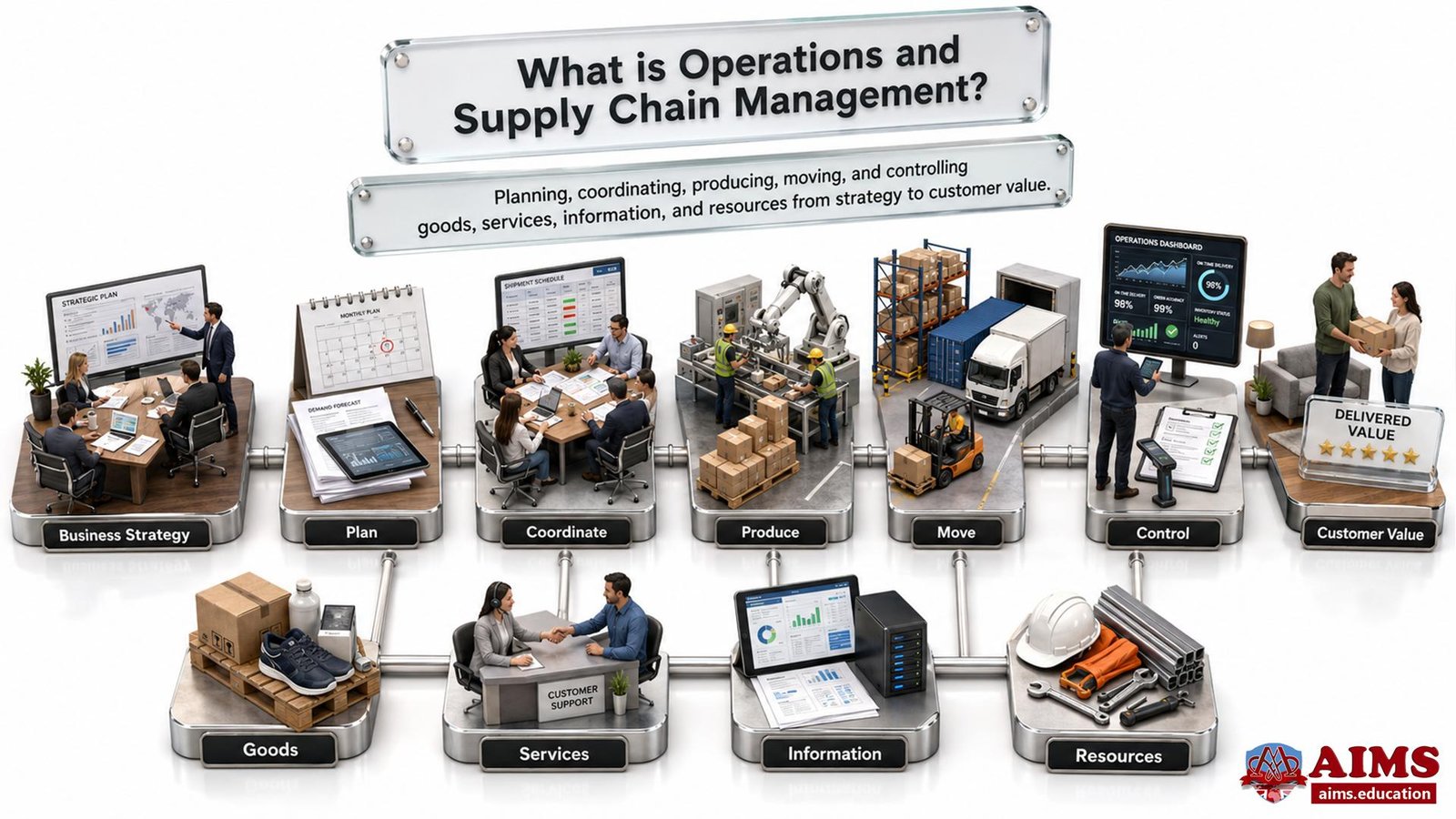
What is Operations and Supply Chain Management?
Supply Chain Operations or Operations and Supply Chain Management (OSCM) refers to the design, operation, and continuous improvement of the supply chain systems to efficiently deliver the organization’s products and services to its’ customers. OSCM is now becoming an essential factor for organizations to stay competitive. The optimization of supply chain management operations has a huge impact on an organization’s success, as good supply chain operations planning eventually positively impacts its growth and credibility.
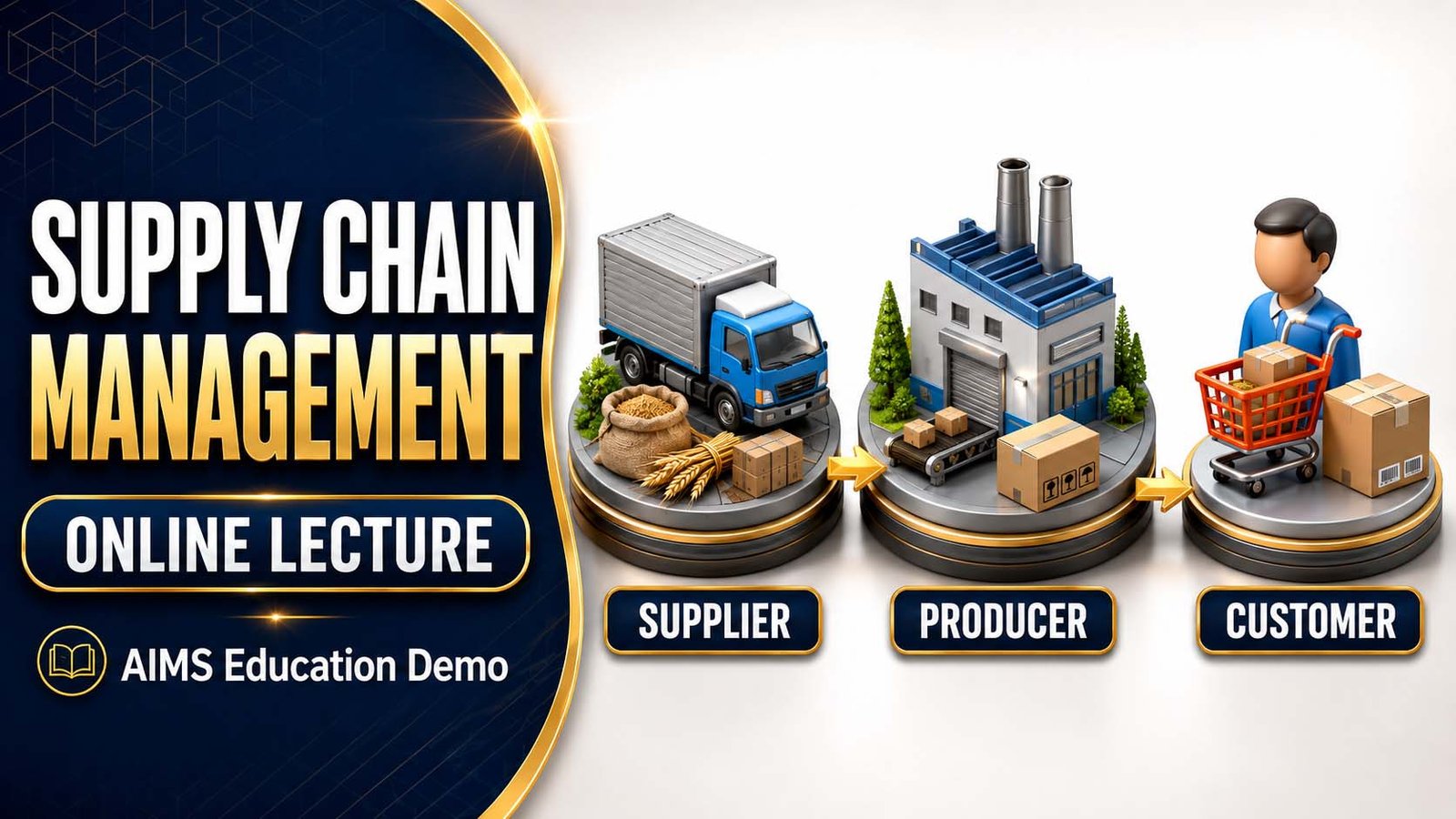
This makes the field especially important for students and professionals who want to understand how strategy becomes action. A company may have a strong market plan, but unless its operations and supply chain can plan, produce, deliver, measure, and adjust that plan, the strategy remains only a document.
What Is Operations and Supply Chain Management?
Operations and supply chain management means managing the full system that turns demand into delivered value. Operations management focuses on how work is performed inside the organization, while supply chain management extends that work across suppliers, distribution channels, logistics partners, customers, and information flows.
The operations and supply chain management meaning is easiest to understand as a bridge between two questions:
- What must the organization do internally? It must plan capacity, schedule production, manage materials, control processes, measure performance, and improve quality.
- How must the wider supply chain support that work? It must coordinate suppliers, inventory, distribution centers, transport, customer orders, demand signals, and service expectations.
That is why supply chain operations management is more than purchasing, warehousing, or production. It is the integrated management of planning, execution, communication, and control across the flow of goods, services, money, and information.
For a broader foundation, learners may also review how the supply chain management process connects suppliers, operations, and customers.
Operations Management and Supply Chain Management Compared
Operations management and supply chain management are closely connected, but they do not mean exactly the same thing. Operations management looks inward at processes, capacity, scheduling, productivity, and quality. Supply chain management looks outward and across the network, connecting the organization with suppliers, distributors, logistics partners, and customers.
| AREA | OPERATIONS MANAGEMENT | SUPPLY CHAIN MANAGEMENT |
|---|---|---|
| Main Focus | Controls internal processes, production, service delivery, scheduling, and capacity. | Coordinates suppliers, logistics, distribution, information, customers, and network performance. |
| Planning Question | Can the organization produce or deliver the required output efficiently? | Can the whole network supply, move, and deliver value reliably? |
| Typical Decisions | Production schedules, labor use, equipment capacity, quality control, and process improvement. | Supplier coordination, inventory placement, replenishment, logistics, risk, and service levels. |
| Performance Concern | Efficiency, utilization, yield, schedule adherence, and process reliability. | Availability, responsiveness, cost, coordination, resilience, and customer satisfaction. |
Actually, the best organizations do not treat these areas as separate departments fighting for different targets. They use supply chain and operations planning together so that customer demand, internal capability, supplier readiness, and financial objectives remain aligned.
Main Components of OSCM
The main components of OSCM are planning, sourcing, production, inventory, distribution, communication, capacity, performance measurement, and control. These components work together because every decision affects another part of the system.
- Demand planning estimates what customers are likely to need. It uses history, forecasts, market knowledge, customer orders, and sales input.
- Business planning converts strategy into operational direction. It gives production, supply, finance, and sales a common reference point.
- Sales and operations planning balances demand and supply. It creates a unified plan agreed by sales, operations, finance, and executives.
- Master scheduling turns aggregate plans into item-level commitments. It identifies what will be made, in what quantity, and on what dates.
- Material requirements planning calculates component needs. It uses the master production schedule, bills of material, inventory records, and lead times.
- Distribution requirements planning controls replenishment across warehouses and distribution centers. It helps position inventory where it is actually needed.
- Capacity management confirms whether the plan can be executed. It checks people, equipment, facilities, work centers, storage, and time.
- Performance measurement shows whether the plan is working. It tracks service, utilization, efficiency, schedule adherence, quality, and improvement.
Example of Operations and Supply Chain Management in Practice
A mid-sized appliance company, BrightHome Ltd., wants to launch a new smart washing machine before the holiday season. Its management team cannot simply ask the factory to produce more units. It must coordinate the whole system.
- Marketing estimates demand. The sales team expects 20,000 units during the launch quarter.
- Operations checks production capability. The plant can produce 1,600 units per week without overtime.
- Procurement checks supplier readiness. Motor suppliers need eight weeks of confirmed orders.
- Finance reviews profitability. The plan must protect margin while avoiding excess inventory.
- Distribution plans warehouse allocation. Regional distribution centers require stock before the campaign begins.
- Management approves one coordinated plan. Sales sells to the plan, operations produces to the plan, and supply chain monitors execution.
This example shows the practical value of OSCM: it turns market opportunity into a controlled, profitable, and deliverable operating plan.
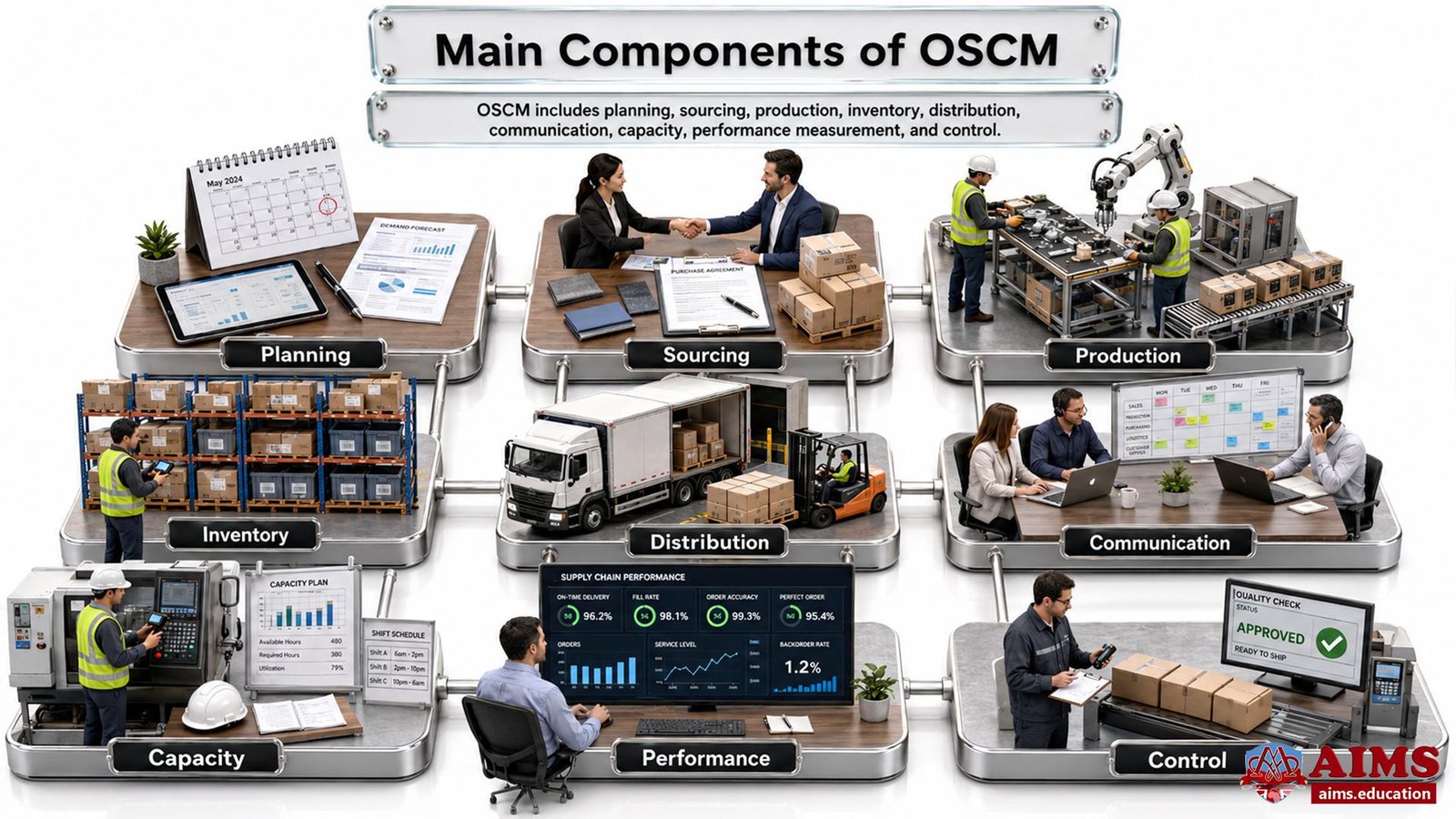
Master Planning in Operations and Supply Chain Management
Master planning in operations and supply chain management is the group of business processes that connects demand management, production planning, resource planning, and master scheduling. It provides the planning structure that helps a company move from broad business objectives to specific production, material, inventory, and capacity decisions.
Master planning includes demand management, production and resource planning, and master scheduling. This is a useful way to teach master planning in supply chain management because it shows how high-level demand is gradually converted into operational detail.
Master planning prevents the organization from jumping directly from sales expectations to shop-floor activity without checking demand, resources, schedules, materials, and capacity.
Main Elements of Master Planning
The main elements of master planning are demand management, production planning, resource planning, master scheduling, material requirements planning, distribution planning, and capacity control. Each element answers a different planning question.
- Demand management asks what customers are expected to need. It includes forecasting, customer orders, demand sensing, and demand-influencing activities.
- Production planning asks what the organization should produce at the aggregate level. It usually works with product families over a medium-term horizon.
- Resource planning asks whether long-range capacity is sufficient. It may involve facilities, equipment, labor, and other resources that take time to acquire.
- Master scheduling asks which specific items should be produced and when. It disaggregates product-family plans into item-level production commitments.
- Material requirements planning asks what components and raw materials are needed. It calculates dependent demand from the master production schedule.
- Distribution requirements planning asks where inventory should be replenished. It supports branch warehouses, distribution centers, and network availability.
- Capacity control asks whether actual execution remains within planned limits. It helps managers correct imbalances before they damage service or cost.
The Operations and Supply Chain Management Process
The operations and supply chain management process begins with demand information and ends with coordinated production, purchasing, distribution, control, and performance feedback.
- The organization gathers and cleanses demand history. It removes unusual events or outliers that are not expected to repeat.
- The statistical forecast is reviewed by commercial teams. Product, brand, marketing, and sales teams add market knowledge that improves forecast quality.
- The demand plan is finalized and passed to supply. At this stage, demand becomes a formal input to supply planning.
- The supply team reviews capacity and constraints. Operations determines whether the demand plan can be fulfilled with available resources.
- Finance and executives review the constrained plan. The plan must be operationally feasible and financially sensible.
- The executive S&OP meeting communicates one plan. Sales sells to the plan, and supply produces to the plan.
- The production plan becomes the input to master scheduling. The master production schedule then guides material requirements planning.
- MRP creates planned production and purchase orders. Production activity control and final assembly scheduling then support execution.
This planning flow is the backbone of operations and supply chain management process thinking because it shows how demand, capacity, materials, production, and delivery become one connected system.
Example of Master Planning in Supply Chain Management
Suppose PrimeDesk Furniture expects higher demand for office chairs after winning a corporate sales contract. The company needs a master planning process before committing to delivery dates.
- The demand team forecasts 12,000 chairs over four months. It separates standard chairs from premium ergonomic chairs.
- The production plan groups chairs by similar manufacturing processes. The plan states a monthly production rate for each product family.
- Resource planning checks long-lead resources. Management discovers that one upholstery machine is already near capacity.
- Master scheduling converts families into item-level schedules. Standard black chairs, blue chairs, and premium chairs receive separate weekly schedules.
- MRP calculates materials. Foam, fabric, frames, wheels, screws, and packaging are ordered according to lead time.
- Capacity control tracks execution. Managers monitor whether production is staying on plan.
Master planning gives PrimeDesk a disciplined way to accept demand without creating late orders, excess costs, or material shortages.
How Business Strategy Guides Operations and Supply Chain Planning
Business strategy guides operations and supply chain planning by defining the value the organization intends to deliver and the results it expects from operations. Strategy tells the organization where it wants to compete, while operations and supply chain planning determine how that intention becomes capacity, production, inventory, distribution, and customer service.
Strategic and business plans is the foundation for sales and operations planning and the resulting production plan. This is important because a production plan should never be isolated from mission, revenue goals, market share, growth, profitability, cash flow, and customer satisfaction.
Strategic Plan, Business Plan, and Production Plan
The strategic plan gives long-term direction, the business plan turns that direction into measurable goals, and the production plan converts the goals into supply-side requirements. These planning layers should be connected rather than treated as separate documents.
- The strategic plan sets high-level direction. It may cover five to ten years or more and defines the organization’s mission, goals, market position, growth objectives, and broad resource direction.
- The business plan makes strategy more specific. It usually covers the next one to three years or more and describes expected revenue, profit, cash flow, customer satisfaction, and market performance.
- The production plan gives the supply side a medium-term operating view. It typically covers 12 to 18 months and expresses future production by product family and rate of production.
The strongest organizations keep the business plan alive. They update it, review it, compare it with actual performance, and use disciplined operations and supply chain planning to correct the course when demand, supply, or financial conditions change.
Resource Planning as the Capacity Link
Resource planning identifies whether the organization has enough long-range capacity to support the business and production plans. It takes a longer view than everyday scheduling because some resources take months or years to acquire.
Resource planning may involve new equipment, plant expansion, facility redesign, workforce realignment, technology investment, or supplier capacity. Capital-heavy decisions normally require executive approval, while capacity adjustments based on the production plan are often managed within supply chain and operations leadership.
Professionals who want to develop stronger planning capability can explore AIMS’ online MBA in supply chain management for strategic operations leadership, especially where business planning, logistics, and supply chain decisions must be connected.
Example of Strategy Guiding Production Planning
GreenPack Foods decides to compete on reliable delivery of eco-friendly packaged meals to supermarkets. Its strategy is not only about marketing. It must shape operations.
- The strategic plan defines the value promise. The company wants to be known for dependable, sustainable, and fresh packaged meals.
- The business plan translates the strategy into numbers. It sets growth targets for three product families: salads, ready meals, and snack boxes.
- The production plan defines monthly output rates. It plans higher volumes for ready meals during winter and higher salad volumes during summer.
- Resource planning checks capacity. Cold storage and packaging lines are evaluated before the company commits to new supermarket contracts.
- S&OP reviews the plan monthly. Sales, operations, finance, and executives adjust the plan as demand changes.
Strategy becomes useful only when it is translated into resources, schedules, capacity, and measurable execution.
Sales and Operations Planning
Sales and operations planning is a unified planning process that balances demand, supply, finance, and executive decision-making into one agreed plan. S&OP in supply chain management connects the commercial view of demand with the operational view of capacity, materials, production, and delivery.
The sales and operations plan is the agreed output, while the sales and operations planning process is the recurring discipline that creates, reviews, updates, and improves that plan.
For wider strategic context, S&OP should be connected with strategic supply chain management decisions that shape long-term competitiveness.
Why Sales and Operations Planning Is Important
S&OP is important because it gives the organization one plan instead of separate sales, operations, finance, and supply plans. Without S&OP, sales may promise what operations cannot produce, operations may produce what customers do not want, and finance may discover too late that the plan does not meet business goals.
- S&OP links business planning with tactical execution. It turns strategic and financial expectations into operational decisions.
- S&OP helps the organization become proactive. Monthly reviews allow leaders to respond to market shifts, capacity constraints, and financial risks before they become emergencies.
- S&OP provides a short-to-medium-term operating plan. The plan often looks 12 to 18 months ahead, which gives enough time to manage resources.
- S&OP integrates functional plans. Sales, marketing, engineering, manufacturing, sourcing, logistics, and finance bring their assumptions into one discussion.
- S&OP balances customer value with supply chain efficiency. It prevents the organization from chasing low cost at the expense of service or chasing perfect service at an unsustainable cost.
- S&OP supports continuous improvement. Each cycle compares actual results with the plan and updates the next cycle accordingly.
The Five-Step S&OP Process
The S&OP process typically moves through data gathering, demand planning, supply planning, a pre-meeting, and an executive meeting. These steps create a disciplined route from information to decision.
| STEP | MAIN PURPOSE | PRACTICAL OUTPUT |
|---|---|---|
| Data Gathering | Updates demand history, forecast files, inventory information, and planning data after the month closes. | Clean data for a new planning cycle. |
| Demand Planning | Commercial teams review the forecast, product plans, sales assumptions, and demand-influencing activities. | Updated demand plan by product family. |
| Supply Planning | Operations checks whether capacity, materials, and resources can meet the demand plan profitably. | Recommended supply plan and constraint analysis. |
| Pre-Meeting | Key managers resolve routine issues and prepare unresolved matters for executive review. | Executive agenda and recommended decisions. |
| Executive Meeting | Senior leaders approve the plan, resolve tradeoffs, and align demand, supply, and finance. | One authorized plan for execution. |
Contributions to S&OP
S&OP works only when each major function contributes honest, current, and decision-ready information. The demand side, supply side, finance function, and executive team each bring a different view of reality.
Demand-Side Contributions
The demand side contributes forecasts, market assumptions, revenue expectations, customer commitments, product plans, and demand-influencing activities. Sales and marketing should not merely state desired sales numbers. They must explain what actions will make those numbers realistic.
- Demand forecasts estimate future customer orders by period and product family. They provide the starting point for supply planning.
- Demand commitments explain commercial actions. These may include product launches, pricing changes, promotions, territory changes, and customer programs.
- Demand assumptions make the forecast testable. Assumptions show why the team believes demand will rise, fall, or shift.
- Market analysis explains external conditions. It may include competitor behavior, target segments, customer expectations, or demand risks.
Operations Contributions
Operations contributes the supply reality: output capability, resources, product-family capacity, constraints, production strategies, and actual performance data. This is where the demand plan is tested against operational feasibility.
- Output targets define what can be produced by product family. These targets are normally stated over a 12 to 18 month planning horizon.
- Product families should be grouped by similar capacity requirements. If sales groups products by market appeal but operations groups them by production process, the S&OP plan becomes confused.
- Operations constraints identify where the plan may fail. Bottlenecks, labor shortages, supplier delays, equipment limits, and work-center restrictions must be visible.
- Operations strategies shape how output will be produced. The organization may use level, chase, or hybrid production strategies.
Finance Contributions
Finance checks whether the demand and supply plan is financially feasible and aligned with business goals. This includes revenue, cash flow, profitability, inventory investment, capacity costs, and the financial effect of alternative plans.
Production Strategies Used in S&OP
Production strategy determines how output will respond to demand over the planning horizon.
We will identify level, chase, and hybrid approaches. Each one has a different cost, service, and inventory profile.
| STRATEGY | DEFINITION | BEST USE | MAIN RISK |
|---|---|---|---|
| Level Production | The organization produces roughly the same output in each period. | Useful when stable operations and predictable capacity are more important than exact demand matching. | Inventory may build during low demand, or stockouts may occur when demand rises sharply. |
| Chase Production | The organization varies production to match demand in each period. | Useful when inventory must be minimized and capacity can be adjusted flexibly. | Overtime, temporary labor, hiring, layoffs, training, and capacity stress may increase costs. |
| Hybrid Production | The organization combines level and chase methods to balance stability and responsiveness. | Useful when demand is seasonal but some operational stability is still required. | The plan becomes harder to manage if inventory, labor, and capacity are not closely monitored. |
Example of S&OP in Supply Chain Management
FreshBite Beverages expects a summer demand increase for bottled juices. Sales wants 40 percent more volume, but operations knows the filling line is already highly loaded.
- Data gathering updates last summer’s sales, current orders, and inventory. The planning team removes one unusual bulk order from the forecast because it is unlikely to repeat.
- Demand planning estimates demand by product family. Orange juice, mixed fruit juice, and sugar-free drinks are planned separately.
- Supply planning checks capacity. The filling line can support orange and mixed fruit growth, but sugar-free production needs extra cleaning time.
- Finance reviews alternatives. Overtime is cheaper than buying a new filling machine for a temporary season.
- The executive meeting approves one plan. Sales accepts a revised promotion calendar, and operations adds weekend shifts for six weeks.
S&OP gives FreshBite a realistic plan instead of allowing sales demand and production capability to collide later.
Master Scheduling and Production Priorities
Master scheduling turns the aggregate sales and operations plan into specific production commitments for individual items, quantities, and dates. It is the planning bridge between product-family decisions and the detailed material, capacity, and shop-floor requirements needed for execution.
The master production schedule, or MPS, is the core output of master scheduling. While S&OP works at the product-family level, the MPS identifies specific products, configurations, quantities, and time periods. This is why master scheduling is essential for production planning in supply chain management.
Master Schedule and Master Production Schedule
The master schedule is a planning format that includes forecasts, customer orders, projected available balance, available-to-promise, and the master production schedule. It also considers backlog, material availability, capacity availability, and management policies.
- Forecast shows expected demand for a specific end item. It may be adjusted for promotions, product launches, or other demand-influencing activities.
- Customer orders show actual demand. These orders represent confirmed customer requests rather than forecast assumptions.
- Projected available balance estimates future inventory availability. It helps planners see when inventory may become negative or excessive.
- Available-to-promise supports customer order promising. It identifies the uncommitted portion of inventory and planned production that can still be promised.
- The master production schedule states planned production. It drives material requirements planning and becomes a formal production commitment.
Production Planning Versus Master Scheduling
Production planning works at the product-family level, while master scheduling works at the specific item level. This is the simplest way to understand the difference between production planning and master scheduling.
| POINT OF COMPARISON | PRODUCTION PLANNING | MASTER SCHEDULING |
|---|---|---|
| Planning Level | Product family or aggregate production rate. | Specific item, configuration, quantity, and date. |
| Typical Horizon | Medium term, often 12 to 18 months. | Shorter and more detailed planning buckets, often weekly. |
| Main Question | How much should we produce by product family? | Which exact items will be produced, and when? |
| Key Output | Production plan. | Master production schedule. |
| Capacity Check | Resource planning. | Rough-cut capacity planning. |
Demand Prioritization, Time Fences, and ATP
Demand prioritization protects the production plan by controlling which orders can be accepted, changed, or promised during different time zones. It is especially important when customer requests, production schedules, materials, and capacity compete for the same resources.
Time fences are planning boundaries that indicate where different operating rules apply. They help planners decide whether changes are allowed, negotiable, or restricted.
- The frozen zone is controlled by the demand time fence. Capacity and materials are already committed, so changes normally require senior approval.
- The slushy zone is controlled by the planning time fence. Some changes are possible, but the master scheduler must evaluate tradeoffs.
- The liquid zone is the more flexible part of the planning horizon. Changes are generally allowed if they do not violate S&OP policy or production limits.
- Available-to-promise supports customer service decisions. It shows what portion of inventory or planned production has not yet been committed to existing orders.
Customer Service Levels in Master Scheduling
Customer service levels measure whether the supply chain is fulfilling customer requirements reliably, quickly, and consistently.
Fill rates, lead time monitoring, order status monitoring, and customer satisfaction are important service measures.
- Fill rate measures how much of the customer order is delivered as requested. It may be measured by order, unit, line item, or monetary value.
- Stockout frequency measures inventory availability problems. It may track how often stockouts occur, how long they last, and how valuable the missing items are.
- Lead time monitoring measures delivery speed and consistency. It helps managers understand whether customers receive orders within expected timeframes.
- Order status monitoring supports communication. Customers and internal teams need visibility when orders are delayed, split, or changed.
- Customer satisfaction connects operations performance with market performance. A technically efficient operation still fails if customers experience poor service.
This is also where the role of supply chain management in coordinating service, logistics, and operations becomes visible.
Rough-Cut Capacity Planning
Rough-cut capacity planning checks whether the master production schedule is realistic for key resources and bottlenecks. It does not examine every detail of capacity. Instead, it tests whether critical work centers, gateway operations, and important suppliers can support the planned schedule.
- The first draft of the MPS is created. It translates the production plan into specific item-level schedules.
- RCCP checks whether key resources can support the schedule. Bottlenecks, critical equipment, skilled labor, and supplier constraints receive special attention.
- The master scheduler revises the plan or capacity if needed. If the schedule is too ambitious, it must be changed before execution begins.
Example of Master Scheduling and ATP
NovaTech produces three models of office printers. The S&OP plan says the printer family should produce 1,200 units in August, but the master scheduler must decide specific weekly quantities by model.
- The aggregate plan is disaggregated. The scheduler assigns weekly quantities to Model A, Model B, and Model C.
- Customer orders are compared with the forecast. Confirmed orders receive priority in the frozen zone.
- ATP is calculated for future periods. Sales can promise uncommitted units only where inventory and planned production support the promise.
- RCCP checks the bottleneck line. Model C requires extra testing time, so the plan is revised before release.
- The approved MPS drives MRP. Components such as toner cartridges, circuit boards, motors, and casings are planned from the schedule.
Master scheduling protects customer promises by making sure the organization promises only what it can reasonably produce.
Material Requirements Planning and Inventory Control
Material requirements planning is a planning method that uses the master production schedule, bill of material data, inventory records, and lead times to calculate required materials and components. MRP is central to inventory control because it turns finished-product plans into time-phased requirements for raw materials, parts, subassemblies, purchase orders, and production orders.
The key principle is dependent demand. Finished goods may be forecasted from customer demand, but components are calculated from the finished goods that must be produced. This is why MRP is more mathematical than intuitive.
Dependent Demand and Independent Demand
Independent demand comes from the market, while dependent demand is calculated from the items needed to produce finished goods. A retailer may forecast demand for 1,000 bicycles, but the demand for frames, tires, chains, pedals, brake cables, and packaging depends on that finished bicycle plan.
- Independent demand requires forecasting. It is influenced by customers, markets, promotions, seasonality, and competitor activity.
- Dependent demand requires calculation. It is derived from the parent item, the bill of material, inventory status, lead time, and production schedule.
- Some items can have both demand types. A battery may be sold as a spare part while also being used as a component in finished products.
MRP Inputs and Outputs
MRP needs three core inputs: the master production schedule, the bill of material, and inventory status data. From these inputs, it creates planned production orders, planned purchase orders, and exception messages.
| MRP ELEMENT | ROLE IN PLANNING | EXAMPLE QUESTION ANSWERED |
|---|---|---|
| Master Production Schedule | States what finished goods must be produced, in what quantity, and when. | What should be produced and when is it needed? |
| Bill of Material | Shows the components, subassemblies, and quantities required for each finished item. | What parts are needed to make one finished unit? |
| Inventory Status | Shows what is on hand, what is on order, and what lead times apply. | What do we already have, and what must still be ordered? |
| Planned Orders | Suggests order quantity, release date, and due date when net requirements appear. | What should we produce or buy next? |
| Exception Messages | Alerts planners when action is needed due to changes, shortages, delays, or schedule issues. | What needs attention before the plan fails? |
Bill of Material, Routing, Lot Size, and Offsetting
MRP accuracy depends on accurate product structure, process routing, order quantity rules, and lead-time offsetting. If these foundations are wrong, the system may calculate the wrong materials at the wrong time.
- The bill of material identifies product structure. It shows what components, subassemblies, and quantities are required to build the finished item.
- The routing file shows the sequence of operations. It identifies the work centers, processes, and standard times needed to manufacture or assemble the item.
- Lot-for-lot ordering matches order quantity to net requirement. It reduces excess inventory but may increase ordering or setup activity.
- Fixed order quantity uses a standard order size. It may reduce ordering complexity but can create more inventory.
- Offsetting schedules orders backward from the need date. It ensures components arrive when needed rather than too early or too late.
MRP, Lean, and System Nervousness
MRP is powerful, but it can become unstable if small demand or schedule changes create too many planning changes. This is often called system nervousness. Planners must manage the system carefully so that useful planning signals do not become constant disruption.
MRP can also work alongside lean or just-in-time thinking. The lesson is not that one system must replace the other. MRP is useful for planning dependent demand across complex product structures, while lean thinking helps reduce waste, improve flow, and avoid unnecessary inventory.
Example of Material Requirements Planning
CityRide Cycles plans to produce 500 electric bicycles in Week 8. The MPS creates the finished goods requirement, but MRP must calculate the components.
- The bill of material lists the components. Each bicycle needs one frame, two wheels, one battery, one motor, one controller, one seat, and one packaging kit.
- Inventory status is checked. The company already has 200 motors, 900 wheels, and 100 batteries in stock.
- Net requirements are calculated. MRP identifies shortages of batteries, frames, controllers, and packaging kits.
- Lead times are applied. Batteries require four weeks, frames require three weeks, and packaging requires one week.
- Planned orders are released on time. MRP recommends purchase and production orders so all materials arrive before Week 8 assembly.
MRP prevents a finished goods schedule from failing because one small component was not available at the right time.
Distribution Requirements Planning and Push-Pull Systems
Distribution requirements planning determines when and how inventory should be replenished at branch warehouses or distribution centers. It extends planning beyond production by deciding how finished goods should flow through the distribution network to meet customer service needs.
DRP is as part of materials and inventory planning. Its purpose is to organize inventory requirements on central supply so the organization has time to plan how many goods are required and when they should move to downstream locations.
Network visibility also improves when managers use tools such as supply chain mapping examples to understand flows, locations, and dependencies.
Pull, Push, and Hybrid Distribution
Pull systems let downstream locations request replenishment, push systems send inventory based on central planning, and hybrid systems combine both methods. Most real supply chains use a mixture rather than a pure model.
| DISTRIBUTION APPROACH | HOW IT WORKS | MAIN BENEFIT | MAIN LIMITATION |
|---|---|---|---|
| Pull System | Field warehouses or downstream locations make replenishment decisions based on local need. | Local demand conditions are visible to the ordering location. | Orders may amplify upstream, creating bullwhip effects and poor network coordination. |
| Push System | A central planning location sends inventory down the chain based on forecasts and systemwide decisions. | Central coordination can improve network-level inventory control. | Local market conditions may be missed or underweighted. |
| Hybrid System | Central planning pushes inventory to a defined point, then downstream locations pull from that point. | Balances central control with local responsiveness. | Requires accurate network data, lead times, and replenishment rules. |
DRP Components
DRP combines demand forecasts, safety stock, lead time, and distribution network structure to plan replenishment. It helps prevent both shortages at customer-facing locations and overstock at locations that do not need the goods.
- Demand forecasts from distribution centers estimate gross requirements. These forecasts show likely need by location and period.
- Safety stock protects customer service. It provides a buffer against uncertainty in demand or replenishment time.
- Lead time data controls timing. Without accurate lead time, inventory may arrive too early or too late.
- Distribution network knowledge shows how inventory flows. The planner must understand central supply points, regional distribution centers, branches, and customer-facing locations.
Example of DRP and Push-Pull Replenishment
HealthPlus Supplies distributes medical gloves from a central warehouse to three regional distribution centers and 40 clinics.
- Central planning reviews demand forecasts. It sees that the northern region will need higher stock next month.
- Inventory is pushed to regional distribution centers. The central warehouse ships extra cartons to the northern DC before clinics run short.
- Clinics pull inventory from the regional DC. Local clinics order based on actual usage and patient volume.
- DRP checks supply before release. The system confirms that the central warehouse will not create a shortage by shipping too much to one region.
- Smaller, more frequent orders are released. The network improves service while reducing unnecessary safety stock.
DRP improves distribution decisions because it considers both the needs of ordering locations and the availability of supplying locations.
Capacity Management and Capacity Planning
Capacity management is the process of establishing, measuring, monitoring, and adjusting the limits of resources so manufacturing and supply plans can be executed. Capacity planning determines how much capacity will be required in the future, while capacity control compares actual output with the plan and corrects variances.
Capacity answers a practical question: can the organization do what the plan requires within the time allowed? This includes workers, machines, work centers, facilities, storage space, suppliers, equipment, and production lines.
For organizations that need deeper process reliability, capacity and quality planning also connect with quality management principles used to improve efficiency, customer satisfaction, and continual improvement.
Capacity Management, Planning, and Control
Capacity management keeps demand and supply in harmony by ensuring the network has the right amount of capacity in the right configuration. Too little capacity damages service. Too much capacity wastes money. The goal is disciplined balance.
- Capacity management establishes, measures, monitors, and adjusts capacity limits. It operates across resource planning, rough-cut capacity planning, capacity requirements planning, and input-output control.
- Capacity planning determines the amount of future capacity required. It may be performed at aggregate, product-line, master schedule, or detailed material planning levels.
- Capacity control measures output against the capacity plan. If actual performance moves beyond accepted limits, corrective action is required.
Capacity Objectives
The objective of capacity planning is to keep load and capacity in balance. Load is the work placed on a resource. Capacity is the ability of the resource to perform the work within the required time.
- Too little capacity creates service failure. The organization may face stockouts, late orders, broken promises, excessive overtime, or lost sales.
- Too much capacity creates waste. Unused people, machines, warehouse space, lease costs, and insurance costs reduce profitability.
- The right capacity supports customer service and cost control. Orders are filled on time, overtime is controlled, equipment is used sensibly, and resources are not wasted.
Time Horizons of Capacity Planning
Capacity planning operates at several levels, from long-range resource planning to daily input-output control. Each level has a different time horizon and detail level.
| CAPACITY LEVEL | PLANNING CONNECTION | PRIMARY QUESTION |
|---|---|---|
| Resource Planning | Business plan and production plan. | Do we need long-range changes in facilities, equipment, labor, or capital resources? |
| Rough-Cut Capacity Planning | Master production schedule. | Can key resources and bottlenecks support the item-level schedule? |
| Capacity Requirements Planning | Material requirements planning and detailed routing data. | How much labor and machine capacity is required by work center and period? |
| Input-Output Control | Production activity control. | Is actual work entering and leaving the work center according to plan? |
Measuring Capacity: Utilization, Efficiency, and Rated Capacity
Capacity measurement uses available time, utilization, and efficiency to estimate what a work center can realistically produce. These measures help managers compare planned work with actual capability.
- Available time measures the time resources are available for work. For example, four machines operating eight hours per day for five days provide 160 machine-hours per week.
- Utilization measures how intensively a resource is used. It is calculated as hours worked divided by available hours, multiplied by 100.
- Efficiency measures actual output against standard output. It is calculated as standard hours of work divided by hours worked, multiplied by 100.
- Rated capacity combines available time, utilization, and efficiency. The formula is: Rated Capacity = Available Time x Utilization x Efficiency.
- Demonstrated capacity reflects practical past performance. It is useful when actual results provide a more realistic view than theoretical capacity.
Example of Capacity Planning
MetroPack Manufacturing has one packaging work center with 160 available hours per week. The work center normally operates at 85 percent utilization and 90 percent efficiency.
- Available time is 160 hours. This comes from the operating schedule and equipment availability.
- Utilization is 85 percent. The resource is not productive every available hour because of setups, changeovers, waiting, and other losses.
- Efficiency is 90 percent. Actual output is slightly below standard output.
- Rated capacity is calculated. 160 x 0.85 x 0.90 = 122.4 standard hours per week.
- The planner compares load with capacity. If next week’s plan requires 145 standard hours, the work center is overloaded.
- Management selects corrective action. The company may add overtime, shift work to another line, subcontract part of the load, or revise the schedule.
Capacity planning gives managers evidence before they commit to a plan that the operation cannot execute.
Communication, ERP, Dashboards, and Supply Chain Coordination
Communication in operations and supply chain management means ensuring that requirements, priorities, constraints, changes, and performance information reach the people who must act on them. Planning systems may look linear on paper, but in real organizations they involve constant feedback between sales, operations, distribution, procurement, suppliers, finance, and customers.
The supply chain manager is a communication intermediary. This is a valuable professional insight. A supply chain manager often does not belong fully to sales, operations, or distribution. That position allows the manager to translate constraints and priorities across functions.
Supply Chain Managers as Communication Intermediaries
Supply chain managers connect functional departments so that planning decisions are understood and executed across the organization. They help prevent the common failure where a major S&OP or planning decision is made, but daily implementers continue working as if nothing has changed.
- They translate capacity constraints for sales teams. Sales may understand customer urgency, but not the operational consequences of schedule changes.
- They explain demand priorities to operations teams. Operations may understand process limits, but not the commercial importance of certain customers or orders.
- They coordinate distribution and inventory decisions. A decision at one warehouse can affect availability across the network.
- They support supplier communication. Suppliers need timely signals about materials, schedule changes, and delivery priorities.
- They monitor whether plans are actually implemented. Communication without follow-up is not control.
ERP and Planning Systems
ERP systems support communication by routing planning decisions, production requirements, purchasing signals, inventory updates, and schedule changes to affected functions. They help integrate MPS, MRP, inventory, purchasing, due dates, production status, and priority messages.
In a complex organization, manual communication alone is not enough. Planners need systems that can show current inventory, open orders, capacity constraints, supplier status, purchase orders, and exception messages. Advanced planning and scheduling tools may also help when multiple plants can produce similar items.
Dashboards and KPI Communication
Dashboards communicate priorities by showing exceptions, capacity issues, action items, and key performance indicators in a form managers can act on quickly. A dashboard should not merely display data. It should help people decide what needs attention now.
- Capacity dashboards show load against available capacity. They reveal bottlenecks before they create late orders.
- Exception reports show where plans have changed. They help planners respond to shortages, delays, or priority conflicts.
- Action-item tracking keeps responsibility visible. It assigns owners and deadlines for corrective action.
- KPI dashboards communicate performance trends. They show whether the system is improving, stable, or drifting away from plan.
For structured performance comparison across supply chain processes, learners may also review the supply chain operations reference model for process and performance visibility.
Example of Communication Failure and Correction
BlueWave Electronics approves an S&OP decision to prioritize a major retailer’s order, but the production supervisor does not receive the revised priority in time.
- The sales team believes the priority has been approved. They promise the retailer delivery within two weeks.
- The production team follows the old schedule. They continue producing smaller regional orders first.
- The warehouse ships lower-priority stock. Inventory that should support the retailer’s order is consumed elsewhere.
- The supply chain manager identifies the gap. The problem is not capacity. It is communication and control.
- An ERP priority alert is introduced. Approved S&OP changes now update the MPS, warehouse priorities, and supplier expedite list.
- A dashboard tracks priority orders. Sales, operations, distribution, and customer service see the same status.
The lesson is simple: a good plan is only as strong as the communication system that carries it into daily execution.
Operations and Supply Chain Management – Performance Measurement
Performance measurement in operations and supply chain management uses objective, consistent, and quantified measures to control work, report results, communicate expectations, identify problems, and support continuous improvement. It turns planning into accountability.
Performance measures should include target values or standards. A number without a target does not tell managers whether performance is good, poor, improving, or dangerous.
Strong performance management also depends on integration. The benefits of supply chain integration for shared data and coordinated decisions become clear when managers need one version of performance truth.
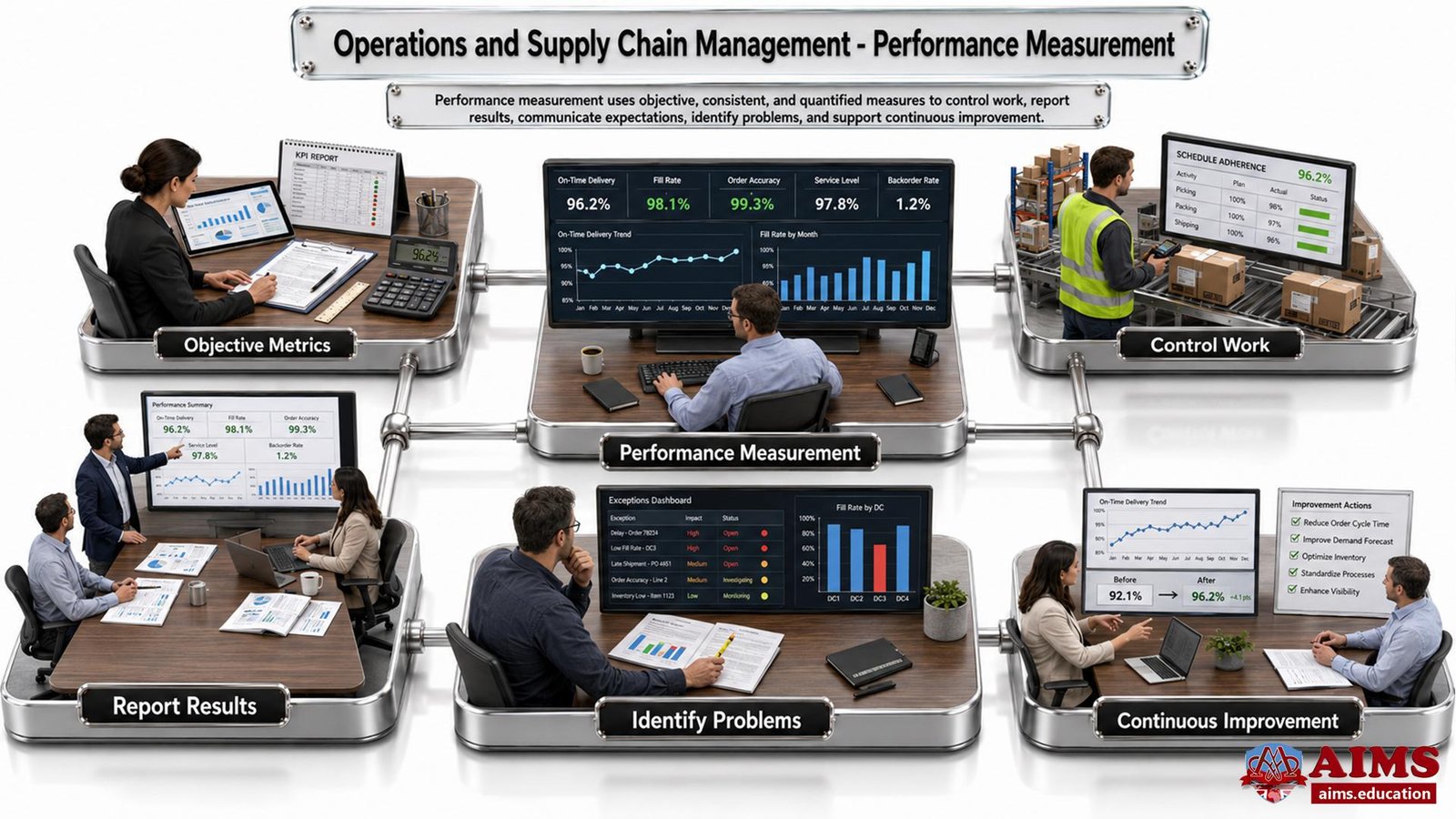
Operational Measures
Operational measures track how well work centers, machines, workers, departments, and processes perform against standards and organizational goals. They should be selected carefully because some traditional measures, such as local machine utilization, may not always correlate with overall business performance.
- Percent MPS completed as scheduled measures schedule discipline. It shows whether production commitments are being met.
- Time fence violations measure planning stability. Frequent violations suggest poor discipline, weak forecasting, or uncontrolled order changes.
- Production yield measures usable output. It compares expected or standard output with actual output after scrap, waste, or shrinkage.
- Quality metrics measure conformance and customer value. They help managers connect internal process performance with customer experience.
- Inventory turnover measures how effectively inventory is used. It can be separated into raw material, work-in-process, and finished goods turnover.
- Throughput, inventory, and operating expense link performance with constraint-based thinking. These measures help managers see whether improvements affect the whole system.
Capacity Requirements and Corrective Action
Capacity requirements compare planned load with available capacity so managers can correct overloads or underloads before performance fails. When load exceeds capacity, the organization must either change capacity, change the load, or change the plan.
- Managers can change capacity to match the load. They may add overtime, move workers, change routings, subcontract work, or hire temporary labor.
- Managers can change the load to match capacity. They may change lot sizes, revise order priorities, move work to a later period, or negotiate customer delivery dates.
- Managers can concentrate on constraints. Improving the bottleneck often improves the performance of the whole system more than improving noncritical areas.
- Managers can use visual signals. Kanban and other pull signals help synchronize work with actual need.
Example of Performance Measurement
NorthStar Components tracks performance at its assembly work center after repeated late orders.
- The MPS completion rate is 82 percent. The target is 95 percent, so schedule adherence is weak.
- Time fence violations occur weekly. Sales is accepting last-minute changes inside the frozen zone.
- Utilization is 98 percent. The work center is busy, but excessive busyness is hiding instability.
- Efficiency is 88 percent. Workers are spending time on rework caused by missing components.
- Inventory turnover is uneven. Some raw materials are excessive, while one electronic component is repeatedly short.
- The improvement action targets the constraint. The company protects the frozen zone, improves component planning, and adds a dashboard for shortage alerts.
Performance measurement helps NorthStar see that the real problem is not worker effort, but planning discipline and material coordination.
Final Words on Operations and Supply Chain Management
Operations and supply chain management is the practical discipline that turns strategy, demand, resources, materials, capacity, communication, and performance measurement into coordinated business execution. Its value lies in integration. Each plan becomes more useful when it is connected to the next level of detail.
The central lesson is straightforward. Demand must be understood before it is promised. Capacity must be checked before it is committed. Materials must be planned before production begins. Distribution must be coordinated before customers are disappointed. Performance must be measured before improvement becomes possible.
For professionals, OSCM is not just a technical planning subject. It is a management discipline that requires analytical thinking, cross-functional communication, financial awareness, operational discipline, and customer-centered decision-making. That is why structured learning through career-focused supply chain management certification online can be valuable for professionals who want to build applied capability in planning, control, logistics, and supply chain coordination.
Frequently Asked Questions
What is operations and supply chain management?
Operations and supply chain management is the integrated management of internal operations and external supply chain activities. It plans, produces, coordinates, moves, controls, and measures goods, services, resources, information, and customer commitments from demand planning through final delivery.
What is operations planning and control?
Operations planning and control is the process of converting business plans and demand plans into production plans, schedules, material requirements, capacity checks, execution priorities, and performance controls. It ensures that the organization can produce and deliver what has been promised.
What is master planning in supply chain management?
Master planning in supply chain management is the group of processes that links demand management, production planning, resource planning, master scheduling, material planning, distribution planning, and capacity control. It turns high-level demand into practical supply-side execution.
Why is sales and operations planning important in supply chain management?
Sales and operations planning is important because it creates one agreed plan across sales, operations, finance, and executive management. It balances demand with capacity, aligns operational decisions with business goals, and reduces the risk of conflicting departmental plans.
What is the S&OP process?
The S&OP process is a recurring planning cycle that usually includes data gathering, demand planning, supply planning, a pre-meeting, and an executive meeting. Its purpose is to review current information, resolve tradeoffs, and approve one feasible demand and supply plan.
How does a production plan support operations and supply chain management?
A production plan supports operations and supply chain management by giving the supply side a medium-term view of required output by product family. It guides resource planning, master scheduling, material requirements planning, and capacity checks.
What is the difference between master scheduling and production planning?
Production planning works at the product-family level and defines aggregate production rates. Master scheduling converts that aggregate plan into specific item-level commitments, including products, configurations, quantities, dates, projected availability, and available-to-promise information.
What is material requirements planning in supply chain management?
Material requirements planning is a method for calculating the materials and components needed to produce finished goods. It uses the master production schedule, bill of material, inventory status, lead times, and order rules to create planned production and purchase orders.
How does capacity planning help balance supply and demand?
Capacity planning helps balance supply and demand by checking whether people, machines, facilities, suppliers, work centers, and time are sufficient to meet planned output. It prevents undercapacity, overcapacity, late orders, excessive costs, and unrealistic production commitments.
What are the main components of operations planning and control?
The main components include demand planning, business planning, sales and operations planning, production planning, resource planning, master scheduling, material requirements planning, distribution requirements planning, capacity planning, production activity control, communication, and performance measurement.
About AIMS Institute of Supply Chain Management
AIMS Institute of Supply Chain Management has delivered international, career-focused education since 2005 through accredited, flexible, and industry-oriented programs for global learners. Its curriculum combines qualified faculty guidance, 3D interactive learning content, practical skill development, and real-world case-study-based assessment. This educational content, along with AIMS’ study content and curriculum, is collaboratively developed and rigorously peer-reviewed by an academic board of qualified industry practitioners. Understanding OSCM strengthens professional competence in planning, logistics, and supply chain execution. Explore AIMS’ practical and flexible supply chain qualifications.