
What Is Blockchain Project Management?
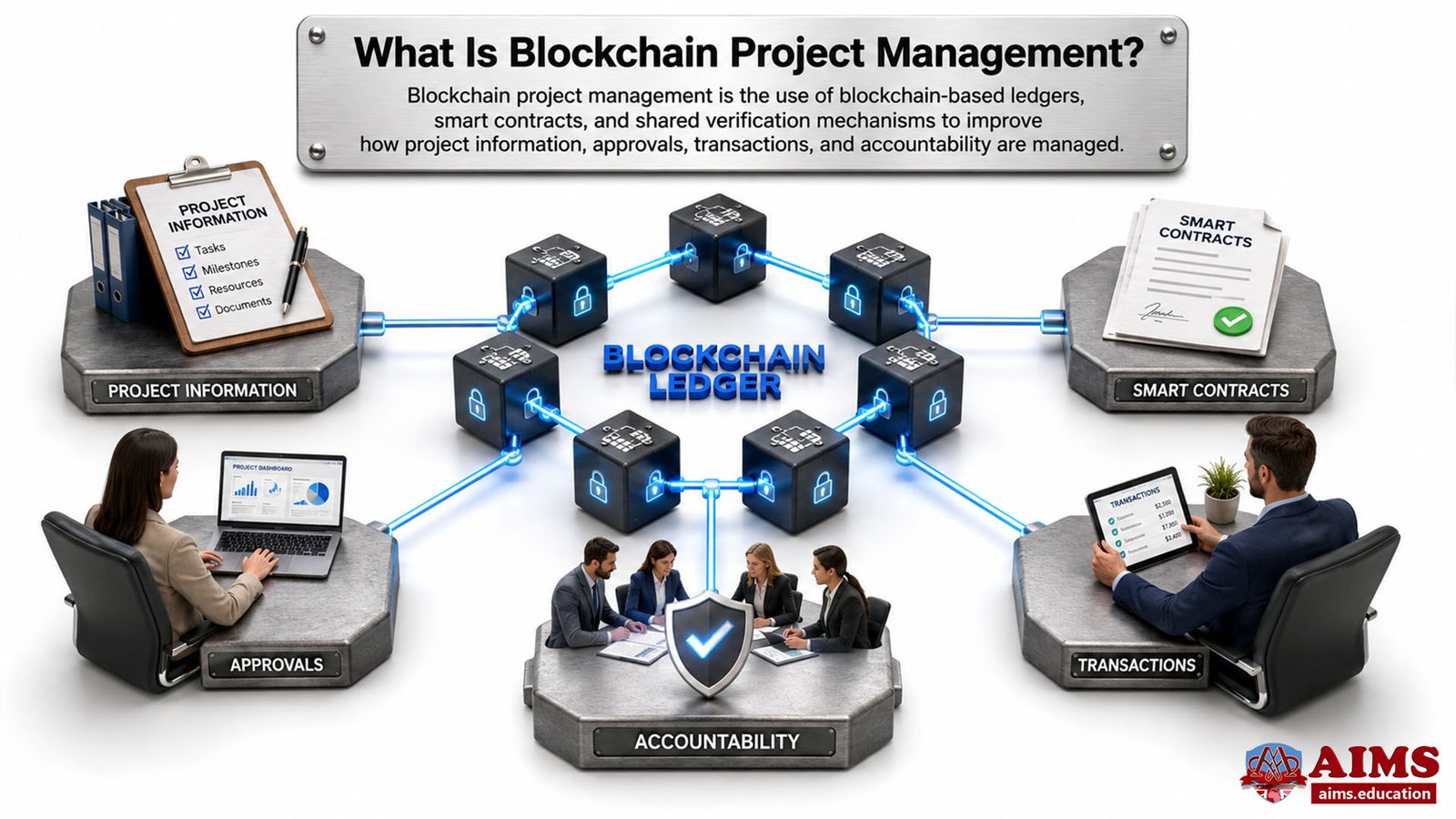
Blockchain project management is the use of blockchain-based ledgers, smart contracts, and shared verification mechanisms to improve how project information, approvals, transactions, and accountability are managed. It can also refer to managing projects that develop or implement blockchain solutions. In practice, its value lies in creating trusted, traceable records across stakeholders rather than simply using cryptocurrency.
- A blockchain is a distributed ledger in which validated records are linked and shared across participating nodes. Well-designed blockchain systems make unauthorized or undisclosed alteration difficult, creating a tamper-evident history of approved activity.
- Blockchain in project management is most useful when several organizations or stakeholder groups must share records but do not want one party to control the entire source of truth.
- It can support project controls, procurement, contract administration, payments, audit trails, and governance. However, blockchain is not automatically superior to a conventional project management system. Its suitability depends on the project problem, participants, data, governance model, cost, and technical constraints.
This distinction corrects an important misconception about blockchain project management. Blockchain does not replace the project manager, project lifecycle, scope definition, budgeting, scheduling, or stakeholder engagement. Instead, it can provide a technical layer through which selected project events, approvals, transactions, or documents are recorded and verified.
For a technical explanation of distributed ledgers and their broader use beyond cryptocurrency, see the NIST overview of blockchain technology.
Two Meanings of Blockchain Project Management
The term is commonly used in two related ways:
- Using blockchain to manage projects: A project team uses blockchain-based records, smart contracts, or decentralized verification to strengthen project coordination, traceability, approvals, procurement, or controls.
- Managing blockchain projects: A project manager leads a blockchain development project or implementation initiative in which the project deliverable itself is a blockchain solution, distributed application, smart-contract system, or supporting infrastructure.
This distinction matters because the first meaning changes how project information is managed, while the second changes what the project team is delivering. In many real initiatives, both meanings overlap.
How Is Blockchain Used in Project Management?
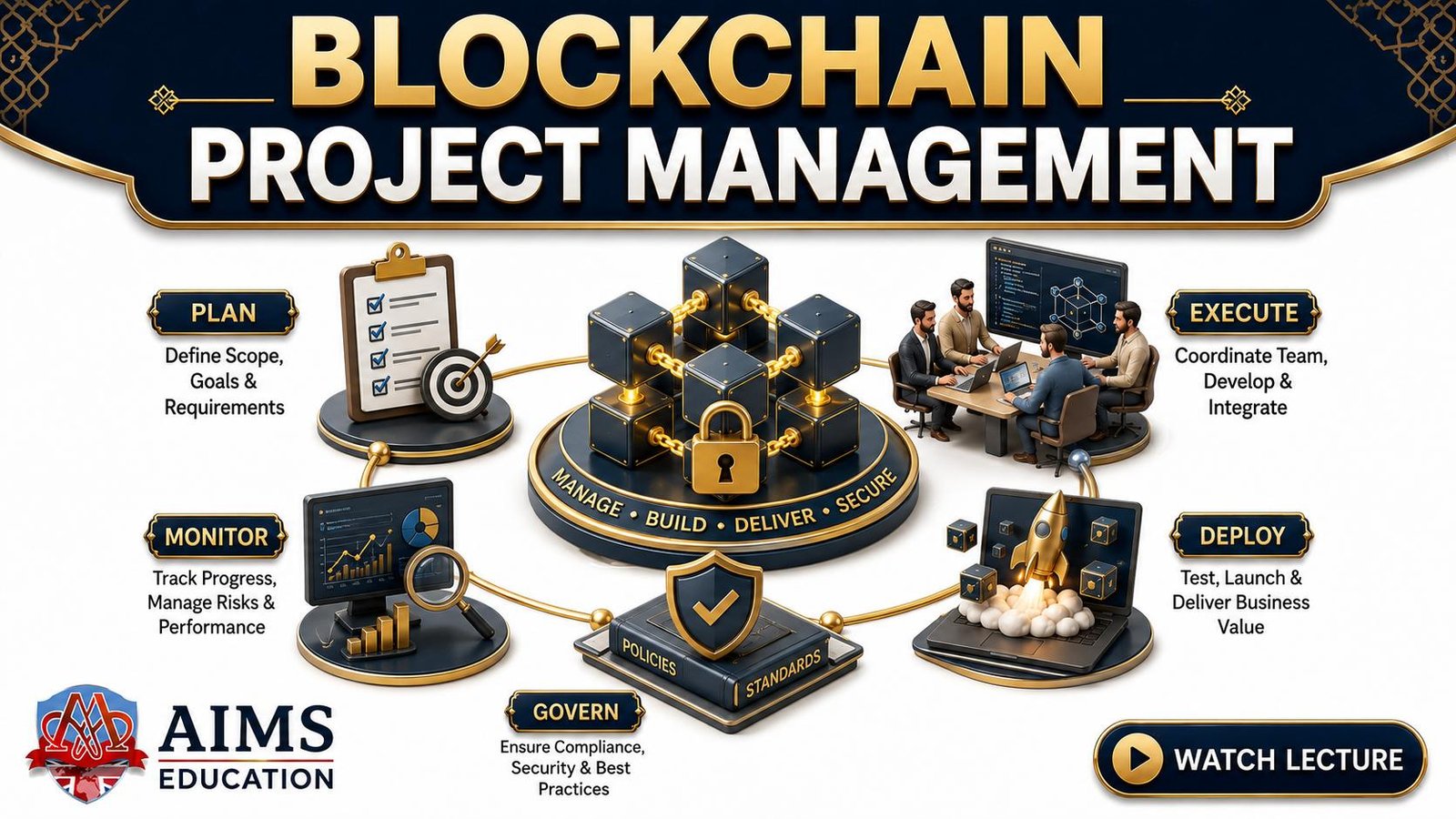
Blockchain is used in project management by recording selected project events in a shared ledger, applying agreed access and validation rules, and, where useful, automating actions through smart contracts. The technology works best when it is integrated into wider project governance rather than treated as a separate technical experiment.
A practical blockchain project management process can be understood in five steps:
- Identify the project problem. The team determines whether it needs stronger traceability, multi-party verification, automated transactions, or a shared record across organizations.
- Define governance and access. The project decides who may submit, validate, view, or approve information and which data should remain off-chain for privacy, performance, or legal reasons.
- Record verified project events. Approved milestones, procurement events, document hashes, payment instructions, changes, or asset transfers can be written to the ledger.
- Automate defined rules where appropriate. Smart contracts can execute agreed actions when specified conditions have been satisfied.
- Monitor and audit the project trail. Authorized stakeholders can review a consistent sequence of validated events and use it to support controls, reporting, assurance, and decision-making.

A blockchain project management system should therefore support, not fragment, the broader project integration management and coordination process. Project teams still need clear requirements, responsibilities, decision rights, and change procedures.
Example: Automated Milestone Payment
Consider a construction project in which Horizon Builders hires Nova Engineering for a GBP 250,000 specialist installation package.
- The contract defines five verified milestones, each worth GBP 50,000.
- Authorized inspectors submit completion evidence for each milestone.
- The project system verifies that the required approval conditions are satisfied.
- A smart contract records the approval and triggers the agreed payment instruction.
- The contractor, client, and auditor can review the same time-stamped transaction history.
This approach can reduce reconciliation work and disputes when payment conditions, evidence requirements, and governance rules are defined correctly.
Blockchain Applications in Project Management
The main applications of blockchain in projects involve trusted records, automated agreements, procurement verification, transaction tracking, project controls, and coordination among parties that need a common audit trail. These applications are especially relevant where information crosses organizational boundaries.
Common blockchain project management applications include:
- Project document and approval records
- Smart-contract-based approvals and payments
- Procurement and supplier verification
- Milestone and deliverable tracking
- Change and configuration records
- Asset provenance and handover records
- Risk and compliance evidence
- Multi-party stakeholder coordination
| APPLICATION | HOW BLOCKCHAIN CAN SUPPORT THE PROJECT | PRACTICAL EXAMPLE |
|---|---|---|
| Project records | Creates a shared, time-ordered record of selected approvals, changes, decisions, or document fingerprints. | A project office records approved scope-change references so all authorized parties can verify the sequence of approvals. |
| Smart contracts | Automates predefined actions when agreed conditions are satisfied. | A supplier payment instruction is released after acceptance evidence and required approvals are recorded. |
| Procurement | Improves traceability of bids, purchase orders, delivery evidence, certifications, and contract events. | A multi-vendor project verifies delivery and acceptance records against agreed procurement conditions. |
| Project tracking | Provides stakeholders with a consistent record of validated milestones and status events. | A consortium records completion of interdependent work packages across several contractors. |
| Risk and compliance | Preserves evidence of approvals, controls, exceptions, and corrective actions for later review. | An audit team verifies when a control exception was raised, approved, and closed. |
| Stakeholder coordination | Reduces disagreement over which approved version or transaction record should be treated as authoritative. | A client, contractor, and regulator review the same validated project event history. |
Procurement is one of the clearest applications because projects often depend on evidence moving between clients, contractors, suppliers, and auditors. A blockchain solution can complement established project procurement and contract management practices when multiple parties need verifiable transaction histories.
How Do Smart Contracts Work in Project Management?
Smart contracts are programs deployed on a blockchain that execute defined logic when specified conditions are met. In smart contracts in project management, this logic can support approvals, payment instructions, access rights, handovers, notifications, or other repeatable project controls.
A smart contract does not understand project context by itself. The project team must define the rules, data sources, approval authorities, exception handling, and consequences. If an off-chain event such as physical completion must trigger an on-chain action, the system also needs a reliable way to verify that external event.
Example: Smart Contract for Deliverable Acceptance
- A software vendor submits a completed module for acceptance.
- The authorized reviewer records acceptance after testing is completed.
- The smart contract checks that the required approval is present.
- The contract records the accepted milestone and triggers the next agreed workflow action.
- If the deliverable is rejected, the automated payment condition is not satisfied and the issue returns to the project team.
Smart contracts can accelerate routine controls, but only when project rules and exception paths are designed before automation begins.
Key Benefits of Blockchain Technology in Project Management
The main benefits of blockchain technology in project management are stronger traceability, shared visibility, tamper-evident records, programmable workflows, and improved accountability across organizational boundaries. The benefit comes from better information integrity and coordination, not from decentralization for its own sake.

1. Transparency and Auditability
Authorized stakeholders can work from a consistent history of validated project events. This can reduce disputes over when an approval occurred, which change was accepted, or whether a contractual milestone was recorded.
Transparency should still be governed carefully. Projects may contain commercial, personal, security-sensitive, or legally restricted information that should not be visible to every participant.
2. Data Integrity and Security
Blockchain can make unauthorized changes easier to detect because records are cryptographically linked and validated according to network rules. Permissioned architectures can also restrict who may submit, approve, or view particular information.
However, blockchain does not make a project system automatically secure. Weak identity controls, compromised private keys, insecure integrations, defective smart contracts, or inaccurate source data can still create serious project risk.
3. More Efficient Reconciliation
When several organizations maintain separate records, project teams may spend considerable effort reconciling versions, approvals, invoices, and transaction histories. A shared ledger can reduce this duplication when the parties agree on governance and validation rules.
4. Stronger Project Controls
Blockchain records can support control evidence for approvals, changes, procurements, deliverables, and payments. This is especially useful when project assurance depends on proving who authorized an action and when it occurred.
5. Stakeholder Trust and Accountability
Projects involving independent organizations often depend on trust between parties with different systems and incentives. A shared verification mechanism can strengthen system-based trust by reducing dependence on one participant’s private record.
Technology does not remove the need for structured project stakeholder management and accountability. Governance, communication, negotiation, and leadership remain project management responsibilities.
Traditional Project Management vs Blockchain-Based Project Management
The central difference is that traditional project systems usually rely on organization-controlled databases and workflows, while blockchain-based project management can distribute selected records and validation across multiple authorized participants. This changes how trust, approvals, auditability, and automation can be designed.
| AREA | TRADITIONAL PROJECT MANAGEMENT | BLOCKCHAIN-BASED PROJECT MANAGEMENT |
|---|---|---|
| Record keeping | Records are usually stored in databases or systems controlled by one organization or platform owner. | Selected records can be distributed across participating nodes under agreed validation rules. |
| Transparency | Visibility depends on system permissions, reporting arrangements, and data-sharing processes. | Authorized participants can share a synchronized and verifiable history of selected events. |
| Approvals | Approvals may occur through workflow systems, email, enterprise applications, or manual processes. | Approvals can be recorded on-chain and linked to automated rules. |
| Contracts | Contract execution usually relies on people and conventional software workflows. | Defined contractual actions can be supported by smart-contract logic where conditions are machine-verifiable. |
| Auditability | Audit evidence may need to be assembled from several systems and organizations. | A shared ledger can preserve a consistent sequence of validated project events. |
| Automation | Automation depends on the organization’s workflow and enterprise systems. | Smart contracts can automate agreed actions across participating organizations. |
| Best fit | Often simpler when one organization can reliably control the system of record. | More compelling when several parties need shared verification without relying entirely on one party’s database. |
The two approaches are not mutually exclusive. In practice, a blockchain solution usually integrates with conventional scheduling, budgeting, document management, collaboration, and reporting systems rather than replacing them.
Types of Blockchain for Project Management
The main blockchain deployment models relevant to project management are public, private or permissioned, consortium, and hybrid blockchains. The choice determines who can participate, who validates transactions, how governance works, and what level of openness or confidentiality the project can support.
- Public blockchain
- Private or permissioned blockchain
- Consortium or federated blockchain
- Hybrid blockchain
1. Public Blockchain
A public blockchain allows broad participation and public verification according to its protocol rules. It may suit projects where openness and public verifiability are more important than confidentiality or centralized organizational control.
2. Private or Permissioned Blockchain
A private or permissioned blockchain restricts participation to approved users or organizations. This model is often more practical for projects involving commercially sensitive records, contractual documents, internal approvals, or regulated information.
3. Consortium or Federated Blockchain
A consortium blockchain is governed by a defined group of organizations rather than one organization alone. It can suit joint ventures, infrastructure programs, supply-chain projects, and other multi-party environments where several institutions need shared control over validation and governance.
4. Hybrid Blockchain
A hybrid design combines controlled private processes with selected information or proofs that can be exposed more broadly. It may be useful when a project needs confidentiality for operational data but public verification for specific records or outcomes.
Smart-contract automation or a self-organizing workflow should not be treated as a separate blockchain type. Automation describes how rules are executed, whereas blockchain type describes the network’s access and governance architecture.
Platform selection is a project decision, not merely a technical preference. Teams should compare governance, permissioning, transaction performance, interoperability, privacy, security, cost, and lifecycle support before committing to an architecture.
Blockchain Project Management Lifecycle
Blockchain can support selected activities throughout the project lifecycle, but the project should use it only where distributed verification or automation creates genuine value. The technology does not change the need to initiate, plan, execute, monitor, control, and close project work.
Within a structured project management lifecycle and its phases, blockchain can support:
- Initiation: Record key approvals, stakeholder commitments, or authorization evidence where multiple parties require a shared record.
- Planning: Define blockchain scope, governance, participant roles, data architecture, smart-contract rules, security requirements, and integration needs.
- Execution: Record validated transactions, procurement events, deliverables, approvals, or asset movements as project work progresses.
- Monitoring and control: Use traceable event histories to support change control, compliance checks, risk monitoring, contract administration, and audit activities.
- Closure: Preserve final acceptance, handover, settlement, and approved project records according to retention and governance requirements.
In a blockchain project management lifecycle, the project manager must also plan for technical testing, data migration, user adoption, operational ownership, and transition to support.
Blockchain Project Risk Management and Implementation Challenges
Blockchain can improve some project controls, but it also introduces technical, governance, integration, security, and organizational risks that must be managed deliberately. A blockchain should therefore be selected because it solves a specific coordination or trust problem, not because the technology is fashionable.
Important blockchain project management challenges include:
- Wrong use case: A conventional database may be simpler, faster, and cheaper when one trusted organization can manage the system of record.
- Governance ambiguity: Multi-party projects need explicit rules for membership, validation, upgrades, disputes, permissions, and accountability.
- Integration complexity: Blockchain components may need to exchange data with finance, procurement, enterprise resource planning, identity, reporting, or document management systems.
- Scalability and performance: Network design, transaction volume, latency, storage, and consensus mechanisms can affect operational performance.
- Privacy and confidentiality: Projects must decide what information belongs on-chain, what should remain off-chain, and who is permitted to view it.
- Smart-contract defects: Automated rules can execute incorrect outcomes if requirements, code, testing, or exception handling are weak.
- Identity and key management: Compromised credentials or poor access control can undermine otherwise strong ledger protections.
- Data-quality risk: Blockchain can preserve a record accurately, but it cannot guarantee that inaccurate data was correct when entered.
- Organizational change: New governance and shared workflows may alter responsibilities, approvals, and relationships between project participants.
For this reason, blockchain project risk management should be integrated into the project’s wider risk management identification, analysis, and monitoring.
Example: Managing Data-Quality Risk
Suppose Atlas Infrastructure records equipment-delivery confirmations on a permissioned blockchain. If a site supervisor enters the wrong serial number, the ledger may preserve that incorrect entry reliably. The control solution is not more immutability. It is better source verification, authorization, correction procedures, and data-quality governance before and after records are committed.
Blockchain protects the integrity of recorded history, but project controls must still protect the quality of the information being recorded.
What Is the Role of a Blockchain Project Manager?
A blockchain project manager coordinates the business case, stakeholders, delivery plan, governance, risks, technical dependencies, and organizational change required for a blockchain-enabled initiative. The role combines normal project leadership with enough blockchain understanding to make sound decisions with architects, developers, security specialists, legal teams, vendors, and business stakeholders.
Typical blockchain project manager role responsibilities include:
- Defining the project problem and expected business value before choosing blockchain as the solution.
- Clarifying scope, requirements, deliverables, milestones, dependencies, budget, and acceptance criteria.
- Coordinating decentralized or multi-organization stakeholders and establishing decision rights.
- Supporting decisions about public, private, consortium, or hybrid architecture with technical specialists.
- Managing smart-contract requirements, testing, approvals, security, integration, and change control.
- Planning data governance, privacy, access, auditability, and operational ownership.
- Managing implementation risk, user adoption, training, vendor performance, and transition to operations.
These responsibilities remain rooted in the broader roles and responsibilities of a professional project manager. Blockchain knowledge extends that foundation rather than replacing it.
Professionals who want to strengthen that foundation can progress through an accredited online certificate project management course, develop broader delivery competence through an online diploma of project management, or build strategic management capability through an online MBA focused on project, program and portfolio management.
When Should a Project Use Blockchain?
A project should consider blockchain when several parties need a shared, verifiable record and no single participant should be the sole authority over that record. The business case becomes stronger when the project also needs traceability, programmable transactions, multi-party governance, or reliable audit evidence.
Blockchain may be appropriate when:
- Several organizations must update or verify a common set of project records.
- Participants need a tamper-evident history of approvals, transactions, or asset movements.
- Contractual actions can be expressed as clear, machine-verifiable rules.
- Reconciliation between independent systems creates repeated cost, delay, or disputes.
- No single organization is an acceptable owner of the complete shared record.
- Governance responsibilities can be defined clearly across participating organizations.
A conventional database or workflow system is usually preferable when one trusted authority can manage the data efficiently, when transactions need extensive manual judgment, when privacy constraints make shared replication unsuitable, or when blockchain adds more technical and governance complexity than business value.
Final Words on Blockchain Project Management
Blockchain project management is most valuable as a targeted project-control and coordination capability, not as a replacement for project management itself. Its strongest applications involve shared records, smart contracts, procurement, traceability, auditability, and multi-party governance. At the same time, project managers must evaluate data quality, security, integration, scalability, privacy, governance, and organizational change before adopting it.
The practical question is therefore not, “Can this project use blockchain?” It is, “Which project problem requires distributed verification, and is blockchain the most proportionate way to solve it?” That decision keeps technology aligned with project value.
Frequently Asked Questions
What is blockchain in project management?
Blockchain in project management is the use of distributed-ledger technology to create shared, verifiable records of selected project events, transactions, approvals, or documents. It can improve traceability and accountability when several parties need a common source of trusted project information.
How is blockchain used in project management?
Projects can use blockchain to record approvals, track milestones, verify procurement events, preserve audit trails, manage selected asset records, and automate predefined actions through smart contracts. It is normally integrated with existing project systems rather than replacing every project management tool.
What are the benefits of blockchain in project management?
The main benefits are stronger traceability, shared visibility, tamper-evident records, improved auditability, programmable workflows, and reduced reconciliation between independent parties. The benefits depend on sound governance, data quality, security, and system design.
What are the applications of blockchain in project management?
Common applications include project records, smart contracts, milestone payments, procurement verification, asset tracking, contract administration, change records, compliance evidence, risk controls, and stakeholder coordination across organizational boundaries.
How do smart contracts work in project management?
Smart contracts execute programmed rules on a blockchain when specified conditions are satisfied. In projects, they can support actions such as recording approvals, triggering payment instructions, changing access rights, or advancing a workflow after a verified milestone.
What are the challenges of using blockchain in project management?
Challenges include selecting the wrong use case or platform, governance complexity, integration, performance, privacy, smart-contract defects, identity and key management, data-quality problems, regulatory obligations, and organizational resistance to redesigned workflows.
How does blockchain improve transparency in project management?
Blockchain can provide authorized participants with a consistent history of validated project events. This makes it easier to verify when a transaction, approval, change, or milestone was recorded, although access still needs to be controlled for confidential information.
How can blockchain improve project risk management?
Blockchain can strengthen evidence, traceability, and control monitoring by preserving validated records of approvals, exceptions, transactions, and corrective actions. It does not eliminate project risk, and it introduces new risks involving governance, security, integration, and smart contracts.
What are examples of blockchain in project management?
Examples include automatic milestone-payment workflows, verifiable procurement and delivery records, shared construction-project audit trails, asset provenance records, contract approvals, and multi-party supply-chain project tracking.
How does blockchain affect the project management lifecycle?
Blockchain can support initiation, planning, execution, monitoring, control, and closure by recording selected approvals, transactions, milestones, controls, and handover evidence. A blockchain implementation project also adds technical design, testing, integration, adoption, and operational-transition activities.
What is the role of a blockchain project manager?
A blockchain project manager leads the business case, scope, plan, stakeholders, governance, risks, technical coordination, smart-contract delivery, integration, security requirements, adoption, and transition to operations. The role combines established project management competence with blockchain-specific delivery knowledge.
What is the difference between blockchain project management and traditional project management?
Traditional project systems usually rely on centrally controlled databases and workflows. Blockchain-based project management can distribute selected records and validation across multiple participants, which may improve shared auditability and automation where parties need common verification.
Project Management Education at AIMS
AIMS’ Project Management Academy has supported global learners since 2005 through internationally accredited, career-focused education. Its internationally standardized curriculum combines qualified faculty, industry-oriented teaching, practical skill development, 3D interactive learning content, and qualifications built around real-world case studies. AIMS study content and curricula are collaboratively developed and rigorously peer-reviewed by an academic board of qualified industry practitioners. Understanding technologies such as blockchain strengthens professional competence in modern project governance and delivery. Explore practical and flexible project management qualifications at AIMS.