
What is PMO?
PMO (Project Management Office) means a management structure that standardizes project-related governance processes and supports the sharing of resources, methodologies, tools, and techniques across an organization. It describe different levels of support, control, and strategic oversight. A PMO may act as a light advisory function, a governance and compliance office, or a directive unit that manages projects directly. Its form depends on organizational needs, delivery maturity, executive expectations, and the complexity of the project environment. A well-designed PMO helps organizations move from scattered project practices to coordinated, visible, and strategically aligned delivery.
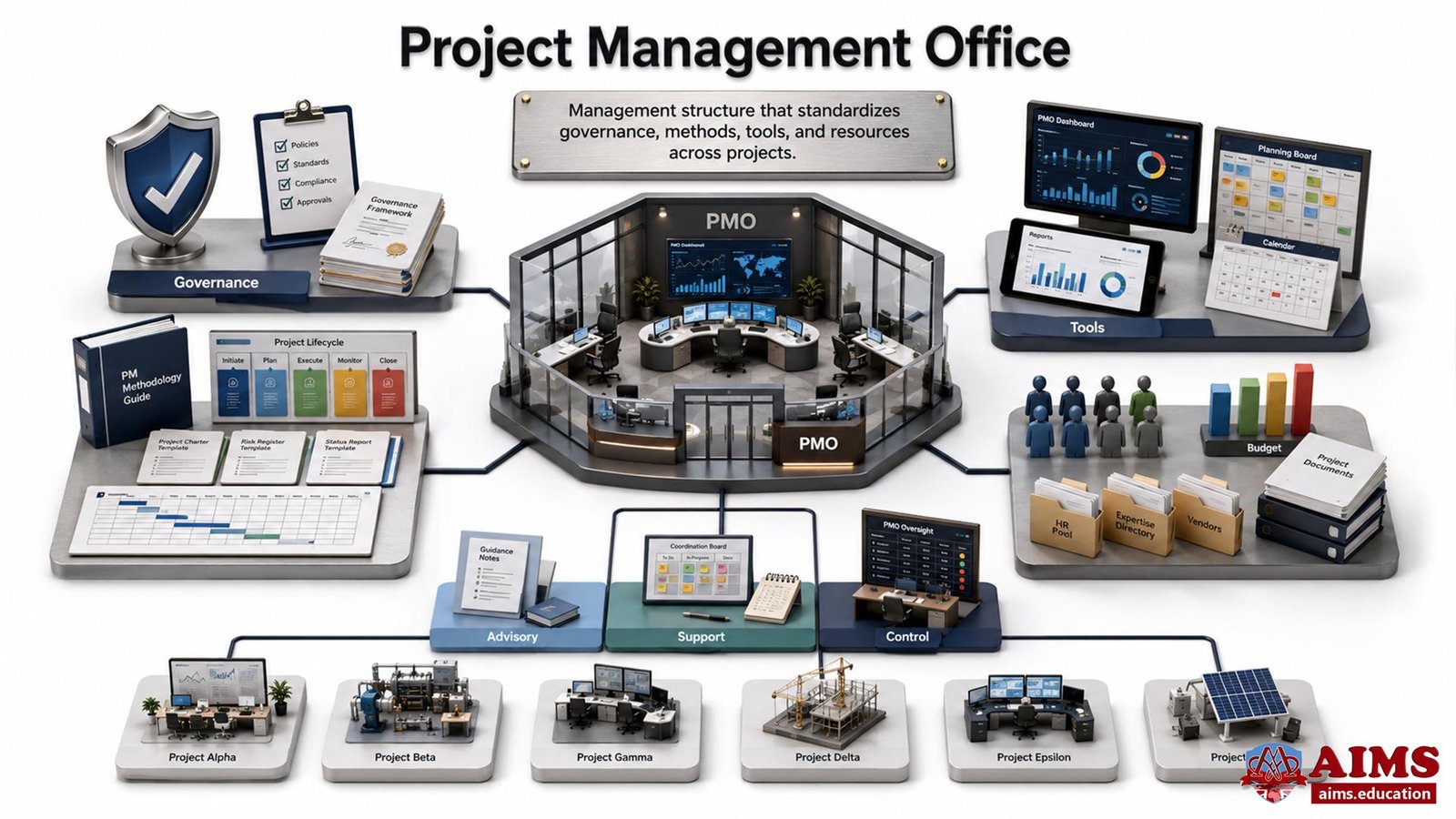
PMO Definition, Scope, and Strategic Relevance
PMO can be defined as: A management structure that standardizes project-related governance, supports shared methods, tools, and resources, and may range from advisory support to direct project control.
Its strategic value depends on how well it improves delivery consistency, decision quality, and alignment with business objectives.
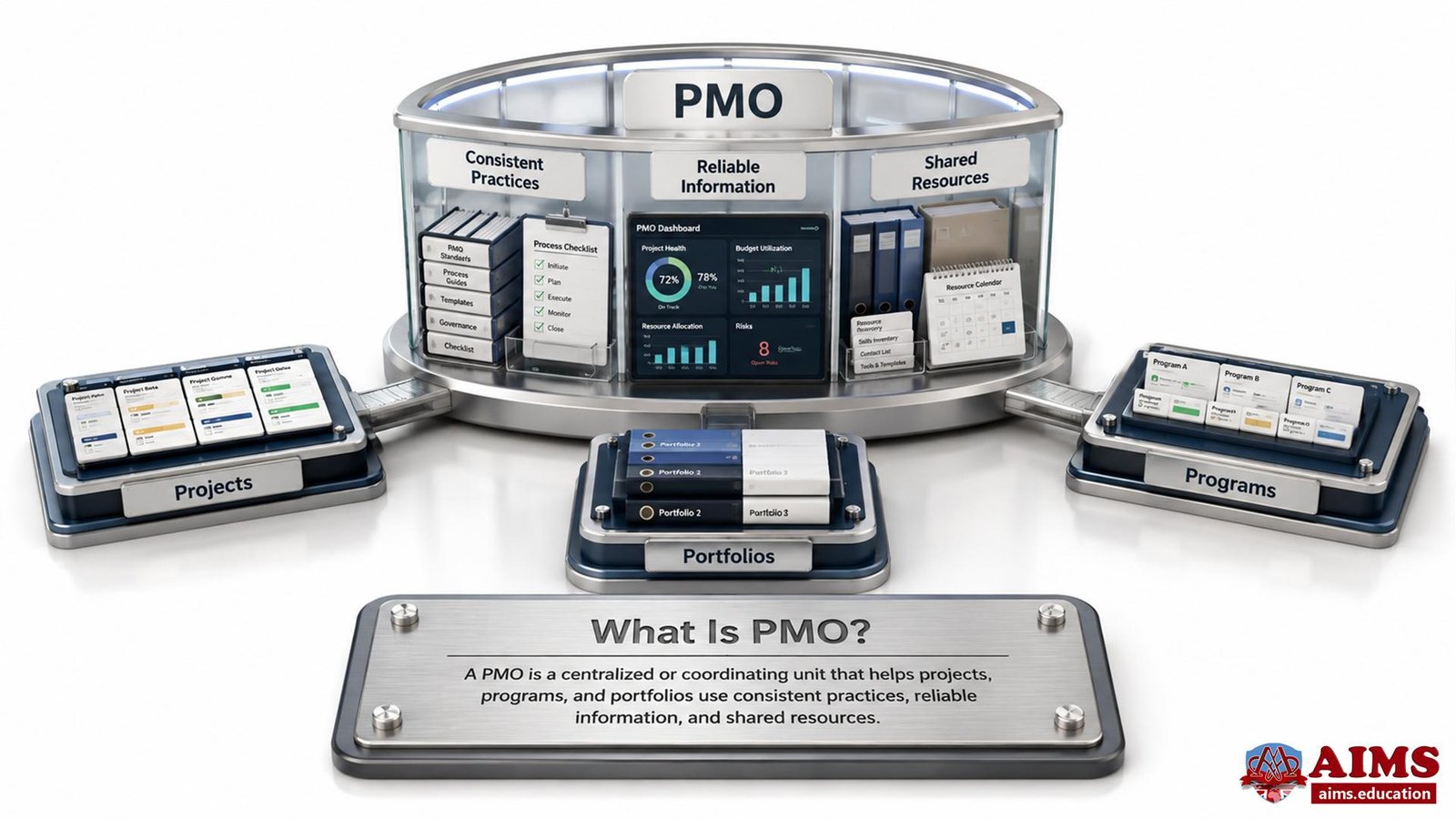
- Structurally, it is usually a centralized or coordinating unit.
- Functionally, it helps projects, programs, and portfolios use consistent practices, reliable information, and shared resources.
Once you understand what is PMO, the next important point is authority.
- Some PMOs advise teams and provide templates.
- Others require compliance with approved methods.
- A directive PMO may take responsibility for managing one or more projects directly.
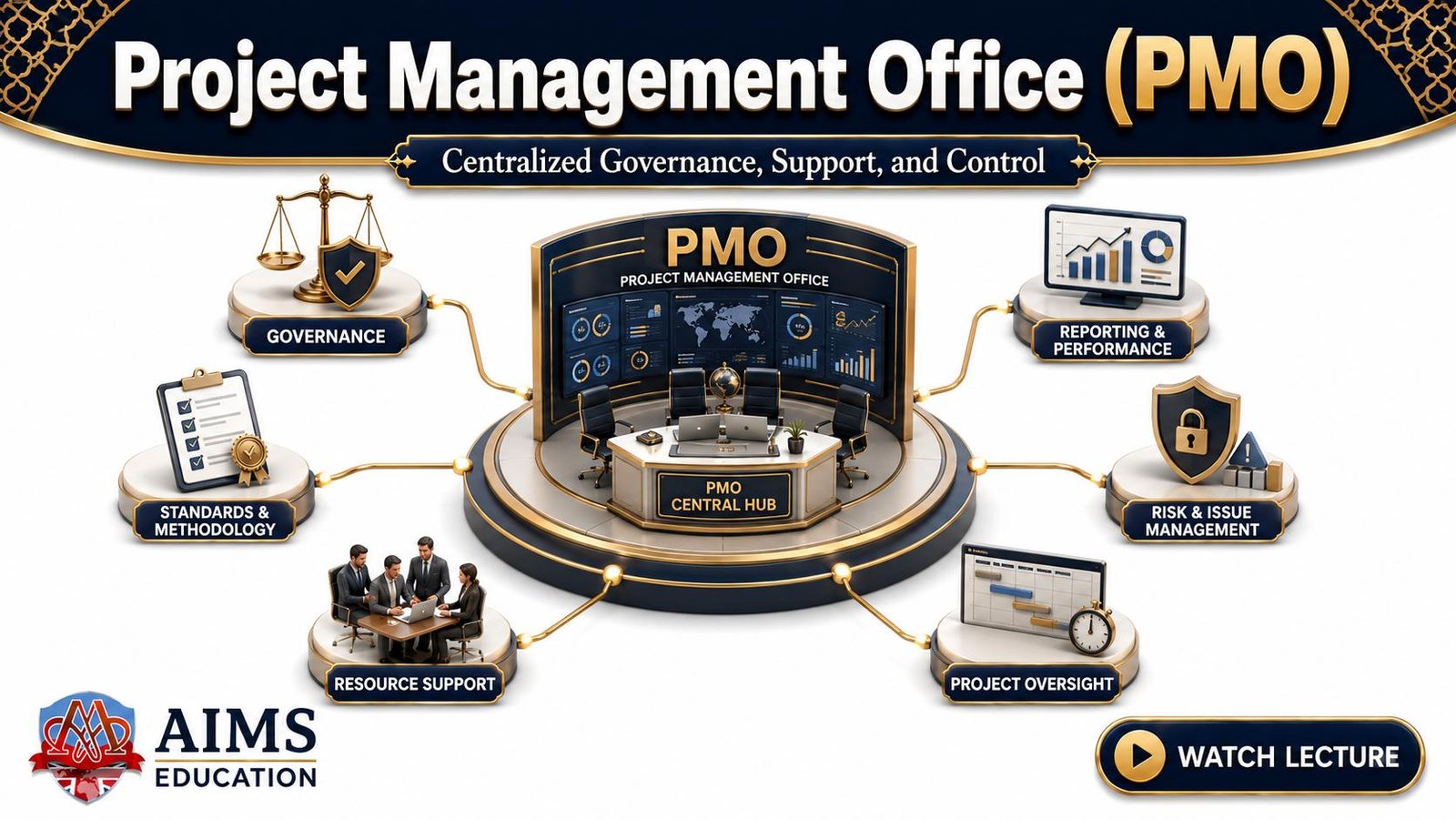
PMO Meaning in Business, Governance, and Delivery Contexts
PMO meaning changes slightly depending on the organizational context.
In business terms, the PMO helps leaders connect project execution with organizational priorities.
- In governance terms, it supports standards, escalation paths, reporting, audits, and decision quality.
- In delivery terms, it gives project managers practical help through methods, tools, coaching, and coordination.
- For executives, PMO meaning may focus on visibility, risk control, resource use, and strategic alignment.
- For project managers, PMO meaning may be more practical: templates, schedules, dashboards, methodology guidance, mentoring, and access to lessons learned from previous projects.
PMO Definition Across Standards and Frameworks
A practical PMO definition should be broad enough to cover different organizational models. The PMO may provide support, require compliance, manage shared resources, maintain project documentation, coordinate communication, and support governance across projects. This PMO definition is deliberately broad because no single PMO model fits every organization.
A standards-aligned understanding also distinguishes project, program, and portfolio contexts. For broader terminology, organizations may refer to international standards for project, programme, and portfolio management, especially when designing governance across multiple layers of work.
Importance of Project Management Office in Multi-Project Organizations
A Project Management Office becomes valuable when many projects compete for the same people, budgets, systems, and executive attention. Without coordination, organizations may approve too many projects, duplicate work, use inconsistent reporting, and lose visibility over risks and dependencies.
The PMO improves coordination by creating a common operating language. It helps leaders compare projects, understand delivery performance, make trade-offs, and align project effort with strategy. In simpe terms, the answer to what is a project management office is: PMO exists to make project delivery more consistent, visible, and valuable.
PMO Roles and Responsibilities in Modern Organizations
PMO roles and responsibilities describe the services, controls, and decision-support activities a Project Management Office provides to help projects, programs, and portfolios perform better. A modern PMO does more than issue templates; it builds capability, improves visibility, coordinates resources, and helps leaders make timely delivery decisions.
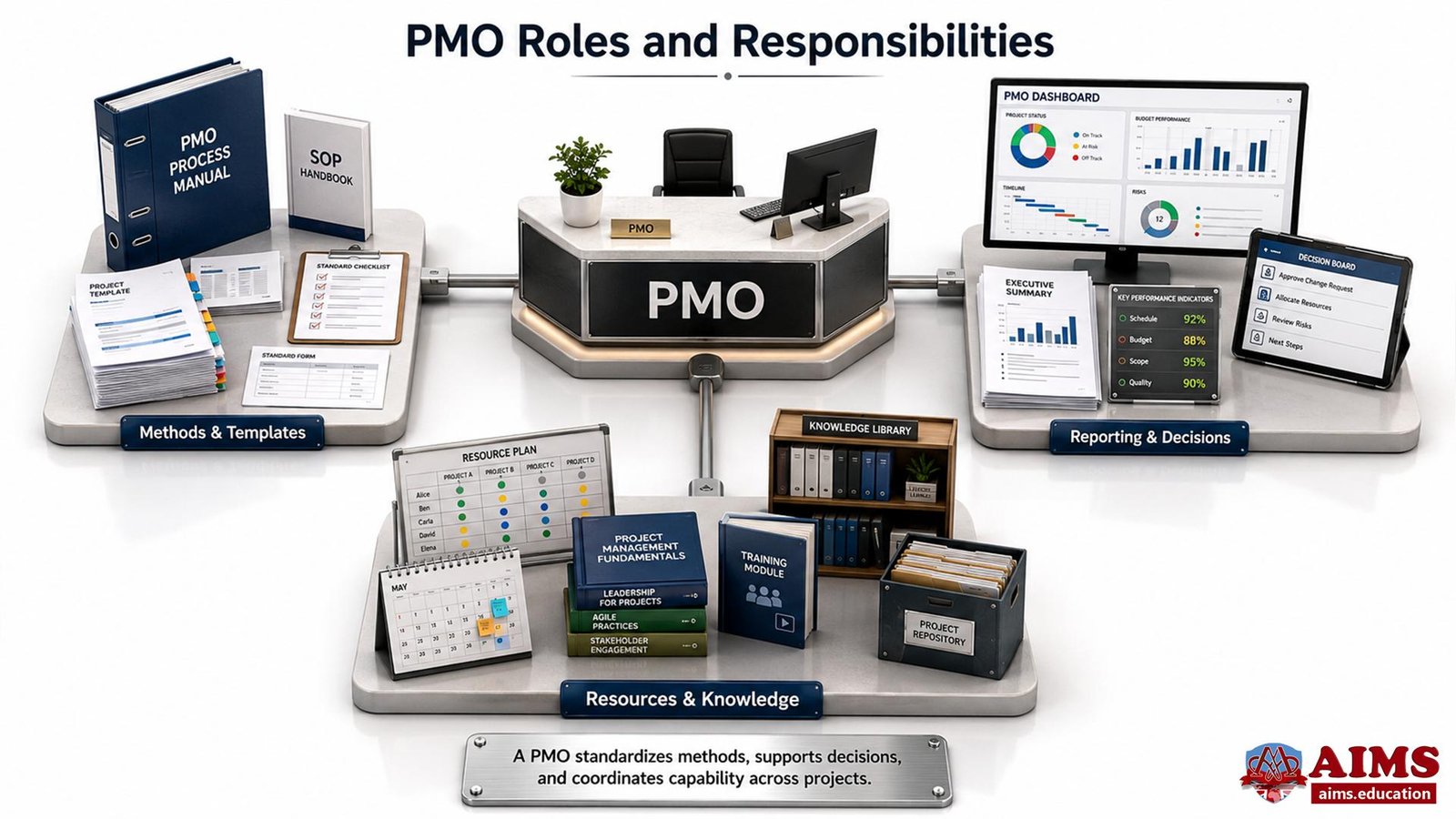
Core Services a PMO Provides to Projects, Programs, and Portfolios
The most common PMO roles and responsibilities include methodology development, governance support, resource coordination, training, mentoring, reporting, risk oversight, quality assurance, and communication across projects. These services support how project work is defined and managed across organizations.
Methodology, Templates, and Standard Operating Guidance
A PMO develops and maintains project management methods, templates, forms, checklists, lessons learned repositories, and organizational process assets. This does not mean every project must look identical. Mature PMOs maintain enough standardization to enable control while allowing flexibility where the project context requires it.
Reporting, Dashboards, and Decision Support
A PMO collects and organizes project information so managers and executives can make better decisions. This may include progress dashboards, milestone reporting, risk summaries, dependency maps, financial snapshots, and forecast updates. The objective is not reporting volume; the objective is reliable information for action.
Resource Coordination, Capability Building, and Knowledge Management
A PMO may coordinate shared resources, identify skill shortages, support project manager development, and organize coaching or mentoring. It may also capture lessons learned and improve knowledge transfer across teams. Professionals preparing for such responsibilities may benefit from formal project management certification for future PMO professionals.
PMO in Project Management Across the Life Cycle
PMO in project management becomes visible across initiation, planning, execution, monitoring, control, and closure.
- During initiation, the PMO may help review business cases and clarify governance requirements. During planning, it may support schedules, budgets, risks, scope baselines, and quality criteria.
- In practice, PMO in project management is not limited to paperwork. It helps project teams apply the right level of structure.
- For a low-risk internal project, the PMO may provide a lightweight checklist.
- For a regulated transformation project, the PMO may require formal gates, risk reviews, and executive reporting.
Which Decisions Belong to the PMO and Which Stay With Sponsors and Project Managers
The PMO usually owns standards, reporting methods, governance rhythm, portfolio visibility, and process improvement. Project managers own day-to-day delivery of assigned projects. Sponsors own business justification, strategic commitment, and major benefit decisions. Senior leaders usually own funding choices, portfolio priorities, and trade-offs between competing initiatives.
This distinction prevents role confusion. A PMO should not casually take over a project manager’s delivery authority unless it is operating as a directive PMO. Equally, project managers should not be expected to solve enterprise resource conflicts or portfolio prioritization issues alone.
Types of PMO and How Authority Changes by Model
Types of PMO differ mainly by authority, service depth, and required compliance.
- Supportive PMO advises teams, a controlling PMO requires agreed methods and governance, and
- Directive PMO directly manages projects or major delivery work.
The right model depends on organizational maturity, complexity, and risk.
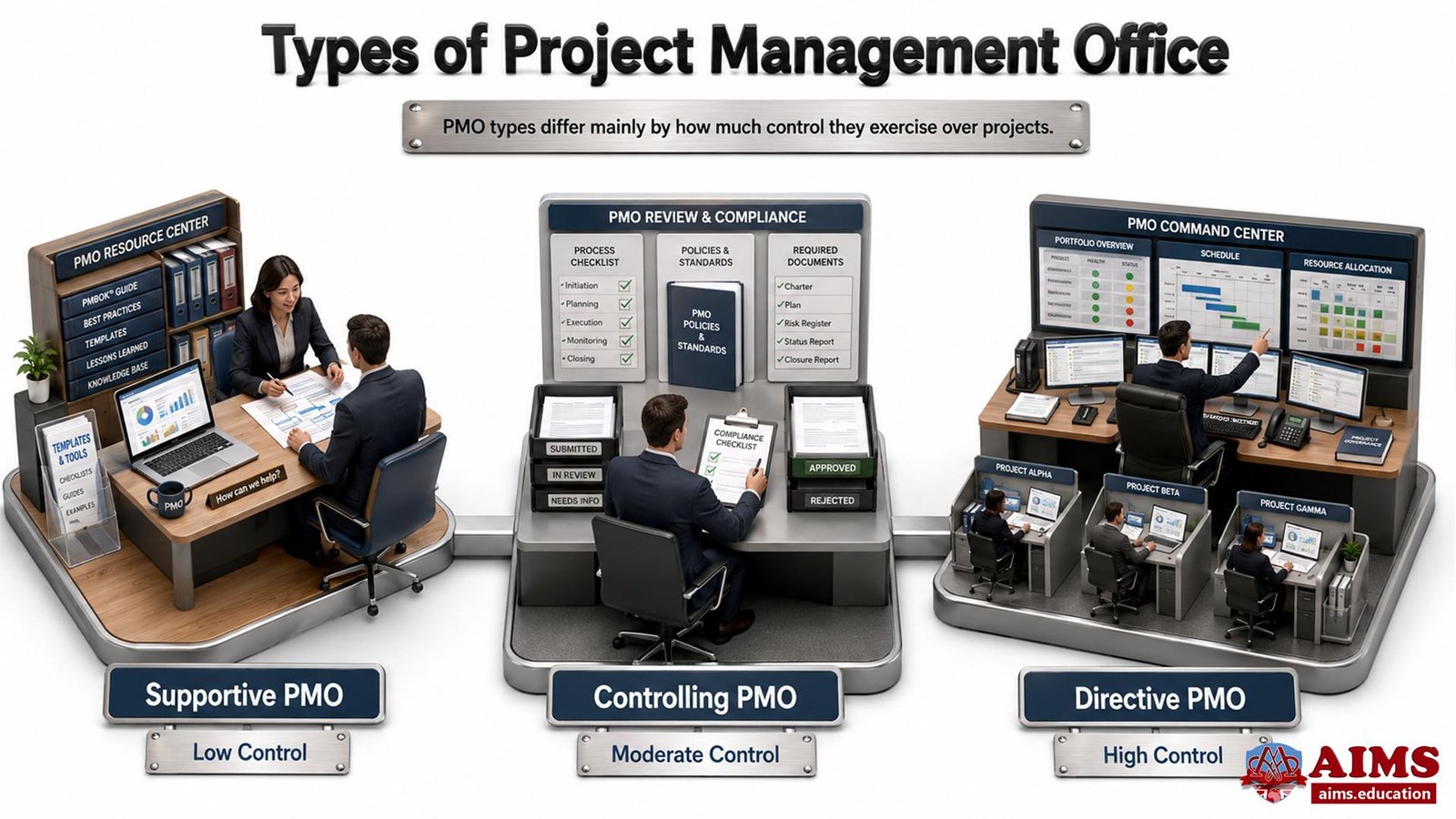
Supportive, Controlling, and Directive PMO Models
The three classic types of PMO are supportive, controlling, and directive.
- A supportive PMO has low control and works mainly through guidance.
- A controlling PMO has moderate control and requires compliance with selected processes.
- A directive PMO has high control because it directly manages projects or project managers.
| PMO MODEL | AUTHORITY LEVEL | BEST FIT | MAIN RISK |
|---|---|---|---|
| Supportive PMO | It has low authority and provides templates, mentoring, training, repositories, and good-practice guidance. | It fits organizations with capable project managers that need consistency without heavy control. | It may be ignored if executive sponsorship and service value are weak. |
| Controlling PMO | It has moderate authority and requires teams to follow approved methods, governance, tools, and reporting standards. | It fits organizations with recurring delivery issues, regulatory needs, or inconsistent project practices. | It may become compliance-heavy if rules are not connected to business value. |
| Directive PMO | It has high authority and directly manages projects, project managers, or major delivery initiatives. | It fits complex, high-risk, or strategically critical environments that need centralized delivery control. | It may reduce local ownership if business units feel delivery has been taken away from them. |
Enterprise, Departmental, and Project-Level PMO Structure
PMO structure may be enterprise-wide, departmental, or project-specific.
- Enterprise PMO supports governance across a portfolio of strategic initiatives.
- Departmental PMO may serve IT, construction, finance, operations, or another business area.
- Project-level PMO supports one large program, megaproject, or transformation initiative.
The correct structure depends on decision rights.
- If the organization needs portfolio prioritization and executive reporting, an enterprise PMO is usually more suitable.
- If the problem is inconsistent delivery within one department, a departmental PMO may be enough.
- If one major project needs intensive control, a temporary project office may be better.
When a Program Management Office Is a Better Fit Than a Project Management Office
A program management office is more suitable when the main challenge is coordinating related projects that together deliver strategic benefits. A Project Management Office may support many unrelated projects, while a program management office focuses on interdependencies, benefits, shared risks, and coordinated outcomes within one program.
Program Management Office vs PMO
A program management office supports program-level integration, dependency management, benefits tracking, and cross-project coordination. A PMO may be broader, serving many projects, programs, or departments. You may also study how program and project leadership differ in real delivery settings.
Portfolio Office vs PMO
A portfolio office focuses on selecting, prioritizing, balancing, and reviewing investments across projects and programs.
- A PMO may provide the governance and reporting infrastructure that supports those decisions.
- The portfolio office asks whether the organization is doing the right work; the PMO helps ensure the approved work is governed and delivered well.
Using a PMO Maturity Model to Decide the Right Level of Control
A PMO maturity model helps organizations avoid building too much structure too quickly. The maturity path often starts with informal coordination, moves into supportive templates and coaching, develops controlling governance and reporting, and may eventually become an enterprise PMO with portfolio-level visibility and strategic decision support.
A practical maturity path may look like this:
- The organization first recognizes repeated delivery pain, such as missed deadlines, unclear roles, weak reporting, or resource conflicts.
- The organization then creates a small supportive PMO to provide guidance, templates, and coaching.
- The PMO later introduces governance standards, reporting cadences, and escalation paths where consistency is necessary.
- The PMO eventually becomes strategic by supporting prioritization, forecasting, resource planning, and executive decision-making.
PMO Governance, Reporting Lines, and Organizational Design
PMO governance defines how project decisions are escalated, who owns standards, how performance is reported, and where the Project Management Office sits in the organizational structure. Good governance balances control with speed, making delivery transparent without turning the PMO into an unnecessary approval bottleneck.
Where the PMO Sits in the Organizational Chart
A PMO may report to the chief operating officer, chief information officer, strategy office, transformation office, finance leadership, or executive board. The best location depends on the PMO’s purpose. A strategic PMO needs senior sponsorship. A departmental PMO may sit within the function it primarily serves.
Reporting lines shape authority.
- A PMO buried too low in the hierarchy may struggle to resolve cross-functional resource conflicts.
- A PMO placed close to executives can influence priorities, but it must still remain service-oriented enough to support project teams.
For structural context, see where PMO reporting lines sit in a project management organizational structure.
PMO Governance, Escalation Paths, and Executive Sponsorship
PMO governance includes decision gates, role definitions, issue escalation, performance reviews, risk oversight, change control, and audit mechanisms. Executive sponsorship is essential because governance without authority becomes advice, while authority without sponsorship becomes resistance.
A strong PMO governance design answers several practical questions.
- Who approves project initiation?
- Who changes priorities when resources are limited?
- Who owns methodology exceptions?
- Who receives risk escalation?
- Who decides whether a project should continue, pause, or stop?
Without these answers, a PMO becomes a reporting office rather than a governance function.
How PMO Structure Influences Compliance, Agility, and Delivery Speed
The lecture material correctly emphasizes that modern PMOs should evolve from process enforcement to value creation.
- A process-focused PMO emphasizes standards, uniform practices, reporting outputs, and compliance.
- A service-oriented PMO emphasizes customer needs, tailored support, proactive engagement, outcomes, agility, and value delivered.
| COMPARISON AREA | PROCESS-FOCUSED PMO | SERVICE-ORIENTED PMO |
|---|---|---|
| Main Emphasis | It emphasizes enforcing standards, methods, and process compliance across projects. | It emphasizes delivering services that customers perceive as useful and valuable. |
| Operating Style | It often applies uniform practices across projects regardless of context. | It adapts practices to project needs while preserving necessary governance. |
| Customer Interaction | It may respond after issues appear or after reports show delivery problems. | It proactively engages customers to understand needs before problems escalate. |
| Success Measure | It often measures success through compliance, reporting completion, and process use. | It measures success through outcomes, satisfaction, decision quality, and value delivered. |
PMO vs Project Manager, Program Manager, and Portfolio Manager
PMO vs project manager is a common comparison because both influence project outcomes, but they do not own the same work.
- The project manager delivers an assigned project.
- The PMO creates the environment, standards, support, and oversight that help multiple projects perform consistently.
| ROLE OR OFFICE | PRIMARY FOCUS | KEY RESPONSIBILITY |
|---|---|---|
| Project Manager | A project manager focuses on delivering one approved project within agreed constraints. | The project manager plans, leads, monitors, controls, and closes the project work. |
| Project Management Office | A PMO focuses on improving consistency, governance, visibility, and support across projects. | The PMO defines methods, coordinates information, supports capability, and monitors standards. |
| Program Manager | A program manager focuses on related projects that together create strategic benefits. | The program manager manages interdependencies, benefits, risks, and coordinated outcomes. |
| Portfolio Manager | A portfolio manager focuses on selecting and balancing investments across initiatives. | The portfolio manager aligns resources and priorities with business strategy and value. |
For deeper role clarity, compare how delivery ownership differs from PMO oversight responsibilities and how portfolio-level prioritization aligns projects with business strategy.
PMO Implementation From Concept to Operating Model
PMO implementation turns an organizational need into a working service model with a charter, scope of authority, reporting cadence, customer groups, tools, and measurable outcomes. The strongest implementation begins small, solves visible delivery pain points, and expands only after stakeholders can see practical value.
Assessing Organizational Need, Delivery Pain Points, and Readiness
PMO implementation should begin with diagnosis, not structure. The organization should identify its main delivery problems: unclear priorities, weak reporting, duplicated work, inconsistent methods, skill gaps, poor risk visibility, unreliable forecasts, or resource conflicts. Each pain point should be translated into an outcome the PMO is expected to improve.
This customer-centered logic is important, because PMO customers usually care less about technical services and more about results. Executives may want reliable decision information. Project managers may want faster approvals, useful templates, or risk support. Functional managers may want clearer resource commitments.
Defining the PMO Charter, Service Catalog, and Scope of Authority
The PMO charter should define purpose, customers, services, authority, reporting lines, governance scope, escalation rights, and success measures. The service catalog should explain what the PMO provides, who receives each service, and what outcome each service supports.
Minimum Viable PMO for Smaller Organizations
A smaller organization may not need a large department. A minimum viable PMO can begin with one PMO lead, a simple project register, standard initiation template, monthly dashboard, risk log, and mentoring support. This lighter model helps build consistency without creating unnecessary bureaucracy.
Enterprise PMO for Complex Portfolios
An enterprise PMO is more appropriate when leadership needs portfolio visibility, prioritization support, cross-project dependency management, resource forecasting, and strategic reporting. This model requires stronger executive sponsorship, clearer decision rights, and more mature PMO KPIs.
Selecting Tools, Cadences, and PMO KPIs
PMO KPIs should measure whether the PMO improves outcomes, not just whether teams submit reports. Useful PMO KPIs can be grouped into operational, governance, and strategic metrics.
| KPI CATEGORY | EXAMPLE PMO KPIs | WHAT THEY INDICATE |
|---|---|---|
| Operational KPIs | Schedule variance, budget variance, issue aging, reporting timeliness, and resource utilization indicate delivery discipline. | They show whether projects are being planned, monitored, and supported consistently. |
| Governance KPIs | Gate compliance, risk escalation speed, audit findings, change control cycle time, and decision turnaround indicate governance effectiveness. | They show whether governance improves control without creating excessive delay. |
| Strategic KPIs | Strategic alignment score, benefits realization status, portfolio balance, priority conflicts resolved, and executive decision quality indicate strategic value. | They show whether the PMO helps the organization invest effort in the right work. |
How to Set Up a PMO With a Simple Roadmap
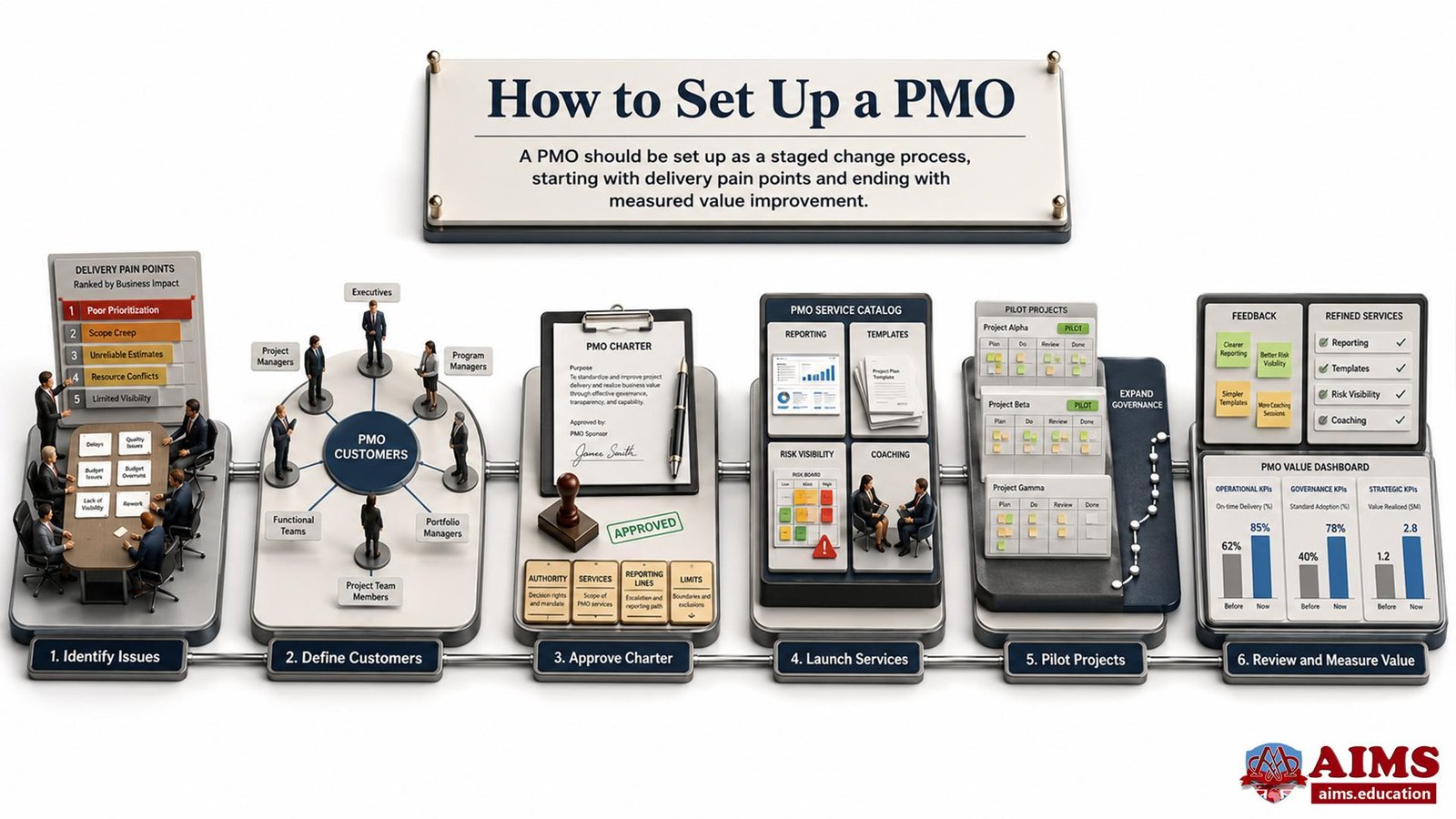
How to set up a PMO should be treated as a staged change process. Start with the smallest structure that solves real delivery problems, then mature the PMO as trust and demand increase.
- The leadership team should identify the most painful delivery issues and rank them by business impact.
- The organization should define PMO customers, including project managers, executives, program managers, portfolio managers, functional teams, and project team members.
- The PMO sponsor should approve a charter that defines authority, services, reporting lines, and limits.
- The PMO team should launch a small service catalog focused on reporting, templates, risk visibility, and coaching.
- The PMO should pilot its approach on a small number of projects before expanding governance across the organization.
- The PMO should review feedback, improve services, and measure value through operational, governance, and strategic KPIs.
Example:
- NoorTech has 18 active projects and repeated delays caused by unclear priorities and inconsistent reporting.
- Its PMO begins with a project register, a monthly executive dashboard, standard risk reporting, and coaching for five project managers.
- Within three months, executives can see resource conflicts earlier and pause two low-priority projects before they consume more budget.
- The practical impact is better focus, not more administration.
PMO Benefits, Limitations, and Evidence-Based Use
PMO benefits are strongest when the office improves decisions, coordination, capability, and strategic alignment, not merely when it creates more reports. A weak PMO can become expensive bureaucracy, so its value must be judged by outcomes, customer perception, governance quality, and measurable delivery improvement.
PMO Benefits for Standardization, Visibility, and Strategy Alignment
PMO benefits include better project visibility, stronger governance, improved resource coordination, clearer roles, more reliable information, better risk oversight, stronger knowledge transfer, and closer alignment between projects and strategic objectives. These benefits become visible when the PMO solves problems that stakeholders genuinely feel.
A mature PMO can also improve decision-making by showing leaders which projects are late, underfunded, overextended, misaligned, or exposed to high risk. It supports strategy by helping the organization avoid the common mistake of approving too many initiatives without enough capacity.
Common Costs, Trade-Offs, and Failure Modes
A PMO can fail when it lacks a distinctive purpose, imposes processes without explaining value, ignores stakeholder needs, collects data that nobody uses, or measures success only by compliance. Over-governance slows delivery and creates resistance, especially when project teams see the PMO as a policing body rather than a service partner.
A PMO survives when customers can see the value it creates, not merely when it proves that processes were followed.
This is why customer perception of value matters. A technically strong PMO may still be challenged if executives, project managers, and functional leaders do not recognize its contribution. Tangible value may include cost control or faster reporting. Intangible value may include trust, collaboration, confidence, and better conversations about priorities.
Why PMOs Should Evolve as Strategy and Organizational Context Change
A PMO should not remain fixed forever. As organizational maturity grows, services should change. Early services may focus on templates, reporting, and project discipline. Later services may focus on portfolio insight, benefit tracking, resource forecasting, agile governance, and strategic advisory support.
The lecture material makes a strong point: value is perceived differently by different customers. A project manager may value practical risk support, while a CEO may value high-level decision intelligence. A PMO must therefore map customer pains, design suitable services, and improve continuously through feedback loops.
When Not to Build a PMO
An organization should avoid creating a PMO when it only wants symbolic control, when leadership will not sponsor governance decisions, when there are too few projects to justify overhead, or when the real issue is poor executive prioritization rather than weak project management. In such cases, a lighter coordination role may be better.
A PMO should also be avoided or redesigned if it becomes a documentation factory. Reports, templates, and dashboards are useful only when they support decisions, reduce uncertainty, improve performance, or help people deliver better results.
Applications, Examples, and Sector-Specific Adaptations
A Project Management Office changes shape by sector because project uncertainty, regulation, capital intensity, and delivery methods differ. IT may need adaptive governance, construction may need rigorous cost and schedule control, finance may emphasize compliance, and public sector work may require transparent reporting and accountability.
How PMOs Work in IT, Construction, Finance, and Public Sector Settings
- In IT, the PMO often supports agile, hybrid, and product-oriented delivery.
- In construction, it may emphasize planning, cost control, contract coordination, safety reporting, and milestone governance.
- In finance, it may focus on regulatory compliance, risk oversight, auditability, and secure change management.
- In public sector settings, it may support transparency, stakeholder reporting, budget control, and policy alignment.
The same PMO should not blindly apply one method everywhere. A manufacturing company may use predictive planning for plant construction, agile practices for software projects, and hybrid governance for product development. The PMO’s real agility lies in selecting the right approach for the context.
PMO in Agile, Hybrid, and Traditional Delivery Environments
PMO in project management is sometimes misunderstood as a waterfall-only concept. That is incorrect. Agile and hybrid teams can use a PMO when the office adapts its governance to support speed, learning, and customer value. Useful guidance is available through how agile delivery changes PMO support, control, and governance.
- In an agile environment, the PMO may focus on lightweight standards, dependency visibility, capacity planning, value streams, team enablement, and portfolio alignment.
- In a hybrid environment, it may support both agile cadences and traditional executive reporting. In a traditional environment, it may emphasize baselines, stage gates, risk logs, and change control.
How the Project Management Office Connects With Scope, Risk, Cost, Quality, and Time Management
The Project Management Office supports core project management areas by establishing methods, tools, and checks that help teams plan and control work.
- For scope, it may provide change request rules.
- For risk, it may define escalation thresholds.
- For cost, it may standardize budget reporting. For quality, it may support assurance reviews.
- For time management, it may require schedule baselines and milestone tracking.
This is where PMO definition becomes practical. A PMO is not simply a department name; it is a working mechanism for improving how project management discipline is applied across multiple initiatives.
Short Project Management Office Example for a Growing Organization
Consider GreenBuild Group, a medium-sized company delivering construction, IT, and sustainability projects. Project managers use different reporting formats, executives cannot compare project risks, and functional managers complain that resources are double-booked. The company creates a controlling PMO with a light service catalog.
- The PMO starts with a shared project register, standard milestone reporting, and a resource conflict log.
- It introduces risk review meetings for high-value projects and coaching for less experienced project managers.
- It creates a simple dashboard showing schedule status, budget exposure, top risks, and strategic alignment.
- It reviews customer feedback after each month and removes reports that do not support decisions.
The result is a PMO that improves visibility and control without becoming a rigid bureaucracy. This answers what is PMO in a practical sense: it is a service and governance function that helps the organization deliver better work through better structure.
FAQ About Project Management Office and PMO
These frequently asked questions answer practical search questions about PMO meaning, PMO definition, PMO roles and responsibilities, types of PMO, and PMO governance. Each answer is intentionally concise so you can understand the concept quickly before applying it to their own organizational setting.
What Is a Project Management Office?
A Project Management Office is a management structure that standardizes project-related governance and supports the use of shared resources, methods, tools, and techniques. It may provide advice, require compliance, or directly manage projects, depending on the organization’s needs and authority model.
What Does PMO Stand For?
PMO stands for Project Management Office. In some organizations, the same acronym may also be used informally for a program management office or portfolio management office, but the most common meaning in project management is Project Management Office.
What Is the PMO Meaning for Non-Technical Readers?
The PMO meaning is simple: it is an office or function that helps an organization manage projects in a more consistent, visible, and controlled way. It supports project teams and leaders through standards, reporting, governance, coordination, and practical delivery guidance.
What Is the Simplest PMO Definition?
The simplest PMO definition is this: a PMO is a function that helps organizations manage projects better by providing standards, support, governance, reporting, and coordination. The exact PMO definition may vary because some PMOs advise, some control, and some directly manage projects.
What Is PMO in Project Management?
PMO in project management means the office, team, or function that supports project delivery through methods, governance, tools, reporting, training, and oversight. PMO in project management is especially useful when organizations manage many projects and need consistency, visibility, and better decision support.
What Are the Three Main Types of PMO?
The three main types of PMO are supportive, controlling, and directive. A supportive PMO advises and provides resources. A controlling PMO requires compliance with standards and governance. A directive PMO takes direct responsibility for managing projects or project managers.
What Does a Project Management Office Do Every Day?
A Project Management Office may review project reports, support project managers, maintain templates, coordinate resources, monitor risks, prepare dashboards, guide governance meetings, help resolve escalations, coach teams, and improve project management practices across the organization.
What Is the Difference Between a PMO and a Project Manager?
A project manager manages one assigned project, while a PMO supports or governs multiple projects. The project manager owns day-to-day delivery decisions. The PMO owns standards, reporting methods, capability support, governance processes, and cross-project visibility.
Is a PMO the Same as a Program Management Office?
A PMO and a program management office are related, but they are not always the same. A Project Management Office may support many unrelated projects. A program management office supports a group of related projects that together deliver strategic benefits.
How Do You Set Up a PMO?
To set up a PMO, identify delivery pain points, define PMO customers, create a charter, agree authority, design a service catalog, choose reporting cadences, select useful KPIs, pilot the model, and improve it through feedback. The best approach starts small and expands with proven value.
What Are Common PMO KPIs?
Common PMO KPIs include schedule variance, budget variance, risk escalation speed, reporting timeliness, resource utilization, governance compliance, change control cycle time, strategic alignment, benefits realization progress, customer satisfaction, and decision turnaround time.
Does Every Organization Need a PMO?
Every organization does not need a formal PMO. A PMO is most useful when there are multiple projects, shared resources, recurring delivery problems, weak visibility, high risk, compliance needs, or strategic coordination challenges. Small organizations may need only a lightweight coordination model.
Can Agile Teams Still Work With a PMO?
Agile teams can work effectively with a PMO when the PMO supports value delivery rather than imposing unnecessary bureaucracy. In agile and hybrid environments, the PMO should adapt governance, improve dependency visibility, support portfolio alignment, and help teams remove obstacles.
About AIMS’ Project Management Academy
AIMS’ Project Management Academy has delivered project management education since 2005, supporting global learners through internationally accredited, career-focused qualifications. Its curriculum combines standardized project, program, and portfolio management knowledge with qualified faculty, industry-oriented teaching, practical skill development, 3D interactive learning content, and real-world case studies.
This content, along with AIMS’ study content and curriculum, is collaboratively developed and rigorously peer-reviewed by an academic board of qualified industry practitioners. These quality controls support job-ready qualifications for professionals in project, program, and project portfolio management. Explore
AIMS’ job-oriented project management programs for project management professionals.