
What Is Project Financial Management?
Project financial management is the systematic management of the financial resources, obligations, information, and controls associated with a project from planning through financial closeout.
In practice, financial project management helps managers determine how much money a project needs, when it will need those funds, how resources should be allocated, whether actual expenditure is following the approved plan, and what the project’s eventual financial outcome is likely to be.
Financial management in project management is broader than simply controlling costs. While project cost management concentrates mainly on estimating, budgeting, and controlling expenditure, financial management may also address funding, cash-flow timing, forecasting, accounting information, financial risks, reporting, and the financial consequences of project decisions.
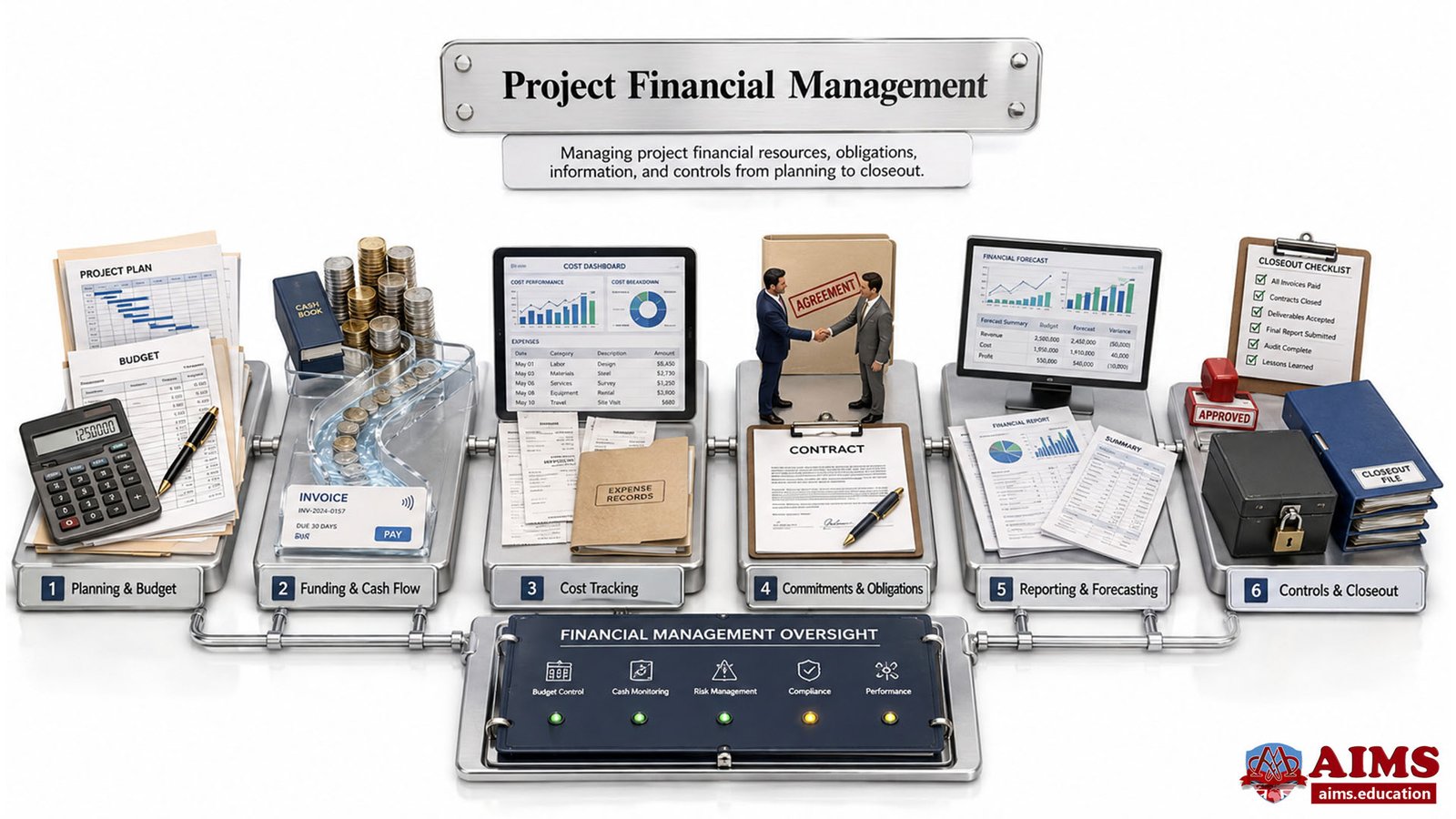
Its major areas commonly include:
- Financial planning: The project team determines expected financial requirements, assumptions, constraints, and financial objectives.
- Project budgeting: Approved estimates are organized into a financial baseline against which expenditure can be monitored.
- Cost management: Costs are estimated, tracked, analyzed, and controlled throughout delivery.
- Cash-flow management: The team considers when money will enter or leave the project so that sufficient liquidity is available when needed.
- Financial forecasting: Current performance and emerging information are used to estimate future expenditure and likely financial outcomes.
- Financial reporting: Relevant financial information is communicated to managers, sponsors, clients, finance teams, and other authorized stakeholders.
- Financial risk and control: Financial threats, variances, commitments, changes, and corrective actions are monitored throughout the project.
This broader interpretation is also visible in the World Bank’s description of financial-management arrangements for investment projects, which covers areas such as planning and budgeting, accounting, internal control, funds flow, financial reporting, and auditing.
Project Financial Management vs Project Cost Management vs Project Accounting
Project financial management provides the broad financial-management view, project cost management focuses specifically on project costs, and project accounting records and reports the financial transactions associated with the project.
| AREA | PRIMARY FOCUS | TYPICAL ACTIVITIES | MAIN QUESTION |
|---|---|---|---|
| Project Financial Management | Overall financial health and control of the project | Planning, budgeting, cash flow, forecasting, cost control, financial risk, reporting, funding coordination, and financial closeout | Is the project being managed responsibly from an overall financial perspective? |
| Project Cost Management | Costs required to deliver project work | Cost estimating, budgeting, cost baselines, expenditure monitoring, variance analysis, and cost control | Are project costs being kept within the approved budget? |
| Project Accounting | Recording and classification of financial transactions | Recording costs, revenues, invoices, accruals, commitments, reconciliations, and financial transactions | What financial transactions have occurred and how should they be recorded? |
For a closer examination of the cost-specific discipline, see how project cost management controls estimates, budgets, and project expenditure.
How Does Financial Project Management Work?
Financial project management works by establishing a financial plan and budget, monitoring actual financial performance, forecasting future requirements, reporting variances, and taking corrective action when financial results move away from the approved plan.
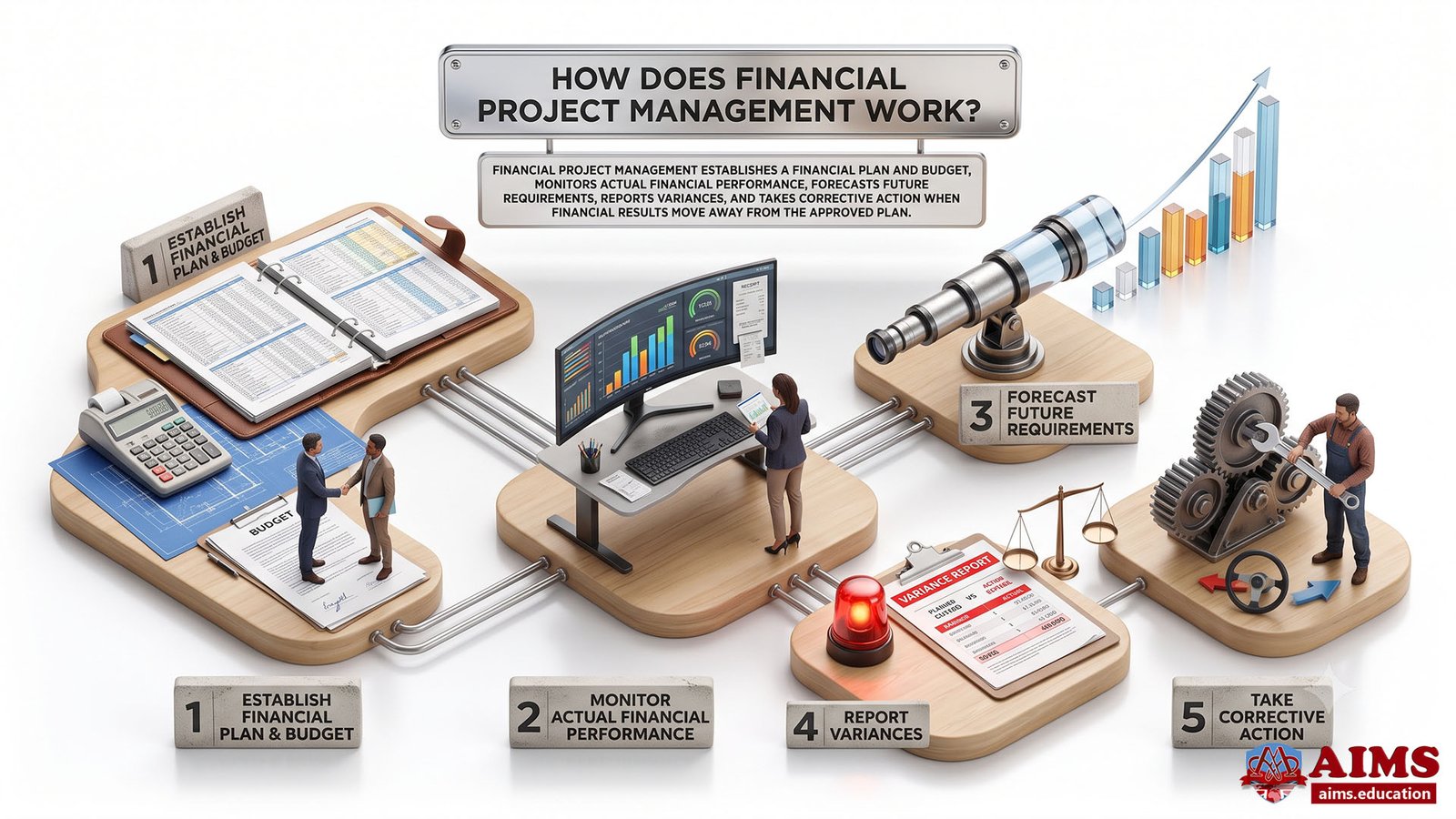
The process is continuous rather than a one-time budgeting exercise. Financial assumptions made during planning are tested against actual performance as the project progresses. Managers then update forecasts and decisions when costs, schedules, risks, scope, funding needs, or operating conditions change.
Project Financial Management Process
| STAGE | FINANCIAL MANAGEMENT ACTIVITY | PURPOSE |
|---|---|---|
| 1. Financial Planning | Define financial assumptions, constraints, objectives, responsibilities, and control procedures. | Establish how project finances will be planned and governed. |
| 2. Cost Estimation | Estimate labor, materials, equipment, services, procurement, overhead, and other relevant costs. | Determine the expected financial requirements of project work. |
| 3. Budgeting | Consolidate approved estimates and allocate financial resources across activities and time periods. | Create an authorized financial baseline for control. |
| 4. Funding and Cash-Flow Planning | Determine when funds will be required and coordinate expected inflows, payments, and financing needs. | Maintain sufficient liquidity throughout execution. |
| 5. Financial Monitoring | Track actual expenditure, commitments, revenues where applicable, and financial performance against the approved plan. | Identify deviations before they become serious problems. |
| 6. Forecasting | Update expected future costs, cash requirements, and final financial outcomes using current information. | Estimate where project finances are heading rather than relying only on historical results. |
| 7. Financial Reporting | Communicate budget status, expenditure, cash flow, forecasts, variances, and significant financial issues. | Support transparency and informed decision-making. |
| 8. Financial Control | Investigate significant variances, evaluate changes, manage financial risks, and implement corrective action. | Keep financial performance aligned with approved objectives. |
| 9. Financial Closeout | Finalize outstanding transactions, reconcile accounts, confirm financial obligations, and document final results. | Establish the project’s final financial position and lessons learned. |
Example of Project Financial Planning and Control
Suppose Northstar Ltd. approves a software implementation project with a budget of £500,000.
- The project team estimates labor, software, consulting, training, and implementation costs before establishing the approved budget.
- Finance and project managers map expected payments across the twelve-month implementation period to identify monthly cash requirements.
- After six months, actual and committed costs are higher than expected because integration work required additional specialist support.
- The team analyzes the variance and revises the forecast. The latest estimate indicates that the project could finish at £540,000 if no corrective action is taken.
- The project manager reviews lower-priority work, vendor commitments, remaining resources, and approved scope before recommending corrective measures.
- The revised financial forecast is communicated to the sponsor so that financial consequences can be considered before further commitments are made.
Financial control therefore helps managers act on emerging evidence before a projected overrun becomes an unavoidable final result.
9 Main Roles of Project Financial Management
The main role of project financial management is to give decision-makers reliable financial information and controls throughout the project lifecycle.
Its principal functions include:
- Plan project finances. Financial requirements, assumptions, spending constraints, funding arrangements, and reporting responsibilities should be established early.
- Develop and control the project budget. Managers need an approved financial baseline against which actual and forecast performance can be compared.
- Allocate financial resources. Available funding should be directed toward approved activities and priorities rather than consumed without reference to project objectives.
- Monitor costs and commitments. Actual expenditure alone may not show the full financial position. Managers should also understand committed and expected future costs.
- Manage cash-flow requirements. Projects may experience financial difficulty even when total funding appears sufficient if funds are unavailable when major payments fall due.
- Forecast future financial performance. Updated estimates help managers understand likely final costs and emerging funding requirements.
- Identify and manage financial risk. Exchange-rate movements, price increases, delays, contract changes, funding uncertainty, inaccurate estimates, and other events can affect financial performance.
- Provide financial reporting and accountability. Sponsors and other authorized stakeholders need timely, understandable information about budget status, variances, forecasts, and significant financial issues.
- Support financial decision-making. Managers use financial information when considering changes, procurement choices, resource decisions, corrective action, and project continuation.
These activities interact closely with broader project risk management methods for identifying and responding to financial exposure.
Responsibilities of a Project Finance Manager
A project finance manager supports the financial planning, analysis, control, systems, and reporting needed for sound project decisions, although the exact responsibilities vary between organizations and projects.
The role should not be treated as synonymous with project financial management itself. Financial management is a project discipline and organizational capability. A project finance manager is one professional who may perform or support parts of that discipline.
Typical responsibilities can include:
- The project finance manager develops or maintains financial controls, analytical systems, forecasts, and reporting processes so that financial information is accurate and available when required.
- The manager works with project leaders and finance executives to prepare budgets, review actual expenditure, examine variances, and update forecasts.
- The manager may evaluate financial processes and introduce suitable systems or technology that improve budgeting, reporting, forecasting, and financial analysis.
- The manager coordinates financial information across relevant functions such as project management, finance, accounting, procurement, and senior management.
- The manager helps maintain appropriate financial procedures, authorization controls, documentation, and reporting practices.
- The manager supports financial evaluation of proposed changes and helps decision-makers understand their budget, cash-flow, and forecast consequences.
- The manager may support financial reconciliation and closeout when project activities are completed.
Project leaders therefore benefit from understanding both financial controls and wider project management practices used in finance and banking. If you need broader formal development, you can also explore advanced diploma in project management.
8 Key Strategies to Succeed in Project Financial Management
Effective project financial management combines disciplined budgeting with forecasting, cost control, reporting, risk management, resource decisions, stakeholder communication, and appropriate financial systems.
- Prepare a comprehensive project budget. Include relevant labor, materials, equipment, procurement, services, overhead, contingencies where appropriate, and expected revenue or funding sources when these form part of the project.
- Update financial forecasts regularly. Forecasts should respond to actual performance, approved changes, emerging risks, market conditions, resource requirements, and new information rather than remaining fixed at their original assumptions.
- Strengthen cost and variance control. Compare actual and committed costs with the budget, identify meaningful differences, investigate their causes, and determine whether corrective action is necessary.
- Maintain regular financial reporting. Reports should communicate relevant information such as budget position, expenditure, commitments, cash flow, forecasts, and significant variances in a form stakeholders can understand.
- Identify financial risks early. Potential cost escalation, funding delays, exchange-rate exposure, contract disputes, estimation errors, schedule delays, and other financially significant risks should be evaluated before they become major problems.
- Optimize the use of resources. Financial control is not simply about spending less. Managers should ensure that resources are allocated where they contribute most effectively to approved project objectives.
- Communicate financial issues with stakeholders. Significant variances and forecasts should not remain hidden until the budget is exhausted. Effective project communication management practices help decision-makers understand financial consequences early enough to respond.
- Use appropriate financial and project-management systems. Suitable technology can support budgeting, cost tracking, forecasting, approvals, reporting, and performance analysis. When selecting technology, managers should evaluate the project’s needs rather than assuming that every feature is necessary. A structured comparison of project management software capabilities can support this decision.
Project Budgeting, Monitoring, and Financial Control
Project budgeting establishes the approved financial plan, monitoring compares actual and expected performance with that plan, and financial control converts the resulting information into management action.
A useful control cycle is:
- Establish an approved budget and relevant cost baseline.
- Record actual expenditure and significant financial commitments.
- Compare actual and expected results with the approved plan.
- Calculate and interpret material variances.
- Investigate the underlying causes rather than reacting only to the numerical difference.
- Update the financial forecast using current project information.
- Assess whether corrective action or formal change control is required.
- Communicate significant financial consequences to authorized decision-makers.
Financial measures should also be connected with operational performance. For example, a project may appear financially favorable simply because important work has been delayed and the associated expenditure has not yet occurred. For this reason, managers often examine financial information alongside schedule, scope, progress, risk, and other project-management KPIs used for performance monitoring.
Important Financial Metrics for Project Managers
Project managers should monitor financial measures that reveal current expenditure, variance, remaining obligations, expected final cost, cash requirements, and the relationship between money spent and work accomplished.
| METRIC | WHAT IT SHOWS | MANAGEMENT USE |
|---|---|---|
| Actual Cost | The cost incurred for project work during a defined period or to date. | Shows how much has actually been spent or incurred. |
| Budget Variance | The difference between budgeted and actual or forecast expenditure. | Highlights areas that require investigation or corrective action. |
| Committed Cost | Financial obligations already entered into but not necessarily paid. | Prevents managers from assuming that unspent cash is entirely available. |
| Estimate at Completion | The current forecast of what the project is expected to cost when completed. | Provides an early warning of likely final overruns or underruns. |
| Cash-Flow Forecast | Expected financial inflows and outflows over future periods. | Helps ensure sufficient funds are available when obligations fall due. |
| Cost Performance Measures | Measures such as cost variance or cost performance index can compare the value of accomplished work with the cost incurred when earned value management is appropriate. | Connects cost information with actual project progress rather than expenditure alone. |
| Project Margin or Profitability | The relationship between project revenue and relevant project costs where the project is commercially revenue-generating. | Helps determine whether commercial financial objectives remain achievable. |
Example of Budget Variance and Financial Forecasting
Assume Apex Engineering has a £1,000,000 approved project budget. At the midpoint, the original plan expected £500,000 of expenditure, but actual and committed costs have reached £560,000.
- The £60,000 difference alerts the team to investigate why expenditure is running ahead of the financial plan.
- The project manager determines that material prices increased and a subcontracted activity required more work than expected.
- The team then examines the remaining project rather than simply reporting the historical overrun.
- An updated forecast indicates a likely final cost of £1,080,000 if current conditions continue.
- Management can now consider scope priorities, procurement choices, resource allocation, available contingency, and other corrective options before approving further expenditure.
The practical value of forecasting is that it changes financial management from retrospective reporting into forward-looking project control.
Project Cash Flow Management
Project cash flow management ensures that sufficient money is available at the right time to meet project obligations while avoiding unnecessary financing pressure or idle funds.
A project can remain within its total approved budget and still encounter a cash-flow problem. For example, a major supplier may require payment before a scheduled client receipt or funding release occurs.
Effective project cash flow management therefore involves:
- forecasting when significant receipts and payments are expected;
- reviewing contractual payment schedules and funding conditions;
- monitoring actual cash movements against forecasts;
- anticipating periods of possible cash shortage or surplus;
- coordinating payment timing and authorized funding requirements; and
- updating cash forecasts when project schedules, procurement plans, or contractual conditions change.
Cash-flow control is especially important in projects with large procurement packages, long supplier lead times, milestone-based billing, external financing, or irregular revenue collection.
Financial Risk Management in Projects
Financial risk management in projects involves identifying uncertain events that could materially affect project costs, cash flow, funding, revenue, or overall financial performance and preparing appropriate responses.
Common financial risks can include:
- Cost-estimation risk: Early assumptions may underestimate the resources or prices required for the work.
- Price and inflation risk: Materials, labor, energy, or services may become more expensive during project execution.
- Currency risk: Exchange-rate changes can affect projects that purchase or receive funds in different currencies.
- Schedule-related financial risk: Delays may increase labor, overhead, financing, equipment, or contractual costs.
- Funding risk: Required funding may arrive later than expected or become subject to new constraints.
- Contract and procurement risk: Claims, supplier failures, change orders, or unfavorable commercial terms can alter financial outcomes.
- Revenue risk: Revenue-generating projects may experience lower sales, delayed billing, or delayed collection.
- Scope-change risk: Approved or uncontrolled changes can increase expenditure beyond the original financial plan.
The purpose of financial risk management is not to predict every possible financial problem. It is to identify material uncertainty early enough that managers can allocate contingency, revise forecasts, change decisions, transfer exposure where appropriate, or escalate the issue.
Funding and Capital Planning for Major Projects
Funding and capital planning determines how financially significant projects will obtain and use the money required for their implementation.
This issue is especially relevant to capital-intensive projects. It should not be treated as a universal requirement for every small operational project.
Where capital planning is relevant, organizations may need to:
- estimate the project’s total and phased funding requirements;
- determine when capital will be required;
- assess available internal funds and external financing arrangements;
- consider working-capital requirements during execution;
- evaluate significant investment alternatives before committing resources;
- align funding releases with the implementation schedule; and
- monitor whether financial assumptions remain valid as the project progresses.
Capital decisions should therefore be integrated with project timing, procurement, risk, and financial forecasts rather than considered as an isolated finance exercise.
Importance of Financial Management in Project Management
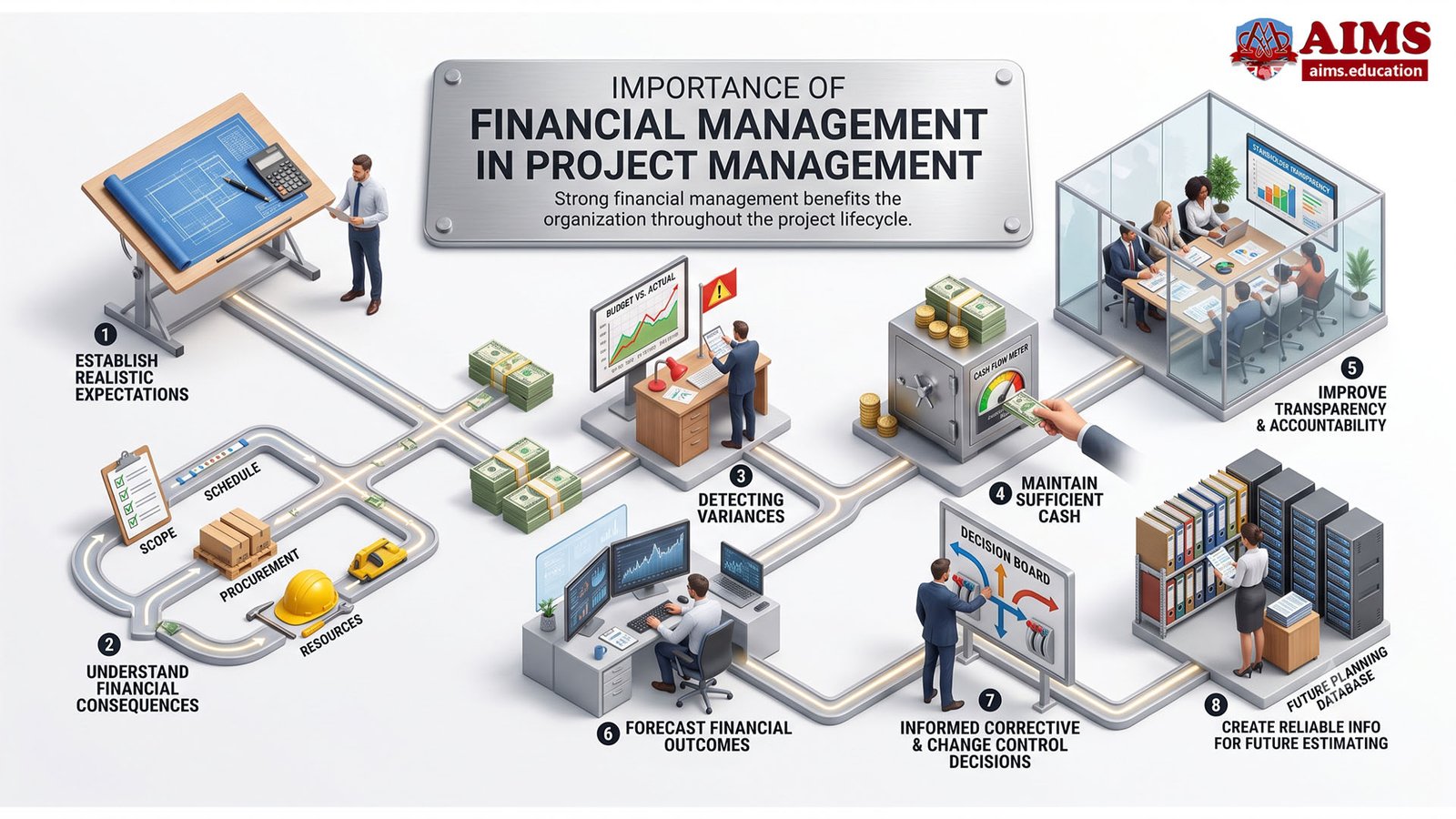
Financial management in project management is important because project decisions consume financial resources, and managers need reliable information to ensure those resources are authorized, available, controlled, and directed toward worthwhile project outcomes.
Strong financial management helps an organization:
- Establish realistic financial expectations before major commitments are made;
- Understand the financial consequences of scope, schedule, procurement, and resource decisions;
- Detect unfavorable variances and emerging overruns earlier;
- Maintain sufficient cash to meet project obligations;
- Improve transparency and accountability to sponsors and other stakeholders;
- Forecast likely final financial outcomes;
- Make more informed corrective and change-control decisions; and
- Create more reliable information for future project estimating and planning.
Developing these capabilities requires more than learning accounting terminology. Project professionals need to understand how financial information interacts with scope, scheduling, procurement, risk, people, stakeholders, and decision-making. Structured online project management course for professional development can help practitioners build these connected competencies.
Final Words on Project Financial Management
Project financial management extends from initial financial planning to final reconciliation and closeout. Budgeting remains central, but effective management also requires forecasting, cash-flow planning, cost and variance control, financial risk assessment, reporting, and timely corrective decisions.
The strongest financial controls are forward-looking. Instead of merely explaining where money has already gone, they help project managers understand where financial performance is heading and what actions are still available to protect project objectives.
Frequently Asked Questions
What is project financial management?
Project financial management is the planning, budgeting, monitoring, forecasting, reporting, and control of a project’s financial resources and obligations throughout its lifecycle. Its purpose is to support responsible resource use, financial accountability, and informed project decisions.
Why is financial management important in project management?
Financial management helps project managers allocate resources, control expenditure, maintain cash availability, identify variances, forecast financial outcomes, manage financial risks, and provide stakeholders with reliable information for decision-making.
What are the main components of project financial management?
The main components generally include financial planning, cost estimation, project budgeting, cash-flow and funding planning, financial monitoring, forecasting, reporting, financial risk management, control, and financial closeout.
What is the project financial management process?
The process normally progresses through financial planning, cost estimation, budgeting, funding and cash-flow planning, financial monitoring, forecasting, reporting, corrective control, and final financial closeout. These activities are revisited as project conditions change.
How do you manage project finances effectively?
Manage project finances by creating realistic estimates and budgets, monitoring actual and committed costs, forecasting future expenditure and cash requirements, analyzing variances, controlling financial risks, reporting significant changes, and taking corrective action early.
What is the difference between project financial management and project cost management?
Project cost management primarily concerns estimating, budgeting, and controlling project costs. Project financial management has a wider scope and may also include funding, cash flow, forecasting, financial reporting, financial risk, accounting information, commercial performance, and financial closeout.
What is the difference between project financial management and project accounting?
Project financial management uses financial information to plan, forecast, control, and support project decisions. Project accounting focuses more specifically on recording, classifying, reconciling, and reporting the financial transactions associated with the project.
How are project budgets planned, monitored, and controlled?
A project budget is created from approved estimates and resource requirements. During execution, actual and committed expenditure is compared with the budget, significant variances are analyzed, forecasts are updated, and corrective action or formal changes are introduced where necessary.
What financial metrics should project managers monitor?
Useful measures may include actual cost, budget variance, committed cost, cash-flow forecasts, estimate at completion, cost-performance measures, and project margin or profitability where commercially relevant. The appropriate metrics depend on the nature of the project.
How is cash flow managed throughout a project?
Project cash flow is managed by forecasting the timing of incoming and outgoing funds, monitoring actual cash movements, identifying potential liquidity gaps, coordinating funding and payment requirements, and updating forecasts when schedules or financial assumptions change.
What is the role of financial forecasting in project management?
Financial forecasting estimates future expenditure, cash requirements, and likely final financial outcomes using current project information. It allows managers to recognize developing problems and make decisions before those problems appear in final accounts.
What are the common financial risks in project management?
Common risks include inaccurate estimates, inflation, price changes, exchange-rate movements, schedule delays, funding shortages, contractual disputes, procurement problems, scope changes, delayed customer payments, and other events that affect project costs, cash flow, or revenue.
Develop Professional Project Financial Management Skills with AIMS
Since 2005, AIMS’ Project Management Academy has delivered internationally standardized, career-focused education to learners worldwide through accredited programs, qualified faculty, industry-oriented teaching, practical skill development, 3D interactive learning content, and real-world case studies. AIMS study content and curriculum are collaboratively developed and rigorously peer-reviewed by an academic board of qualified industry practitioners. Understanding project financial management strengthens the financial judgment required for responsible project leadership. Explore AIMS’ career-focused project management academy for professional qualifications.