
Project management in different industries is the structured planning, coordination, and control of temporary work used to deliver a defined result. It is applied in construction, engineering, information technology, healthcare, banking and finance, manufacturing, energy, and government. The core discipline remains consistent, but each sector adapts its methods, controls, skills, and decisions to industry-specific risks and requirements.
Understanding project management across industries helps students, professionals, and employers see where common principles apply and where specialist knowledge becomes essential. It also explains the range of project management career opportunities, the methodologies commonly used in each sector, and the practical responsibilities project managers accept when moving from one industry to another.
Project management principles are transferable, but successful delivery depends on tailoring them to the industry, organisation, and project environment.
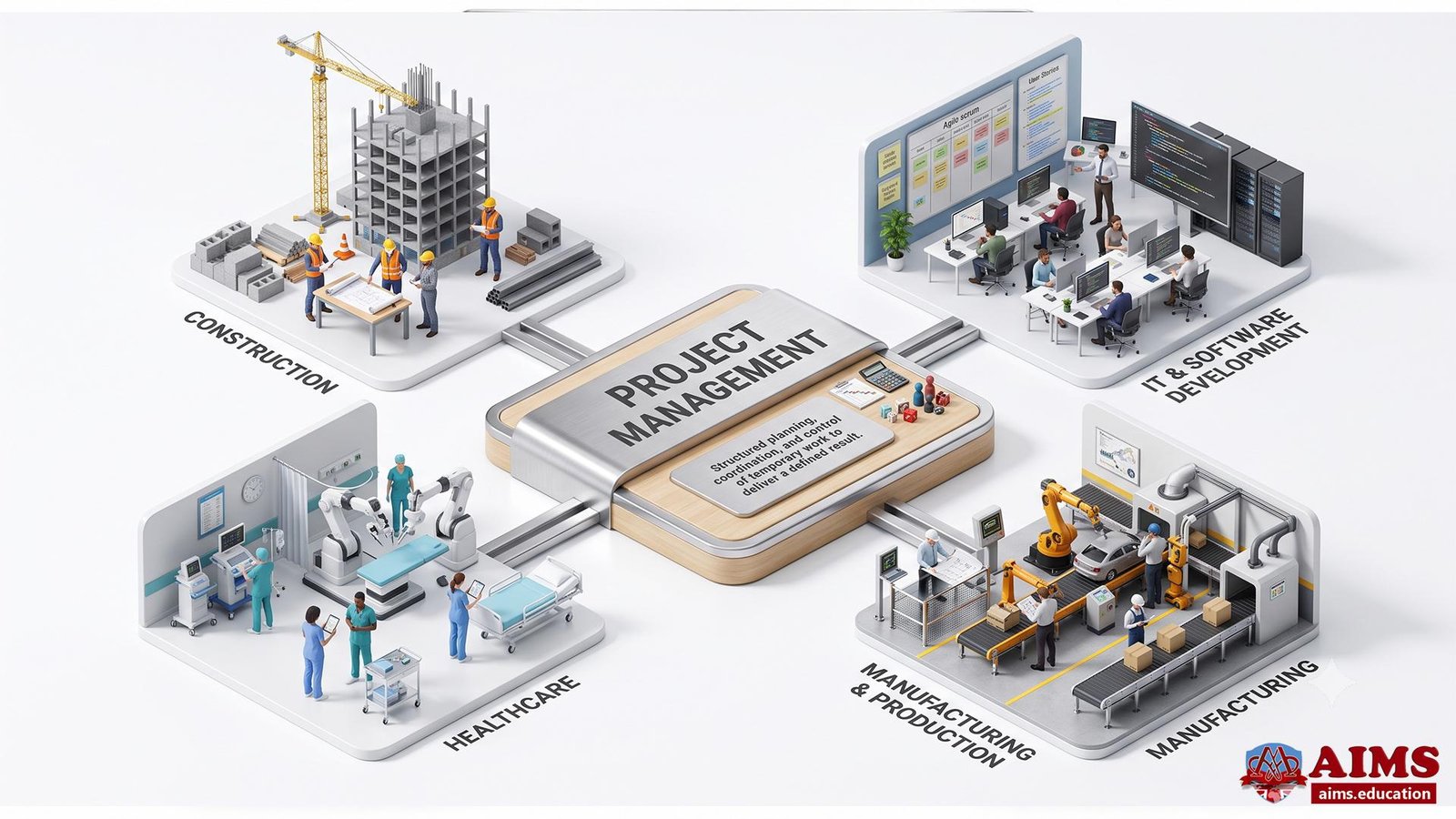
What Is Project Management Across Industries?
Project management across industries applies a common management discipline to different types of temporary, goal-oriented work. The Project management centres on applying knowledge, skills, tools, and techniques to meet project requirements. In practice, every sector uses these elements differently because its outputs, stakeholders, risks, regulations, and working conditions are different.
A useful starting point is the broader definition of project management and its core processes. Whether a team is constructing a bridge, implementing banking software, or introducing hospital equipment, the project manager must connect the intended result with an achievable delivery plan.
The common foundations normally include:
- The project must have a defined purpose, scope, deliverables, and completion point.
- The team must plan time, cost, resources, quality, procurement, communication, and risk.
- Stakeholders must understand decisions, responsibilities, dependencies, and approved changes.
- Progress must be measured against agreed objectives rather than activity alone.
- The delivery approach must be tailored to the project’s uncertainty, complexity, and operating environment.
Therefore, project management is not a separate administrative layer. It is the discipline that integrates people, technical work, resources, and decisions around a specific outcome.
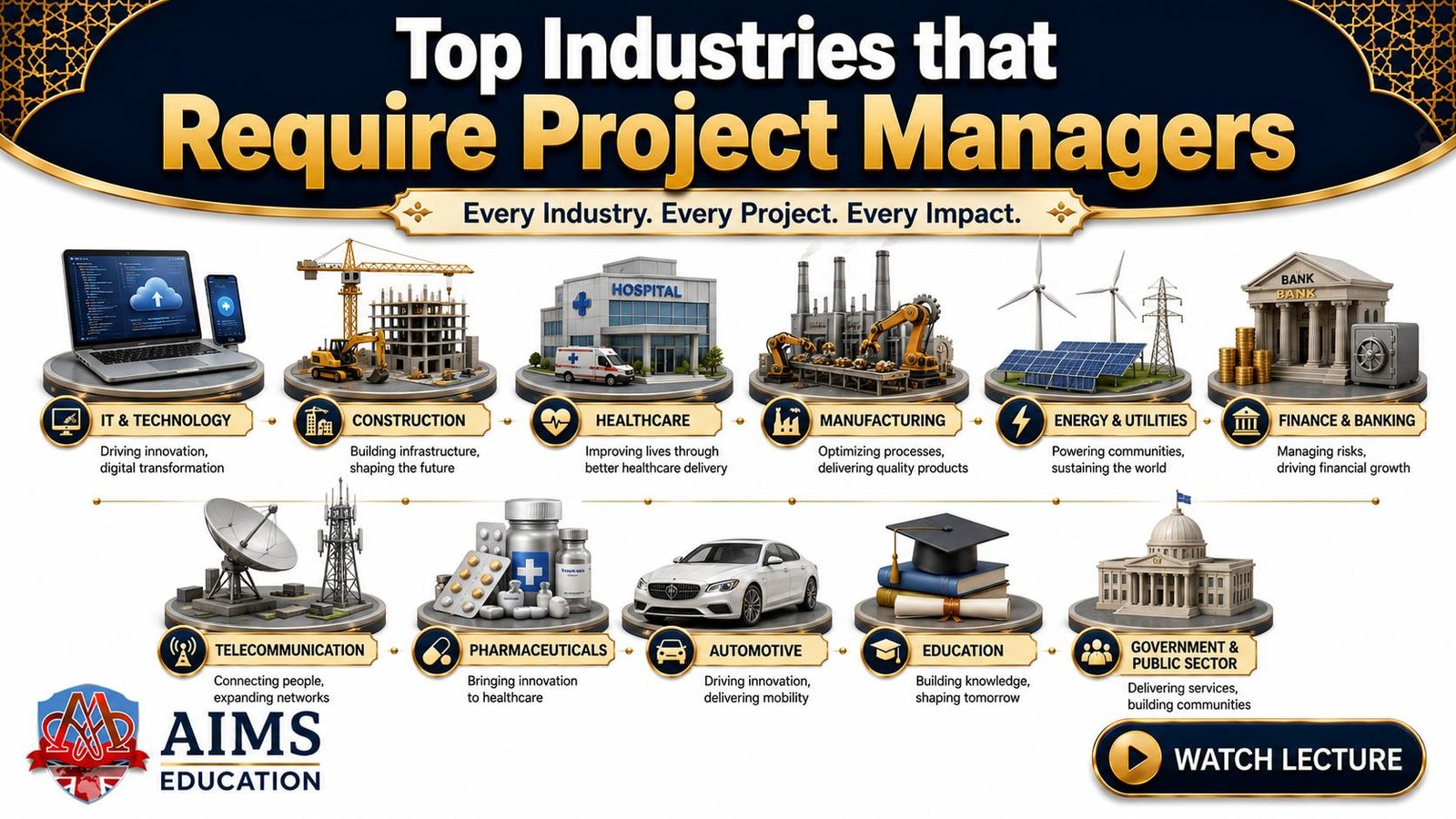
Why Project Management Matters in Different Industries
Project management is important because it converts an organisational objective into coordinated work with clear accountability. Without that structure, specialists may perform valuable tasks while the overall initiative still suffers from delays, cost growth, duplicated effort, unmanaged risk, or unclear ownership.
Across major project management sectors, effective management helps organisations:
- Clarify the intended result: The project team agrees what will be delivered, what is outside scope, and how acceptance will be judged.
- Coordinate specialised contributors: Project managers connect technical experts, suppliers, customers, regulators, executives, and operational teams.
- Control time and cost: Schedules, budgets, forecasts, and corrective actions make performance visible before problems become irreversible.
- Manage uncertainty: Risk planning prepares the team for technical failure, resource shortages, compliance issues, market changes, and stakeholder resistance.
- Protect quality and safety: Defined standards, reviews, testing, and approvals reduce defects and unsafe outcomes.
- Control change: Formal evaluation prevents uncontrolled additions from weakening time, cost, quality, or strategic value.
- Support organisational learning: Lessons, performance data, and post-project reviews improve future delivery.
The practical value is consistent: project management creates a disciplined path from an idea or requirement to a usable result.
How Project Management Differs Between Industries
Project management is not exactly the same in every industry because the delivery environment changes the way projects must be planned and controlled. A software team can revise a digital feature after testing, while a construction team may face costly physical rework. A healthcare project must protect patient safety, while a banking project may place stronger emphasis on data security, auditability, and regulatory approval.
The main differences arise from:
- The nature of the final deliverable, such as a physical asset, digital system, service improvement, or public policy outcome.
- The level of technical uncertainty and the cost of changing completed work.
- Safety, environmental, legal, financial, and data-protection obligations.
- The number and authority of customers, regulators, suppliers, communities, and internal stakeholders.
- The availability of specialist labour, equipment, materials, technology, and funding.
- The need for predictive, adaptive, iterative, stage-gated, or hybrid delivery methods.
| INDUSTRY | TYPICAL PROJECTS | COMMONLY SUITABLE APPROACH | MAJOR RISKS | ESSENTIAL KNOWLEDGE | PROJECT MANAGER RESPONSIBILITIES |
|---|---|---|---|---|---|
| Construction | Buildings, roads, utilities, and infrastructure upgrades | Predictive, stage-gated, or hybrid | Safety incidents, delays, cost escalation, defects, and site constraints | Contracts, permits, sequencing, procurement, and site safety | Coordinate design, contractors, schedule, budget, quality, and handover |
| Information Technology | Software, cloud migration, cybersecurity, and data platforms | Agile, iterative, predictive, or hybrid | Changing requirements, integration failure, security weaknesses, and technical debt | Systems, user needs, testing, releases, and data governance | Manage requirements, backlog, dependencies, testing, releases, and adoption |
| Healthcare | Clinical systems, facility improvements, equipment deployment, and service redesign | Predictive, quality-led, or hybrid | Patient safety, operational disruption, privacy, and compliance failure | Clinical workflows, ethics, privacy, quality, and change adoption | Coordinate clinicians, administrators, vendors, testing, training, and safe transition |
| Banking and Finance | Digital banking, regulatory change, payment systems, and data migration | Predictive, agile, or hybrid with formal governance | Cybersecurity, financial loss, non-compliance, service interruption, and data error | Controls, audit, data, regulation, products, and customer operations | Manage governance, testing, controls, approvals, migration, and operational readiness |
| Engineering | Product development, plant design, automation, and technical upgrades | Predictive, systems-based, stage-gated, or hybrid | Design failure, interface problems, rework, technical uncertainty, and resource constraints | Engineering lifecycle, specifications, verification, and configuration control | Integrate disciplines, requirements, design reviews, testing, cost, and schedule |
| Manufacturing | Production lines, factory expansion, process improvement, and product launches | Lean, predictive, stage-gated, or hybrid | Downtime, quality failure, supply disruption, capacity loss, and commissioning delay | Operations, quality systems, supply chains, equipment, and process capability | Plan installation, suppliers, trials, training, ramp-up, and benefits measurement |
| Energy and Oil and Gas | Power generation, renewable installations, pipelines, refineries, and maintenance shutdowns | Predictive, stage-gated, critical-path, or hybrid | Safety, environmental harm, geopolitical disruption, logistics, and capital exposure | Engineering, environmental controls, contracts, logistics, and safety systems | Control interfaces, contractors, permits, risk, schedule, cost, and commissioning |
| Government and Public Sector | Public infrastructure, digital services, policy implementation, and community programmes | Predictive, programme-based, agile, or hybrid | Political change, procurement delay, public scrutiny, budget limits, and stakeholder conflict | Public procurement, governance, policy, accessibility, and accountability | Coordinate agencies, suppliers, users, approvals, reporting, and public value |
This comparison shows why industry-specific project management matters. The project manager carries the same coordinating responsibility, but the controls and specialist knowledge must reflect the sector.
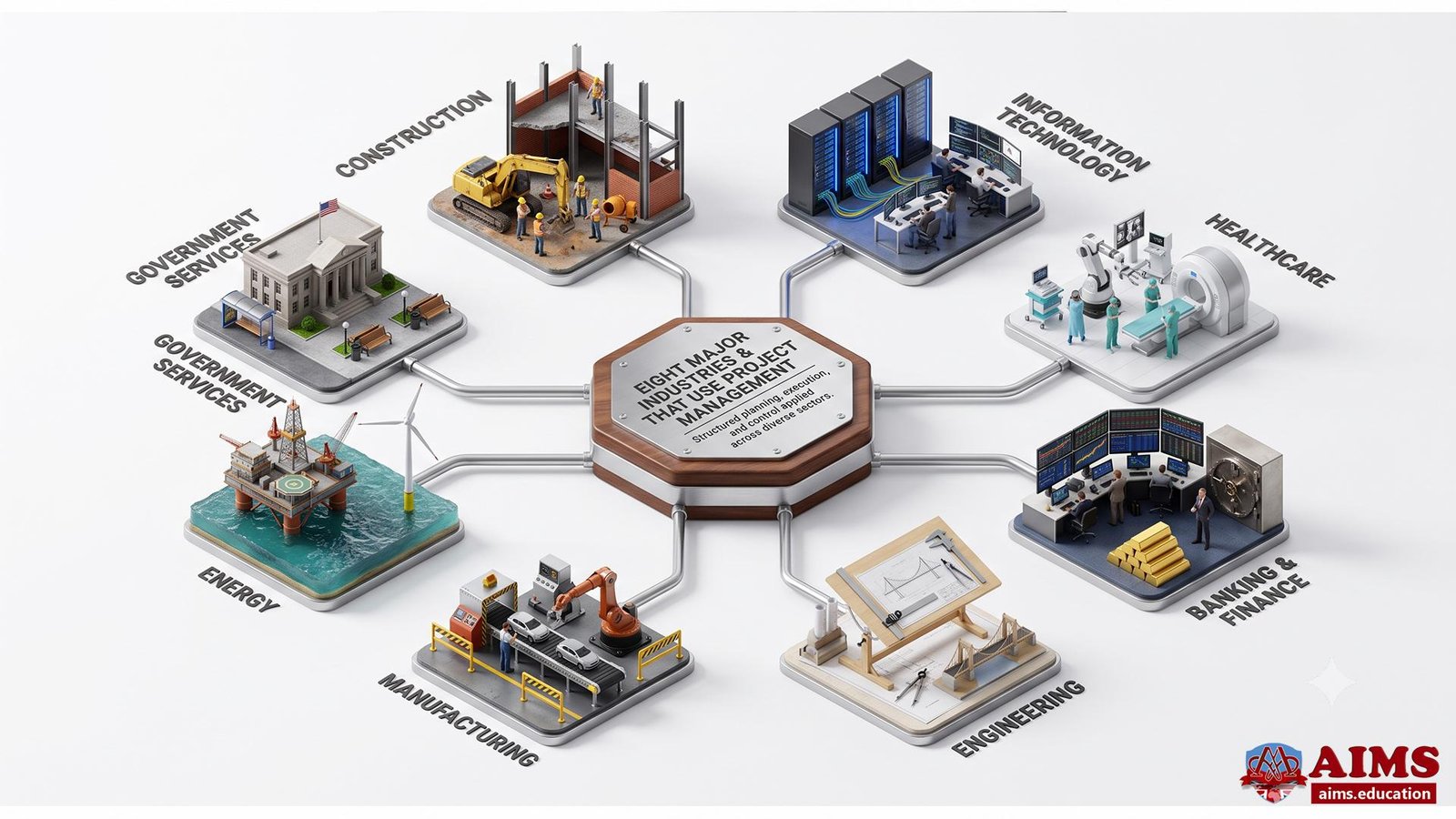
Eight Major Industries That Use Project Management
Industries use project management whenever they must deliver a unique result through coordinated people, resources, decisions, and deadlines. The following sectors illustrate how the discipline changes according to the work being delivered.
- Construction
- Information technology
- Healthcare and medical services
- Banking and finance
- Engineering
- Manufacturing
- Energy, including oil and gas
- Government and public services
1. Project Management in Construction
Construction project management plans and controls the delivery of physical structures and infrastructure from design through handover. It requires close coordination because design decisions, permits, materials, labour, equipment, contractors, weather, and site conditions influence one another.
- The project manager develops an integrated schedule that reflects design, procurement, site preparation, construction, inspection, and commissioning.
- The team controls contracts, variations, safety requirements, quality inspections, and progress payments.
- Changes must be assessed carefully because completed physical work can be expensive or unsafe to reverse.
Construction Project Management Example
Meridian Build is delivering a twelve-storey office building within an eighteen-month programme.
- The project manager divides the work into design, approvals, groundworks, structure, building services, finishes, testing, and handover.
- Long-lead materials are ordered early, while contractor responsibilities and interface dates are recorded in the master schedule.
- Weekly site reviews compare actual progress, cost forecasts, safety observations, and quality findings with the approved plan.
- When a design change affects electrical routing, the manager assesses time, cost, safety, and downstream work before approval.
Structured control helps the team protect safety, minimise rework, and complete the building in an orderly sequence.
2. Project Management in Information Technology
Project management in information technology coordinates the design, development, testing, deployment, and adoption of digital products and systems. IT projects often face changing user expectations, complex integrations, cybersecurity concerns, and uncertain technical solutions.
- Requirements may be refined through prototypes, demonstrations, user feedback, and iterative testing.
- Project managers coordinate developers, analysts, security teams, vendors, users, and operational support staff.
- Release planning must consider system dependencies, data migration, training, support, and recovery arrangements.
Information Technology Project Example
NovaRetail plans to replace its customer portal within six months.
- The product owner prioritises essential functions, while the project manager establishes governance, budget, milestones, and dependencies.
- The delivery team develops the portal in short iterations and demonstrates completed features to users.
- Security testing, performance testing, data migration, and staff training are planned before the final release.
- After launch, the team monitors incidents and user behaviour before closing the project and transferring support to operations.
Iterative delivery allows useful feedback while formal governance protects security, cost, integration, and business continuity.
3. Project Management in Healthcare and Medical Services
Healthcare project management coordinates changes to clinical services, facilities, technology, equipment, and patient-care processes. Medical and healthcare work should not be treated as completely separate project sectors because both depend on clinical safety, privacy, professional workflows, and continuity of care.
- Project decisions must consider patient safety and the effect of change on doctors, nurses, administrators, technicians, and patients.
- Implementation plans normally require clinical validation, privacy controls, training, phased transition, and operational support.
- Success is measured not only by completion, but also by safe adoption and improved service performance.
Healthcare Project Management Example
Greenfield Hospital is introducing an electronic patient-record system across four departments.
- The project manager maps existing clinical and administrative workflows with staff representatives.
- The system is configured and tested using controlled scenarios before any patient data is migrated.
- Training is scheduled by role, and the deployment is phased so that clinical services remain available.
- After go-live, the team monitors safety concerns, data quality, user support requests, and adoption levels.
Careful transition management protects patients while helping staff adopt the new system with confidence.
4. Project Management in Banking and Finance
Project management in banking and finance governs initiatives that affect financial products, customer data, payment processes, technology, compliance, and operational control. These projects require disciplined approval, testing, documentation, and auditability because errors can create financial, legal, security, and reputational consequences.
Professionals can study the field in greater depth through this explanation of project management applications in finance and banking.
- The project manager aligns business, technology, risk, compliance, legal, operations, and vendor teams.
- Data migration and system changes require reconciliation, security testing, access control, and recovery planning.
- Regulatory or policy deadlines may limit flexibility, making governance and escalation especially important.
Banking Project Management Example
Crescent Bank is introducing digital customer onboarding for personal accounts.
- The project team defines customer journeys, identity checks, approval rules, data fields, and exception handling.
- Technology and compliance teams test security, privacy, fraud controls, and regulatory requirements.
- A pilot is released to a limited customer group, and defects are prioritised before wider deployment.
- Operational teams receive procedures, training, support arrangements, and performance measures before launch.
Strong governance enables innovation without weakening customer protection, control, or regulatory accountability.
5. Project Management in Engineering
Engineering project management integrates technical disciplines to create, modify, or improve a product, facility, system, or process. The project manager must connect engineering requirements with schedule, cost, procurement, quality, testing, and stakeholder decisions.
Because technical depth can influence career progression, aspiring professionals may also explore the requirements of an engineering project management career.
- Requirements and interfaces must be controlled across mechanical, electrical, civil, software, or other engineering disciplines.
- Design reviews, verification, configuration management, and testing reduce technical failure and uncontrolled change.
- The manager must distinguish between technical decisions owned by engineers and integration decisions owned by project governance.
Engineering Project Management Example
AeroWorks is developing an automated inspection system for a production facility.
- The team translates operational needs into measurable technical and performance requirements.
- Mechanical, electrical, software, and safety workstreams develop coordinated designs through scheduled reviews.
- A prototype is tested before full-scale equipment is manufactured and installed.
- Final acceptance depends on performance tests, safety approval, documentation, and operator training.
Integrated engineering control reduces interface failures and ensures that the complete system performs as intended.
6. Project Management in Manufacturing
Manufacturing project management delivers changes to products, production systems, factories, equipment, quality processes, and supply networks. The central challenge is often introducing change without causing unacceptable disruption to ongoing operations.
- Project plans must consider equipment procurement, factory layout, installation, validation, workforce training, and production ramp-up.
- Quality, capacity, maintenance, supply availability, and process stability are important acceptance criteria.
- Lean methods can improve flow and reduce waste, but major capital work may still require detailed predictive planning.
Manufacturing Project Management Example
BrightForm Packaging is installing a new automated production line.
- The project manager confirms output targets, quality standards, layout requirements, utilities, and shutdown windows.
- Equipment design and supplier milestones are reviewed before delivery to the factory.
- Installation occurs during a planned shutdown, followed by safety checks, trial runs, and operator training.
- The line enters controlled production, and performance is monitored until output and quality targets are stable.
Phased commissioning helps the organisation increase capacity without sacrificing safety, quality, or operational continuity.
7. Project Management in Energy, Oil, and Gas
Energy project management coordinates complex, capital-intensive work involving power, fuel, infrastructure, natural resources, and environmental controls. Projects may operate across remote locations, long supply routes, demanding technical interfaces, and strict safety requirements.
- Front-end planning and stage approvals help test technical, commercial, environmental, and financial feasibility before major commitments.
- Contractor management, logistics, permits, safety systems, and commissioning require detailed coordination.
- Risk planning must account for environmental harm, supply disruption, weather, market conditions, and geopolitical uncertainty.
Energy Project Management Example
NorthGrid Energy is developing a utility-scale solar facility connected to an existing power network.
- The project manager coordinates land access, environmental review, design, permits, procurement, and grid-connection requirements.
- Panels, transformers, and control equipment are ordered according to design maturity and delivery lead times.
- Construction progress is monitored alongside safety, quality, weather, cost, and contractor performance.
- The completed facility undergoes inspection, testing, grid synchronisation, and formal operational handover.
Integrated planning connects technical delivery with environmental responsibility, safety, commercial control, and reliable commissioning.
8. Project Management in Government and Public Services
Public-sector project management delivers infrastructure, digital services, policy initiatives, and community improvements under formal accountability. These projects may involve multiple agencies, procurement rules, elected decision-makers, public scrutiny, accessibility requirements, and diverse stakeholder interests.
- Objectives must be translated into measurable public outcomes rather than internal activity alone.
- Governance should clarify who approves funding, scope, procurement, policy decisions, and acceptance.
- Communication must address officials, suppliers, service users, employees, communities, and oversight bodies.
Government Project Management Example
CityWorks Council is replacing a paper-based permit process with an online service.
- The project team consults residents, businesses, reviewers, accessibility specialists, and technical staff.
- Process rules are simplified before the digital system is configured and tested.
- The council pilots the service, measures completion time and user difficulties, and corrects problems before full release.
- Public guidance, staff training, support procedures, and performance reporting are introduced with the new service.
Public-sector project management balances efficient delivery with transparency, accessibility, compliance, and public value.
Project Management Methodologies by Industry
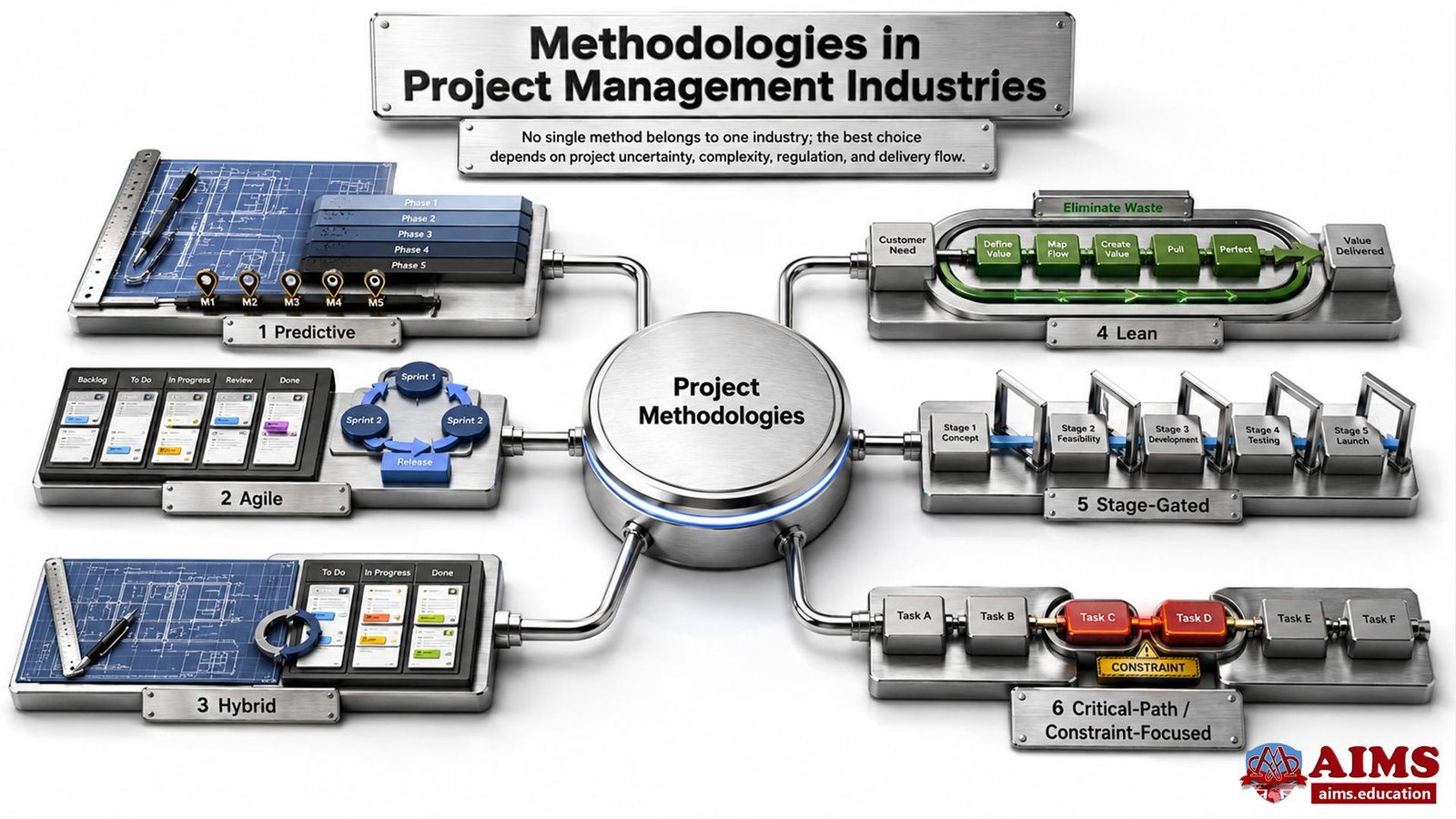
No single methodology belongs exclusively to one industry. The correct approach depends on requirement stability, technical uncertainty, compliance, delivery sequence, stakeholder access, and the cost of change. Organisations should therefore compare project management methodologies before selecting or combining them.
- Predictive methods: These suit work with stable requirements, defined sequencing, formal approvals, and high change costs, such as many construction and infrastructure projects.
- Agile methods: These suit work where solutions can be developed incrementally and frequent user feedback is valuable, such as many software and digital-service projects.
- Hybrid methods: These combine predictive governance with adaptive delivery. A bank, hospital, or government agency may use formal approval gates while developing technology iteratively.
- Lean methods: These focus on value, flow, efficiency, and waste reduction, making them useful in manufacturing, operations improvement, and service redesign.
- Stage-gated methods: These require evidence and approval before further investment, which is useful in engineering, product development, energy, and regulated environments.
- Critical-path or constraint-focused methods: These help teams manage dependencies and scarce resources in schedule-sensitive physical or technical projects.
The practical rule is simple: tailor the method to the project, not merely to the industry label.
Transferable and Industry-Specific Project Management Skills
Project managers can transfer many core competencies between industries, but they must learn the new sector’s language, risks, regulations, and operating model. The balance between transferable ability and specialist knowledge depends on the role’s technical responsibility and the consequences of poor decisions.
| TRANSFERABLE SKILLS | INDUSTRY-SPECIFIC KNOWLEDGE |
|---|---|
| Scope definition and requirements management | Sector terminology, workflows, products, and technical standards |
| Schedule, cost, resource, and procurement coordination | Regulatory, legal, safety, environmental, or privacy obligations |
| Risk, issue, change, and quality management | Typical failure modes, control systems, and acceptance practices |
| Stakeholder communication, negotiation, and leadership | Industry stakeholder expectations and decision-making authority |
| Governance, reporting, benefits, and lessons learned | Sector-specific data, performance measures, contracts, and technology |
Professionals should develop strong transferable project management skills while building enough domain knowledge to ask informed questions, recognise risk, and communicate with technical specialists.
Can Project Managers Move From One Industry to Another?
Yes, project managers can move between industries when they can demonstrate transferable delivery competence and a credible plan for learning the new sector. Movement is usually easier when the projects share similar technology, customers, regulations, suppliers, or delivery environments.
A project manager changing sectors should:
- Map previous achievements to the new role’s project types, risks, stakeholders, and outcomes.
- Learn the sector’s terminology, operating model, regulations, common contracts, and performance measures.
- Identify where a technical specialist must own decisions that exceed the manager’s professional competence.
- Use interviews, mentoring, professional reading, and small assignments to close knowledge gaps.
- Show evidence of adaptation rather than attempting to copy every process from the previous industry.
For example, an IT project manager moving into banking may already understand software delivery but must learn financial controls, audit requirements, data sensitivity, and operational resilience.
Which Industry Is Best for a Project Management Career?
There is no universally best industry for project managers. The strongest choice depends on your background, interests, location, preferred work environment, tolerance for risk, and willingness to gain sector knowledge. Salary and vacancy levels also vary by country, experience, qualification, and economic conditions.
Consider the following decision criteria:
- Existing expertise: A technical, clinical, financial, construction, or operational background can provide immediate credibility.
- Preferred project output: Some professionals prefer physical assets, while others prefer technology, services, policy, or organisational change.
- Delivery environment: Construction and energy may involve sites and contractors, while IT may involve remote, iterative, cross-functional work.
- Regulatory intensity: Healthcare, finance, energy, and government often require stronger compliance knowledge and documentation.
- Career flexibility: Broad business, technology, change, and leadership experience may support movement across several sectors.
- Learning commitment: Senior or highly technical roles often require deeper industry knowledge than general coordination roles.
Professionals seeking structured development can compare online project management certification pathways or pursue a more comprehensive diploma-level project management qualification, depending on their experience and career objective.
Common Mistakes in Industry-Specific Project Management
The most common mistake is applying a familiar process without understanding the project’s actual environment. Standard methods are useful, but they must be interpreted through the sector’s risks, stakeholders, technical work, and governance requirements.
- Starting delivery before objectives, scope, acceptance criteria, and decision authority are clear.
- Assuming technical specialists and project managers have the same responsibilities.
- Ignoring regulations, safety obligations, privacy controls, or contractual requirements until late in the project.
- Selecting agile or predictive methods by fashion rather than project characteristics.
- Underestimating operational disruption, training, adoption, support, and handover.
- Reporting activities without explaining progress toward deliverables, benefits, and risk reduction.
- Copying a previous industry’s templates without adapting terminology, controls, or performance measures.
- Allowing changes to enter the project without evaluating their effect on time, cost, quality, risk, and value.
Effective project managers use standards as a foundation, then tailor governance and delivery to the real conditions of the project.
Final Words
Project management is used across construction, IT, healthcare, finance, engineering, manufacturing, energy, government, and many other sectors. Its core purpose remains stable: organise temporary work so that people can deliver a defined result responsibly. However, project methods, risks, controls, technical knowledge, and stakeholder expectations vary considerably.
For this reason, successful project managers combine transferable planning and leadership capabilities with industry awareness. They do not need to become the chief technical expert in every field, but they must understand enough to integrate specialist work, challenge assumptions, manage risk, and support sound decisions.
Frequently Asked Questions
What industries use project management?
Project management is used in nearly every industry that delivers temporary, coordinated work. Major examples include construction, engineering, information technology, healthcare, banking and finance, manufacturing, energy, government, telecommunications, transport, education, consulting, and creative services.
Which industries have the highest demand for project managers?
Demand varies by country, investment cycle, regulation, technology adoption, and economic conditions. Construction, IT, engineering, healthcare, finance, energy, manufacturing, and public infrastructure commonly require project managers, but no sector should be labelled universally highest without current local labour-market evidence.
How is project management applied in different industries?
Each industry uses project management to define outcomes, organise tasks, coordinate specialists, control time and cost, manage risk, communicate with stakeholders, and complete handover. The specific controls change according to the sector’s deliverables, regulations, technologies, and operational risks.
Is project management the same in every industry?
No. The core principles of planning, leadership, risk, communication, and control remain transferable, but terminology, regulations, technical processes, stakeholders, methodology, and acceptance criteria vary. A healthcare project, for example, requires different safeguards from a construction or software project.
Which industry is best for a project management career?
The best industry depends on your previous experience, interests, preferred project type, location, and willingness to learn sector-specific requirements. A professional with engineering experience may prefer technical projects, while another may be better suited to IT, finance, healthcare, or organisational change.
What are examples of projects managed in different industries?
Examples include constructing a hospital, launching banking software, installing a manufacturing line, migrating data to a cloud platform, introducing clinical equipment, developing an energy facility, automating an engineering process, or creating a digital government service.
Do project managers need industry-specific knowledge?
Yes, although the required depth varies by role. Project managers need enough sector knowledge to understand risks, regulations, workflows, stakeholders, and acceptance criteria. Technical specialists should still own decisions that require licensed or highly specialised professional judgement.
Can project managers move from one industry to another?
Yes. Core delivery skills can transfer, especially when project types or technologies overlap. The manager must still learn the new sector’s terminology, regulations, risks, controls, and operating model, then demonstrate how previous achievements apply to the new environment.
What project management skills are transferable across industries?
Transferable skills include scope definition, scheduling, budgeting, resource coordination, risk management, change control, stakeholder communication, negotiation, leadership, procurement, quality management, governance, reporting, problem-solving, and benefits tracking.
How does project management differ between IT and construction?
IT projects can often develop and revise outputs iteratively, while construction projects usually follow stronger physical sequencing and face higher rework costs. IT may favour agile or hybrid delivery, whereas construction commonly relies on predictive planning, contracts, site coordination, safety controls, and formal inspections.
Which project management methodologies are used in different industries?
Industries use predictive, agile, hybrid, lean, stage-gated, critical-path, and other approaches. Method selection should reflect uncertainty, requirement stability, change cost, regulation, stakeholder access, and delivery sequence rather than an industry label alone.
Why is project management important in healthcare, finance, and engineering?
These sectors combine specialised work with significant consequences. Healthcare projects must protect patients, finance projects must protect money, data, and compliance, and engineering projects must control technical interfaces and performance. Project management integrates these demands with time, cost, quality, risk, and stakeholder decisions.
Develop Industry-Ready Project Management Expertise with AIMS’ Project Management Academy
Since 2005, AIMS’ Project Management Academy has supported a global learner community through internationally accredited, career-focused qualifications. Its internationally standardised curriculum is delivered by qualified faculty through industry-oriented teaching, practical skill development, 3D interactive learning content, and real-world case studies. This educational content, study material, and curriculum are collaboratively developed and rigorously peer-reviewed by an academic board of qualified industry practitioners. Understanding project management across industries strengthens professional judgement and career mobility. Explore AIMS’ practical and flexible project management programmes.