
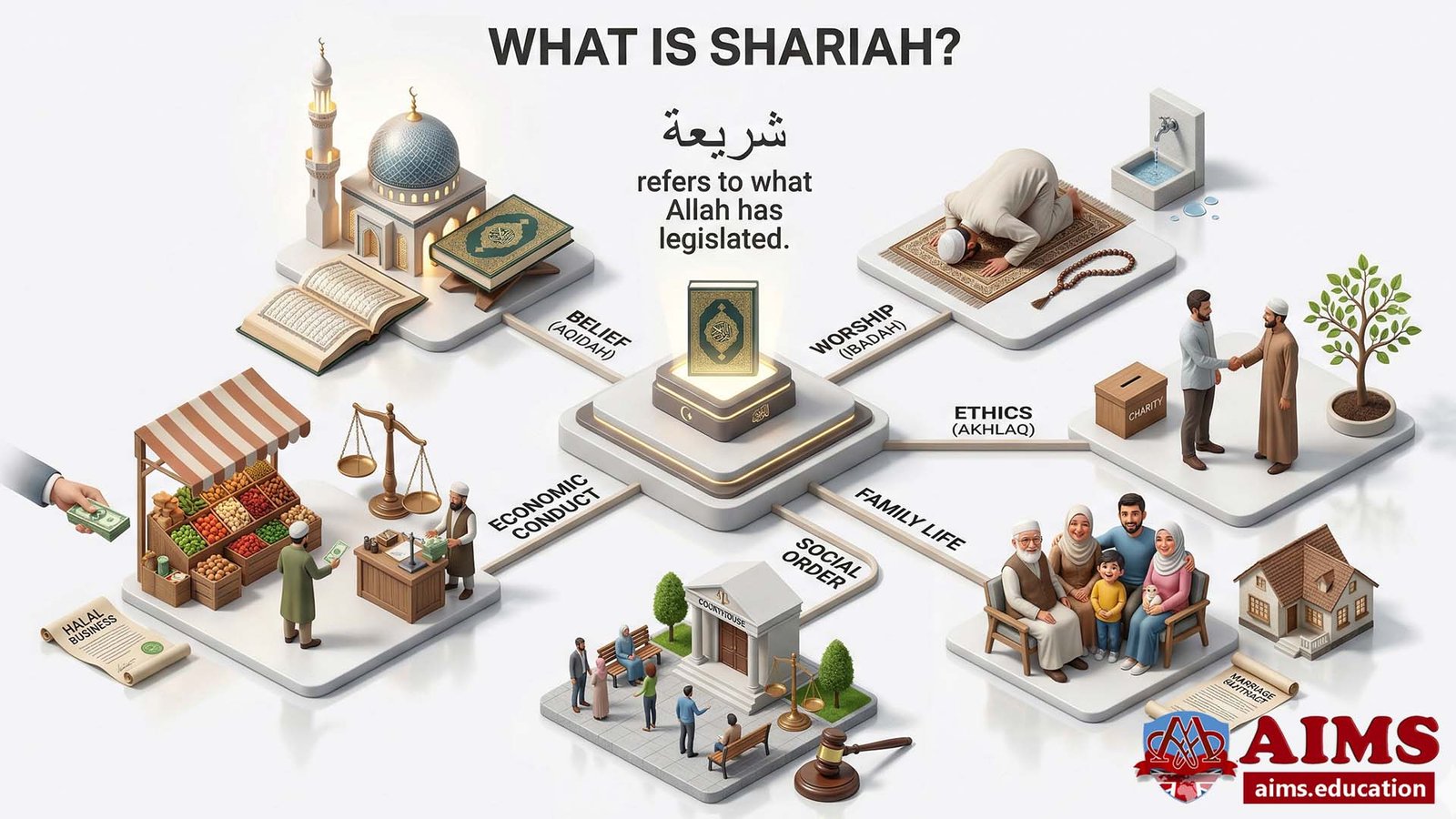
Shariah is the revealed framework that guides belief, worship, ethics, family life, social order, and economic conduct in Islam. Many readers encounter it through related expressions such as Shariah law, Islamic law, Muslim law, Sharia, Shari’ah, or the Arabic term شريعة. All of these point toward the same foundational reality, although they are not always used with the same precision. At its core, Shariah means the divinely guided path that directs human life toward obedience, justice, mercy, and balance.
This foundation matters greatly in Islamic Banking and Finance. Lawful trade, valid contracts, ethical investment, and accountability for wealth do not stand apart from revelation. They grow directly out of the sources of Shariah. Once that relationship becomes clear, it also becomes clear why riba is prohibited, why contracts must be transparent, and why economic activity is treated as a moral responsibility as well as a commercial act.
In classical understanding, Shariah is not a narrow legal code. It is a complete way of life. It governs matters that are personal and public, spiritual and material, individual and social. That wider scope is essential for any serious understanding of Islamic law.
Shariah (Islamic Law): Definition and Scope
Shariah literally means a way or a clear path. In Arabic usage, it also conveys the image of a well trodden path to water, which suggests a path that sustains life. In Islamic terminology, Shariah refers to what Allah has legislated for His servants in matters of religion and life. That is why the meaning of Shariah cannot be reduced to state enforcement or court rulings alone.
“Today I have perfected your way of life (din) for you, and completed My favour upon you, and have chosen Islam as your way of life.”
Al-Quran, Surah Al-Ma’idah Verse-3.
This statement establishes completeness. Shariah is presented as a perfected way of life, not as a temporary or fragmented arrangement. It covers worship, morals, human relations, property, justice, and public responsibility. In that sense, Islamic law is inseparable from faith, because it grows from revelation rather than from social convenience alone.
“We have only sent you are a mercy for all creation.”
Al-Quran, Surah Al-Anbiya, Verse 107.
This verse frames the Prophetic Mohammad (صلى الله عليه وسلم)’s mission in terms of mercy. It also helps explain why Shariah must be studied as guidance for human welfare, not as a harsh list of isolated commands.
1. Shariah Law and Its Practical Scope
The expression Shariah law is common in English, and it usually refers to the legal framework derived from Islam. That phrase is widely understood, but it can sound narrower than the original concept. Shariah law includes rules and rulings, yet it also includes moral duties, spiritual accountability, and standards of conduct that shape ordinary life. A Muslim turns to Shariah law in prayer, marriage, inheritance, charity, trade, and public dealings.
That is why Shariah law covers several broad areas. It covers acts of worship such as prayer and fasting. It covers family matters such as marriage, divorce, and inheritance. It covers social dealings such as honesty, fairness, and trust. It also covers economic conduct such as lawful earning, valid contracts, and proper use of wealth. When understood this way, Shariah law becomes a complete framework for living under divine guidance.
2. Islamic Law as a Complete Way of Life
Islamic law is the most common academic English term for Shariah. It is useful because it clearly signals the legal dimension of Islam, but it must still be understood in a full religious context. Islamic law is not limited to litigation or formal legislation. It includes values, duties, rights, and obligations that organize human life under revelation.
Islamic law therefore governs personal, familial, religious, social, moral, political, economic, and business matters. It does not divide life into sacred and non sacred compartments. Instead, Islamic law treats all human action as potentially answerable to Allah. This broader understanding is especially important for readers who approach Islamic Banking and Finance through technical products but have not yet understood the legal and ethical worldview behind them.
“When Allah and His Messenger have decreed a matter, it is not for any believing man or believing woman to have a choice in their affairs. And whosoever disobeys Allâh and His Messenger has gone astray into clear error.”
Al-Quran, Surah Al-Ahzab, Verse 36.
This verse shows why Islamic law carries binding force for believers. Its authority is rooted in divine command, not in human preference alone.
3. Muslim Law in Historical and Legal Usage
Muslim law is another expression that readers often encounter, especially in legal history and South Asian jurisprudence. In many contexts, Muslim law refers to the body of law applied to Muslims in matters such as marriage, divorce, gifts, and inheritance. In broad usage, Muslim law overlaps heavily with Shariah and Islamic law. Still, Muslim law can sometimes sound more descriptive of the law applied to Muslims than of the divine source of that law.
That distinction is useful. Shariah refers to the revealed path itself. Islamic law is the most common English academic expression for that revealed legal framework. Muslim law often reflects legal usage shaped by courts, colonial systems, or personal law traditions. Readers exploring related rulings can also see how this language appears in matters such as
What is Hiba in Muslim Law (Islamic gift).
4. شريعة, Sharia, and Shari’ah in Transliteration
The Arabic word شريعة preserves the original form of the term. In English, readers may search for Sharia or Shari’ah. These are spelling variations, not separate ideas. A reader who searches Sharia is looking for the same revealed framework. A reader who writes Shari’ah is also referring to the same legal and moral path. The Arabic term شريعة simply preserves the word in its original script.
Using these forms naturally is helpful because search behavior differs across readers. Some are introduced to Sharia through news media. Others encounter Shari’ah in academic writing. Many readers from Muslim backgrounds are comfortable with شريعة in Arabic. A clear educational explanation should recognize all of these paths without creating confusion.
Sources of Islamic Law (Shariah)
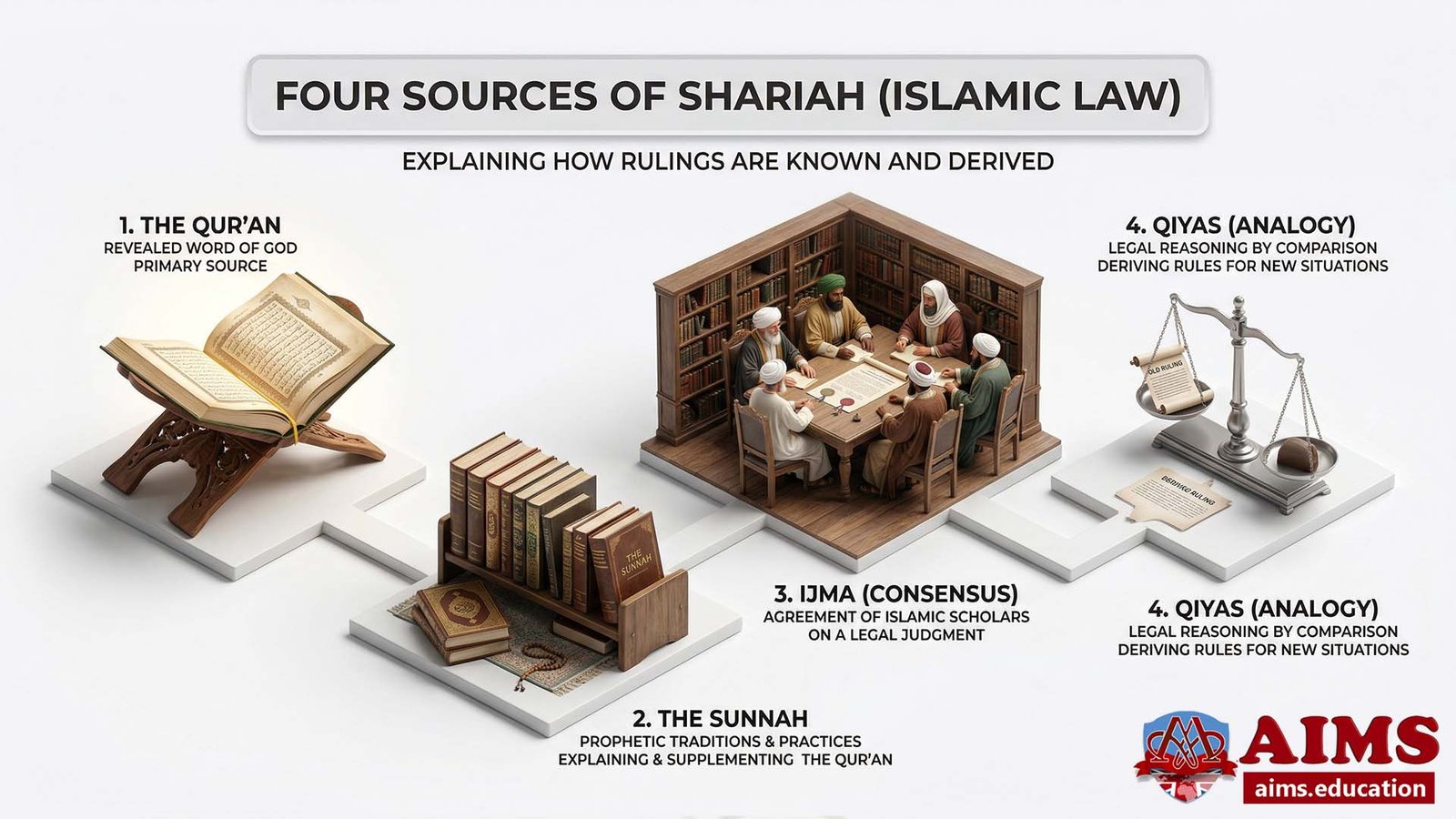
The sources of Islamic law explain how rulings are known and derived. In the classical structure presented here, there are four main sources of Shariah: the Qur’an, the Sunnah, Ijma, and Qiyas. These are often called the four sources of Shariah. The first two are primary and revealed. The last two are interpretive and derivative. This order matters because Islamic law begins with revelation and only then moves to scholarly reasoning.
For anyone asking what is Shariah in practical terms, the answer must include these sources. Shariah is not formed by unstructured opinion. It is formed through a disciplined method rooted in the revealed texts and guided by juristic principles.
1. The Qur’an: Primary Source of Shariah
The Qur’an is the first and highest source of Shariah. It is the direct word of Allah revealed to Prophet Muhammad, peace be upon him, through Angel Jibril. Every other source of Islamic law must remain in agreement with the Qur’an. If the Qur’an speaks clearly on a matter, that ruling has priority.
“So we have made it easy in their tongues that they may be mindful”.
Al-Quran, Surah Az-Zumar, Verse 28.
The Qur’an provides commands, moral principles, legal boundaries, and broad guidance for life. It addresses worship, family relations, charity, commerce, inheritance, justice, and public responsibility. It is therefore the foundation of both Shariah law and Islamic law in every serious legal discussion.
A simple classroom example shows its role. If the Qur’an prohibits riba, then no commercial convenience can make riba lawful. If the Qur’an establishes inheritance shares, then those shares cannot be altered by personal preference. In this way, the Qur’an anchors Muslim law to revelation.
2. The Sunnah: As a Second Source of Shariah
The Sunnah is the second source of Shariah. It consists of the sayings, actions, approvals, and practical example of Prophet Muhammad, peace be upon him. The Qur’an provides the foundation, while the Sunnah explains, clarifies, and demonstrates how that guidance is lived. That is why the phrase Qur’an and Sunnah as legal sources is central to Islamic legal method.
The Sunnah gives detail where the Qur’an states principles in a more general form. Prayer is the simplest example. The Qur’an commands prayer, but the Sunnah explains how prayer is performed. The same pattern appears in charity, family relations, contracts, and judicial conduct. Through the Sunnah, Shariah law becomes visible in lived practice.
Hadith literature preserves this Prophetic guidance. Its importance is not merely historical. It is legal, moral, and practical. Because of that, Islamic law cannot be understood by reading the Qur’an in isolation from the Sunnah.
Consider a clear example:
- Farid wants to open a small trading business.
- He learns from the Qur’an that honesty, fairness, and lawful earnings are required.
- He learns from the Sunnah how truthful disclosure, fair measurement, and proper conduct in trade are practiced.
- He then structures his conduct according to both revealed principle and Prophetic example.
This example shows how the Sunnah translates broad guidance into lived action.
3. Consensus (Ijma) in Shariah
Consensus (Ijma) in Shariah is the third source. It refers to the consensus of qualified Muslim jurists on a legal matter. Ijma becomes important when a case requires settled scholarly agreement after the revealed sources have been consulted. Its role is not to replace the Qur’an or Sunnah. Its role is to preserve stability and authoritative interpretation within the legal tradition.
“If anything comes to you for decision, according to the book of Allah, if anything comes to you which is not in the book of Allah, then look to the Sunnah of the Prophet Mohammad (صلى الله عليه وسلم), if anything comes to you which is not in the Sunnah of Prophet Mohammad (صلى الله عليه وسلم), then look to what people unanimously agrees upon”.
Hadith.
This wording captures the legal sequence clearly. Revelation comes first. The Prophetic example comes next. Consensus then helps settle issues that require collective scholarly confirmation.
Ijma also guards Muslim law from fragmentation. Without it, every difficult case could become a matter of isolated personal preference. In serious legal reasoning, Ijma helps preserve continuity in Islamic law.
4. Analogical Reasoning (Qiyas) in Shariah
Analogical reasoning (Qiyas) in Shariah is the fourth source. Qiyas applies the ruling of a known case to a new case because both share the same effective legal cause. It is therefore a disciplined form of comparison, not free speculation. Through Qiyas, Shariah remains connected to revelation while also addressing new realities.
This is especially important in finance, medicine, technology, and commercial practice. Modern cases often do not appear by name in early texts. Yet their legal character can still be assessed by comparing them to established rulings from the Qur’an, Sunnah, and Ijma.
“Judge upon the book of Allah, upon the Sunnah of the Prophet and if you do not find it in that, then use your personal opinion”.
Hadith
A simple finance example makes the process easier to understand:
- Amina is offered a financial product that guarantees fixed return without genuine trade risk.
- A jurist studies whether the substance of the arrangement resembles an interest based transaction.
- The jurist compares the effective cause of prohibition in known riba based dealings with the new structure.
- If the same cause is present, the ruling is extended through Qiyas.
This example shows how Qiyas helps Islamic law address new financial realities while preserving fidelity to the sources of Shariah.
Islamic Jurisprudence (Fiqh) vs. Shariah
The difference between Shariah and fiqh is one of the most important distinctions in Islamic legal studies. Shariah is divine in origin. Fiqh is the human understanding and application of Shariah. Put simply, Shariah is the revealed path, while fiqh is the juristic effort to derive rulings from that path.
This distinction matters because it explains why Islamic law can have schools of interpretation without changing its revealed foundations. The sources of Shariah remain constant, but fiqh can differ on subsidiary matters because human reasoning, evidence assessment, and method can differ.
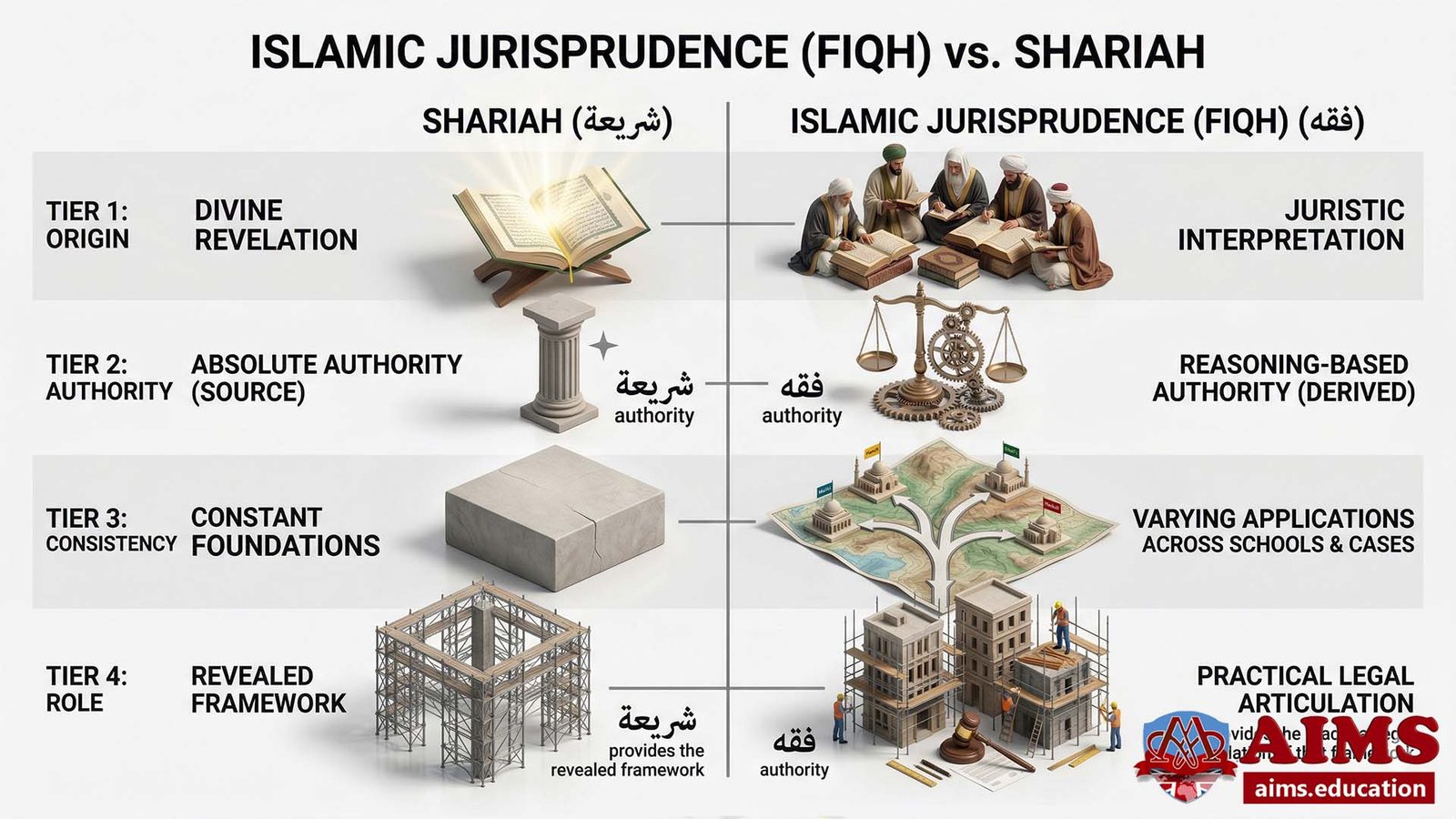
| Aspect | Shariah | Fiqh |
|---|---|---|
| Origin | It comes from divine revelation. | It comes from juristic interpretation. |
| Authority | Its authority is absolute in source. | Its authority depends on sound reasoning from the sources. |
| Change | Its foundations remain constant. | Its applications may vary across schools and cases. |
| Role | It provides the revealed framework. | It provides the practical legal articulation of that framework. |
This distinction is essential in Islamic Banking and Finance because practical rulings are usually expressed through fiqh, but their legitimacy comes from Shariah. Readers who want to build this foundation more systematically may benefit from the Islamic Banking and Finance Lectures and Study Notes and the Islamic Banking and Finance Blog.
Maqasid al-Shariah: The Objectives of Islamic Law
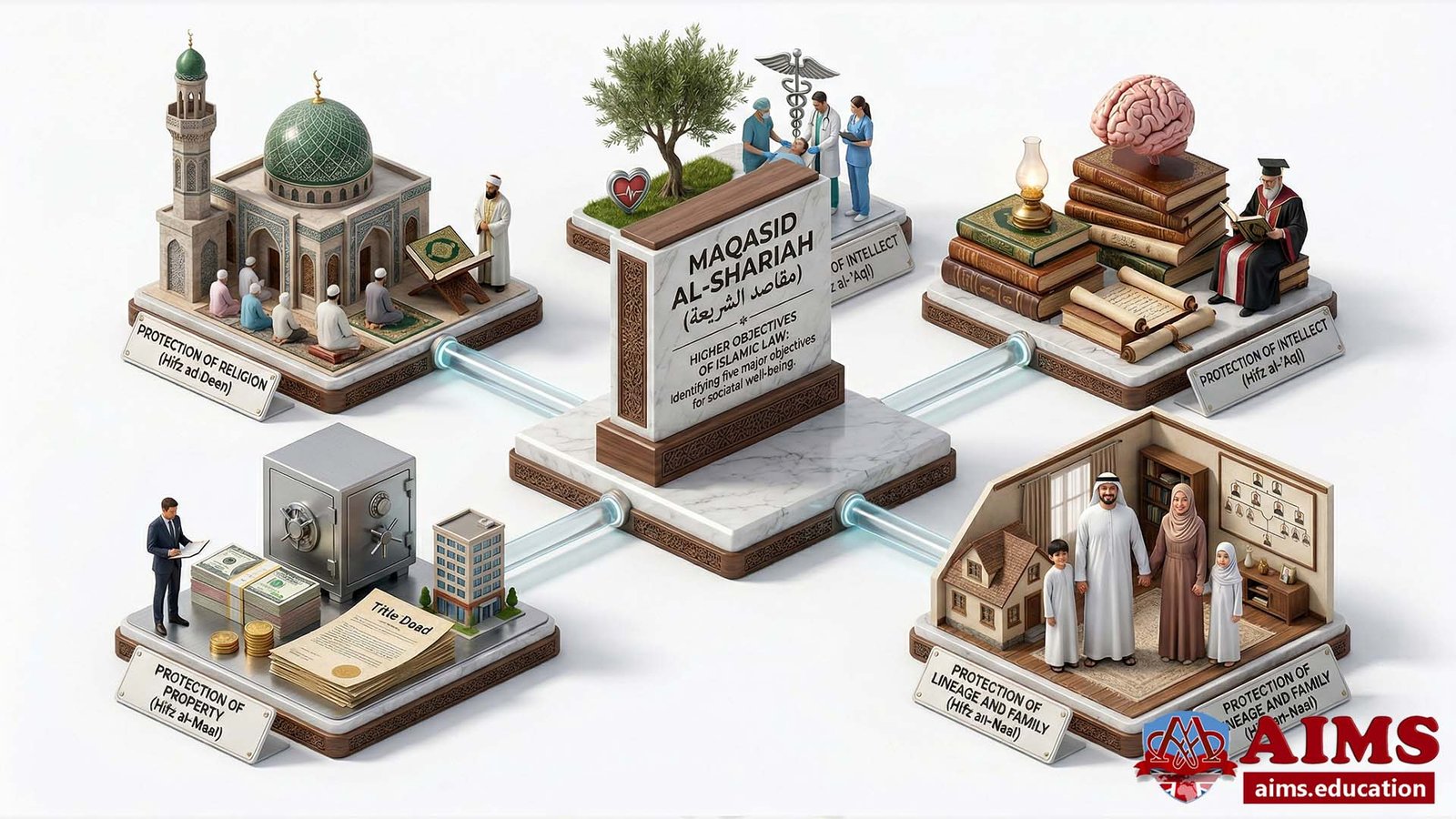
Maqasid al-Shariah refers to the higher objectives of Islamic law. These objectives explain the wisdom behind legal rulings and show that Shariah is directed toward human welfare under divine guidance. Even when a rule is specific, its purpose remains tied to justice, mercy, order, and protection.
Classical jurists commonly identify five major objectives:
- Protection of religion.
- Protection of life.
- Protection of intellect.
- Protection of lineage and family.
- Protection of property.
This framework helps readers understand why Islamic law prohibits exploitation, fraud, and unlawful gain. It also explains why wealth is treated as a trust. A Muslim is accountable not only for how wealth is spent, but also for how it is earned. That is a deeply important point for Islamic finance.
The same higher objectives also show why Shariah law is not an arbitrary system. Its rulings aim to preserve moral order and human welfare. In economic life, that means lawful earning, responsible spending, fair exchange, and protection of rights.
Shariah in Modern Context and Islamic Finance
Modern Islamic economics and finance grow directly out of these legal and moral foundations. Economic activity in Islam is lawful and often necessary, but it is not the final purpose of life. Wealth is a means, not an end. This sharply distinguishes Islamic law from systems that treat material gain as the highest good.
That distinction also explains why modern Islamic finance cannot simply copy conventional finance and rename it. Financial structures must comply with Shariah. That means they must avoid riba, avoid unlawful uncertainty, respect ownership, and reflect real legal substance. Readers exploring these applied questions can deepen their understanding through Riba in Islamic Banking and Finance and the Difference between Islamic and Conventional Banking.
Here is a simple example:
- Noor Holdings wants equipment worth $80,000.
- A conventional lender may simply advance funds on interest.
- An Islamic institution must examine whether the arrangement can be structured through a lawful sale, lease, or partnership form.
- The structure changes because Islamic law judges both outcome and legal form.
This example shows how Muslim law, Islamic law, and Shariah law all shape commercial structure when the framework is genuinely applied.
Those who want advanced study in this area may explore the online MBA in Islamic Banking and Finance by AIMS or the internationally recognized diploma in Islamic Finance offered by AIMS.
Common Misunderstandings About Shariah
Several common misunderstandings prevent readers from grasping the real nature of Shariah.
1. Misconception: Shariah Is Only a Criminal Code
This is one of the most common mistakes. Shariah is much broader. It includes worship, ethics, family life, contracts, property, charity, business, and public conduct. Criminal law is only one part of a far wider revealed system.
2. Misconception: Shariah and Fiqh Are Exactly the Same
They are related, but not identical. Shariah is divine revelation. Fiqh is the juristic understanding of that revelation. That distinction helps explain why legal schools may differ in some rulings while remaining within the same sources of Shariah.
3. Misconception: Muslim Law Is Just Culture
Culture can influence how communities live, but culture is not the same as revealed law. Muslim law in its serious legal sense must be grounded in the Qur’an, Sunnah, and juristic method, not in custom alone.
4. Misconception: Sharia, Shari’ah, and شريعة Refer to Different Systems
They do not. Sharia, Shari’ah, and شريعة are simply different ways of writing the same term. The concept remains the same revealed path of guidance.
5. Misconception: Shariah Cannot Address Modern Problems
This overlooks the role of Ijma, Qiyas, and juristic reasoning. Islamic law contains structured tools for dealing with new realities. That is why modern finance, commercial law, and social questions continue to be discussed within Shariah rather than outside it.
Frequently Asked Questions
1. What Is Shariah Law and How Does It Guide Muslim Life?
Shariah law is the divinely guided framework of Islam. It guides Muslim life by regulating worship, morals, family relations, commercial dealings, and social responsibilities according to revelation.
2. What Are the Four Primary Sources of Shariah (Islamic Law)?
The four sources of Shariah are the Qur’an, the Sunnah, Ijma, and Qiyas. The Qur’an and Sunnah are the primary revealed sources, while Ijma and Qiyas help derive rulings for new or disputed matters.
3. How Do Ijma and Qiyas Function in Deriving Shariah Rulings?
Ijma functions through qualified scholarly consensus. Qiyas functions through analogy by extending a known ruling to a new case because both share the same effective cause.
4. How Is Shariah Different From Islamic Jurisprudence (Fiqh) or Secular Law?
Shariah is divine revelation. Fiqh is the human understanding of that revelation. Secular law is a human legal system created through state or social authority. Islamic law may interact with state law, but its primary authority comes from revelation.
5. What Are Maqasid al-Shariah (Objectives of Islamic Law)?
Maqasid al-Shariah are the higher objectives of Islamic law. They include protection of religion, life, intellect, lineage, and property. They show that Shariah seeks justice, welfare, and moral order.
6. Are Islamic Law and Muslim Law the Same as Shariah?
In broad usage, yes, they usually refer to the same general framework. Still, Shariah is the most precise term because it emphasizes the revealed path itself, while Islamic law and Muslim law are English legal descriptions of that framework.
7. Why Is the Qur’an the Highest Source of Shariah?
The Qur’an is the direct word of Allah. All other sources of Islamic law must remain consistent with it. It provides the primary commands, principles, and foundations of Shariah.
Conclusion
Shariah is the revealed path that gives structure to belief, conduct, law, and economic life. Its sources, the Qur’an, Sunnah, Ijma, and Qiyas, form a coherent legal method that remains anchored to revelation while still allowing reasoned application. Once that framework is understood properly, Shariah no longer appears as a narrow legal code. It appears as a complete and purposeful system of guidance for just and lawful human life.
About the Author
AIMS’ Institute of Islamic Banking and Finance has been advancing Islamic Finance education since 2005, helping learners around the globe connect classical Fiqh with modern banking and finance through scholarly depth and industry expertise. It continues to support serious academic and professional growth in this field. Explore the AIMS’ Institute of Islamic Banking and Finance programs and learning opportunities.