
Whether crypto is halal or haram depends on the cryptocurrency, its purpose, and the way it is bought, held, or traded. Some scholars prohibit most cryptocurrencies because of excessive uncertainty, speculation, weak utility, and regulatory risk. Others permit selected digital assets when ownership is genuine, the project is lawful, settlement is immediate, and riba, maysir, deception, and harmful speculation are absent.
Therefore, the correct Islamic assessment is not a one-word judgment on blockchain technology. It is a Shariah review of the token, transaction, platform, ownership, purpose, and risk. This article explains the major scholarly views, evaluates Bitcoin and common crypto activities, and provides a practical framework for cautious Muslim investors.
Cryptocurrency and Islam: Why the Ruling Is Debated
Cryptocurrency is a digital asset whose ownership and transfer are recorded through cryptographic systems, usually on a distributed ledger called a blockchain. The question is cryptocurrency halal cannot be answered merely by asking whether the asset is digital. Islamic law also examines whether the asset has recognized value, a lawful purpose, clear ownership, deliverability, and a transaction free from prohibited elements.
The debate continues because the term cryptocurrency covers very different products. Bitcoin, stablecoins, utility tokens, governance tokens, meme coins, tokenized assets, and interest-bearing crypto accounts do not have identical structures. Likewise, buying an asset outright is not the same as trading a leveraged derivative based only on its price.
For this reason, a sound Islamic ruling should separate three questions:
- Is the digital asset itself permissible? Its purpose, rights, technology, issuance, and economic value must be examined.
- Is the transaction permissible? The sale must avoid riba, excessive gharar, maysir, deception, and the sale of something not properly owned.
- Is the investor’s conduct permissible? A lawful asset can still be used through gambling-like speculation, manipulation, fraud, or irresponsible risk-taking.
This distinction explains why scholars may reach different conclusions while applying the same broad principles governing Islamic banking and finance.
What Is Cryptocurrency?
Cryptocurrency is a digitally recorded unit of value that can be transferred between users without relying on a conventional bank to maintain the central transaction ledger. Most cryptocurrencies use blockchain or a related distributed-ledger system, although their design, governance, supply, and practical purpose vary considerably.

Cryptocurrencies commonly fall into several categories:
- Payment cryptocurrencies are designed mainly to transfer value, as Bitcoin originally was.
- Stablecoins aim to maintain a reference value, usually against a currency such as the US dollar.
- Utility tokens provide access to a platform, service, network function, or digital resource.
- Governance tokens may allow holders to vote on changes to a decentralized protocol.
- Asset-backed tokens represent a claim on an underlying asset, reserve, security, commodity, or contractual right.
- Meme and highly speculative tokens may depend mainly on attention, community promotion, or short-term price momentum.
The category matters because Shariah does not judge a token by its label alone. A token representing a lawful asset and enforceable right is fundamentally different from a token created primarily for manipulation or speculative resale.
How Does Cryptocurrency Work?
Cryptocurrency works by recording validated transfers on a digital ledger shared across a network. The network applies agreed rules to verify transactions, update balances, and prevent the same unit from being spent twice.
- A user instructs a wallet to transfer a specified amount to another address.
- The transaction is digitally signed with the sender’s private key.
- The network checks whether the signature is valid and whether the sender can transfer the asset.
- Validators or miners confirm the transaction according to the network’s consensus mechanism.
- The confirmed transaction becomes part of the ledger, and the recipient gains control of the transferred units.
Example of a Blockchain Transaction
Suppose Mariam sends a digital asset to Ahmed:
- Mariam enters Ahmed’s wallet address and the amount she intends to send.
- Her wallet signs the instruction using her private key.
- The network validates the transfer and records it on the blockchain.
- Ahmed can then control the received asset through his wallet credentials.
The blockchain record may be secure, but users still face exchange failure, wallet theft, coding defects, fraud, and loss of private keys.
Readers who need the technical and financial distinction can study how blockchain is applied within Islamic finance without assuming that every blockchain-based product is automatically Shariah-compliant.
Cryptocurrency as Money or Property in Islam
Islamic jurists first ask whether a cryptocurrency qualifies as recognized property, money, a tradable good, a contractual right, or another form of digital asset. This classification affects the rules that apply to ownership, exchange, possession, and profit.
Three concepts are particularly important:
- Mal refers broadly to property or wealth recognized as having lawful value and capable of ownership or exchange.
- Thaman refers to something functioning as money or a standard of value.
- ‘Urudh refers to goods or tradable property other than money.
Some scholars argue that widely used cryptocurrencies can qualify as digital property because people assign value to them, control them, transfer them, and accept liability for their loss. Other scholars reject this classification where the token has no dependable utility, recognized backing, stable monetary function, or legitimate institutional acceptance.
Non-tangibility alone does not make an asset haram. Modern financial systems recognize many valuable non-physical rights, balances, licenses, and claims. The stronger Shariah question is whether the claimed value is lawful, sufficiently defined, genuinely owned, deliverable, and protected from deception.
A notable institutional approach appears in the Securities Commission Malaysia Shariah Advisory Council resolutions on digital assets. In its 233rd and 234th meetings in June and July 2020, the SAC recognised SC-regulated digital currencies as mal, classified digital tokens as mal under ‘urudh, and permitted investment and trading in qualifying assets through a Digital Asset Exchange registered with the SC. The resolution expressly applies only to digital assets within the SC’s jurisdiction and subject to its stated Shariah requirements.
Is Crypto Halal or Haram? Two Main Scholarly Approaches
Scholars generally adopt either a restrictive approach or a conditional-permissibility approach. The difference usually concerns whether cryptocurrencies possess recognized Shariah value and whether current markets can control excessive uncertainty, speculation, manipulation, and unlawful use.
| APPROACH | CORE VIEW | MAIN REASONS | PRACTICAL RESULT |
|---|---|---|---|
| Restrictive | Most existing cryptocurrencies and their trading are impermissible or should be avoided. | Excessive gharar, gambling-like speculation, weak recognition as property or money, manipulation, fraud, and harmful volatility. | Buying, selling, or using ordinary cryptocurrencies is prohibited or suspended until their status becomes clearer. |
| Conditional permissibility | A digital asset may be permissible when its structure, purpose, rights, and transaction satisfy Shariah requirements. | Digital property can have recognized value, while prohibition attaches to unlawful tokens or transaction features rather than the technology itself. | Selected spot purchases and genuine ownership may be allowed after token, platform, contract, and risk screening. |
Why Some Islamic Scholars Consider Crypto Haram
Some scholars consider crypto haram because current cryptocurrency markets often combine uncertain value, extreme speculation, weak consumer protection, and transactions that do not transfer genuine ownership. They also question whether many tokens constitute recognised wealth under Shariah.
Restrictive rulings are strongest where a token has no credible use, promoters control the price, buyers expect profit only from later buyers, or the platform uses leverage, interest-bearing finance, derivatives, or deceptive marketing.
Why Some Scholars Consider Cryptocurrency Halal
Some scholars consider selected cryptocurrencies permissible because a digital asset can possess lawful utility, market value, controllable ownership, and transferability even without a physical form. Under this approach, the default permissibility of commercial activity remains relevant unless a prohibited feature is established.
Conditional permissibility normally requires a lawful project, transparent issuance, identifiable rights, genuine possession, a valid sale, and avoidance of riba, maysir, fraud, and excessive gharar. The ruling is therefore attached to the specific asset and transaction, not to the word crypto alone.
Named Scholarly and Institutional Positions on Cryptocurrency
Contemporary rulings differ in scope, reasoning, jurisdiction, and the type of digital asset examined. The following positions are attributed views and should not be presented as a universal scholarly consensus.
Mufti Taqi Usmani and Jamia Darul Uloom Karachi
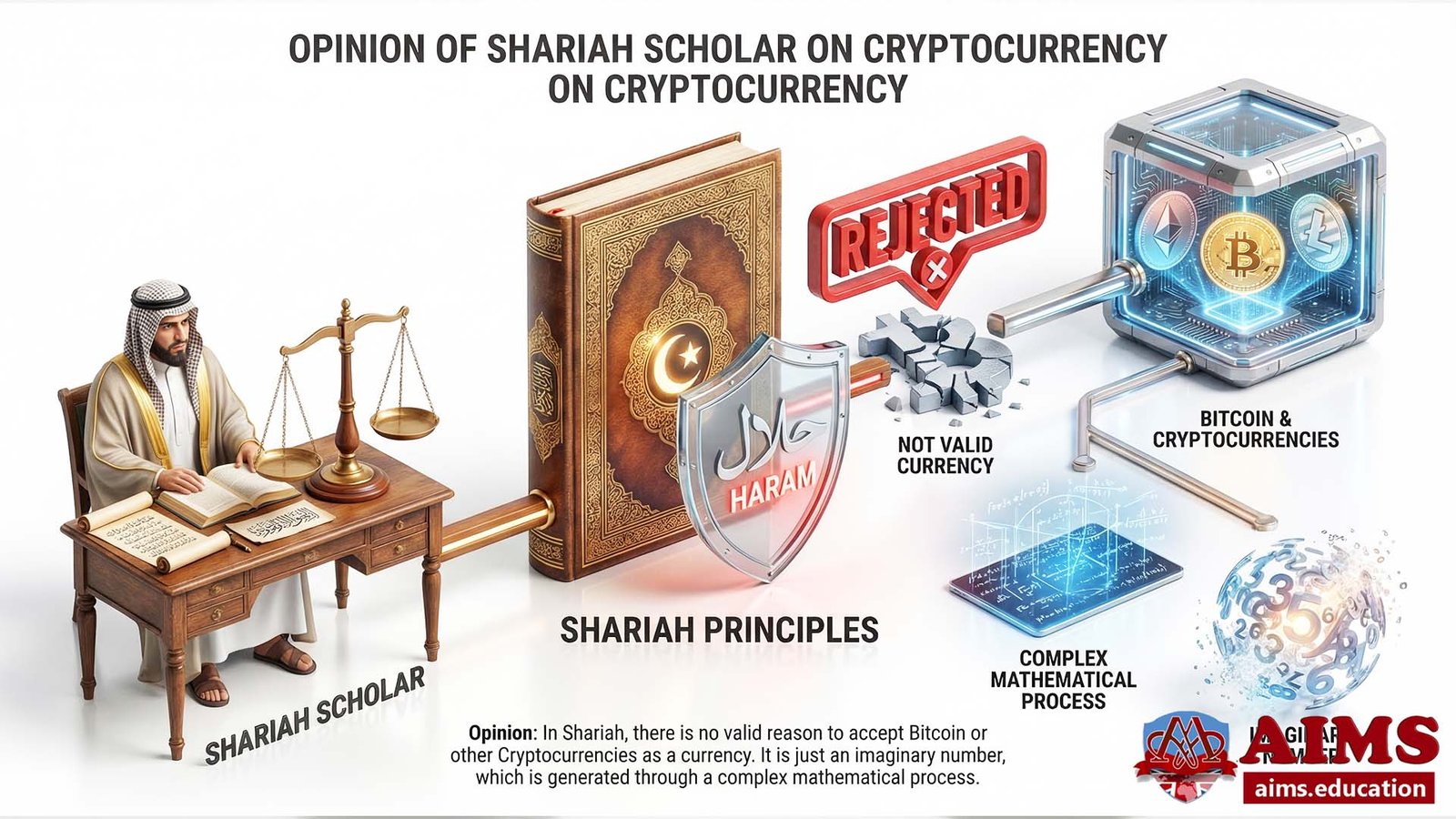
“Currencies are originally a medium of exchange, and making them a tradable commodity for profit earning is against the philosophy of Islamic economics. In Shariah, there is no valid reason to accept Bitcoin or other cryptocurrencies as a currency. It is just an imaginary number, which is generated through a complex mathematical process. It is purchased for gharar or speculation and used in illegal or unlawful transactions.”
This fatwa, dated June 10, 2026, was issued by Darul Ifta at Jamia Darul Uloom Karachi and signed by Mufti Muhammad Taqi Usmani and five other scholars. It responded specifically to questions concerning books and an online course purchased using cryptocurrency.
Mufti Shawki Allam and Egypt’s Dar al-Ifta
In an official ruling published on January 2, 2018, Egypt’s then Grand Mufti, Dr Shawki Allam, stated:
“Here is my fatwa on cryptocurrency, as today’s widely asked questions are: is crypto halal or is crypto haram, or is crypto trading halal or haram? In my opinion, trading in cryptocurrency is haram. This is because it is not approved by legitimate bodies, such as the treasury departments of states, as an acceptable instrument of exchange. Such currencies facilitate contraband trade and money laundering, and they amount to gambling.”
Türkiye’s Directorate of Religious Affairs
Türkiye’s High Board of Religious Affairs expressed a restrictive position on cryptocurrency trading, stating:
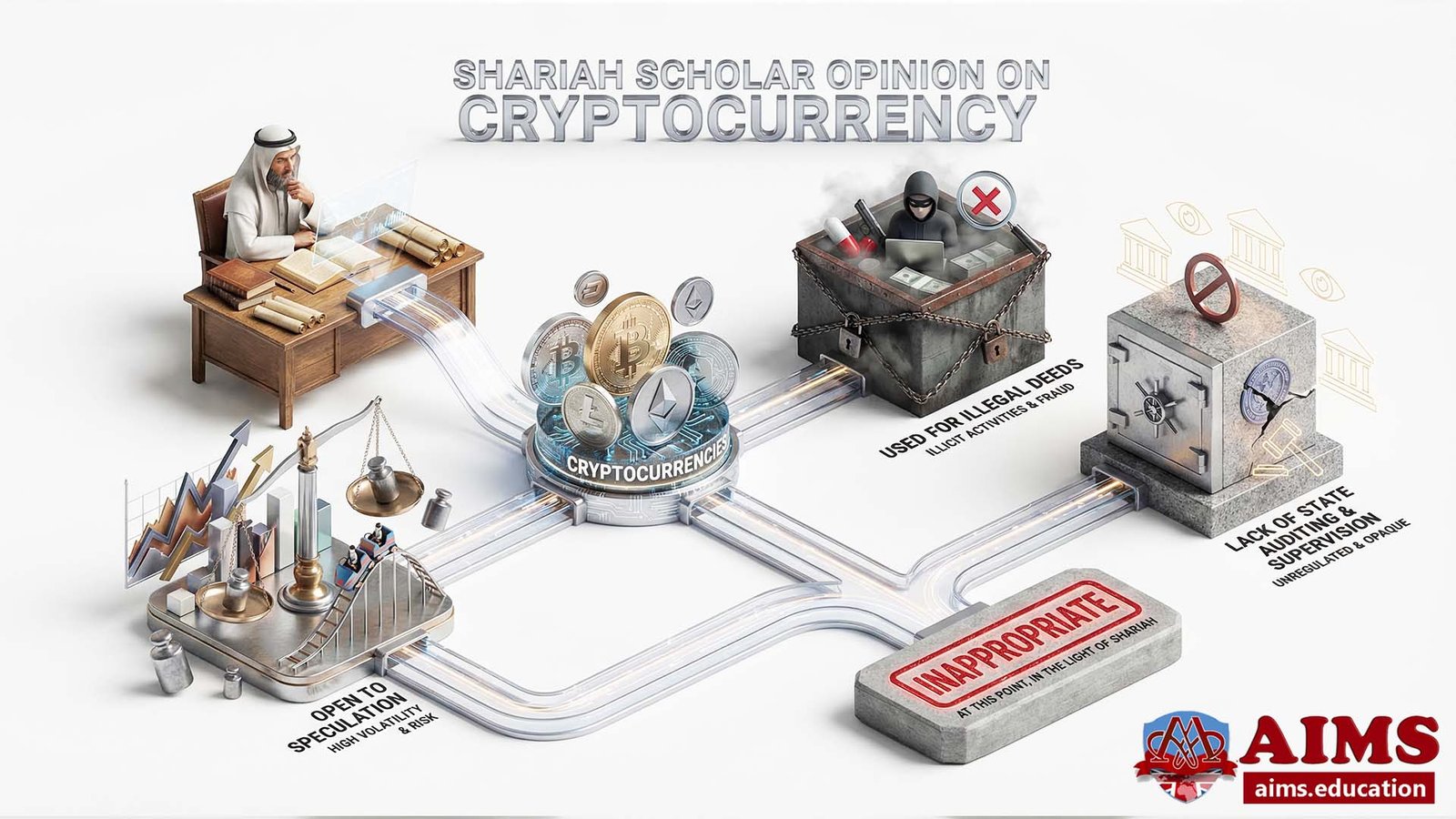
“Since cryptocurrencies are open to speculation, are frequently used for illegal activities, and remain outside state auditing and supervision, their trading is not appropriate at this point in light of Shariah.”
Shaykh Assim al-Hakeem
In an answer published on his official website on May 23, 2022, Shaykh Assim al-Hakeem maintained a restrictive view concerning Bitcoin. He stated:
“In my opinion on whether cryptocurrency is halal or haram, I would say that crypto transactions remain anonymous. Cryptocurrencies may facilitate money laundering, drug money, and other haram funds. Hand-to-hand currency exchange is permissible in Islam; however, with virtual currencies, such physical exchange does not occur.”
Is Crypto Haram? Seven Key Shariah Concerns
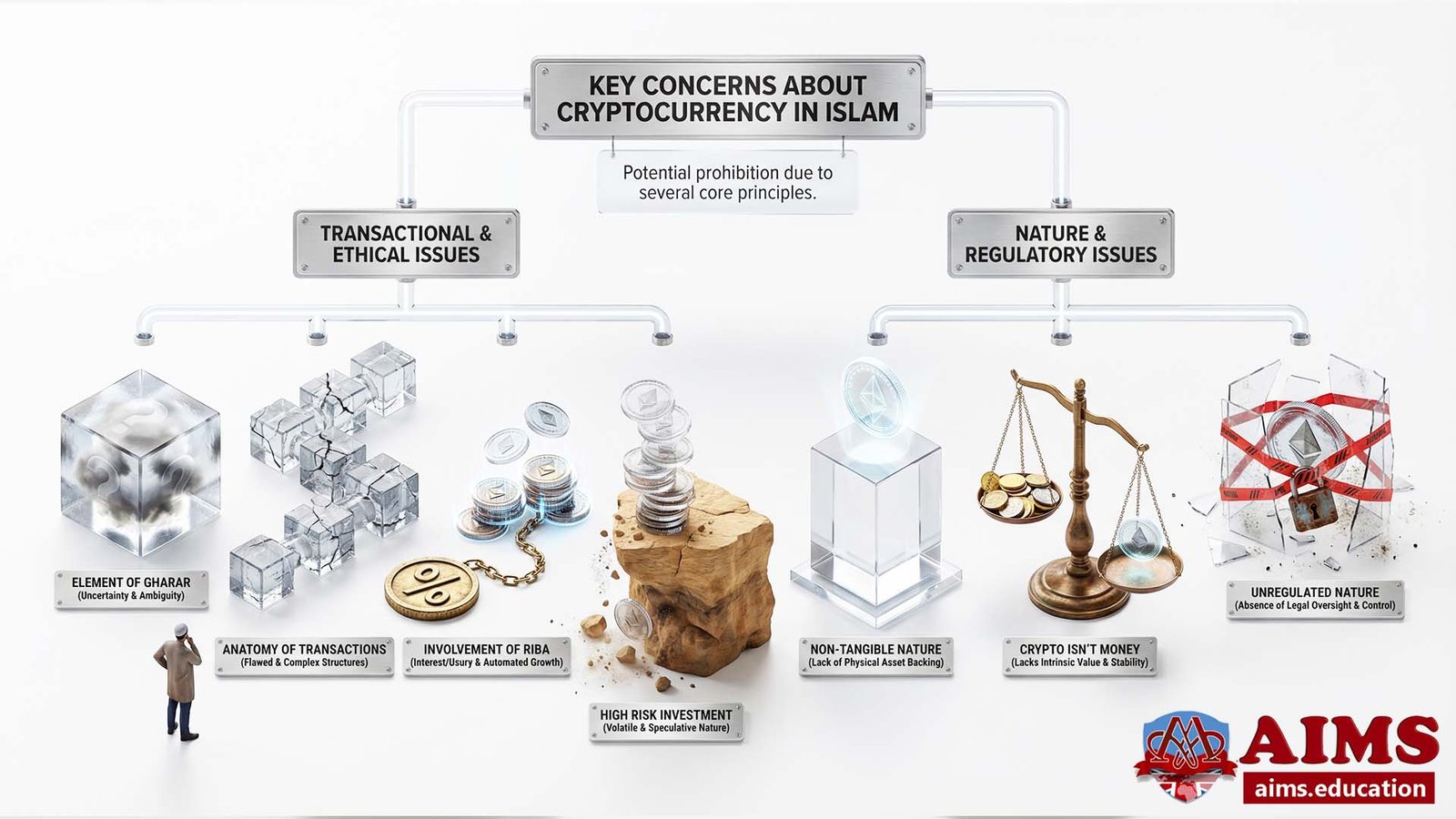
The principal Shariah concerns are excessive uncertainty, gambling-like speculation, riba, defective ownership, unlawful purpose, market abuse, and preventable financial harm. Each concern must be examined separately because its presence and severity differ across crypto products.
1. Excessive Gharar in Crypto Transactions
Gharar is excessive contractual uncertainty that exposes a party to an unjust or poorly understood outcome. Ordinary commercial risk is not automatically prohibited. The concern arises when essential information about the asset, rights, delivery, issuer, reserves, or transaction is materially unclear.
- A token’s purpose may be vague or technically impossible.
- The buyer may not know what legal or economic right the token represents.
- The exchange may show a balance without transferring withdrawable ownership.
- Promoters may conceal token supply, insider allocations, or the ability to change the contract.
This concern should be assessed through the broader rules governing gharar in Islamic financial transactions.
2. Maysir and Gambling-Like Speculation
Maysir arises when gain depends substantially on chance, wagering, or a zero-sum speculative contest rather than lawful trade, ownership, or productive activity. Crypto becomes especially problematic when users trade only rapid price movements with no concern for the asset’s function or value.
- Highly leveraged bets magnify small price movements.
- Perpetual futures often settle profit and loss without delivery of the asset.
- Meme-coin schemes may reward early insiders at the expense of later buyers.
- Trading driven by excitement, rumours, or fear of missing out can resemble wagering behavior.
The distinction becomes clearer when crypto speculation is compared with the Islamic prohibition of maysir and games of chance.
3. Riba in Crypto Products
Riba can arise when a crypto arrangement produces a contractually guaranteed increase on a loan or debt. The fact that the payment is made in tokens rather than conventional currency does not remove the underlying prohibition.
Potential examples include:
- Lending a stablecoin for a predetermined return guaranteed by the borrower or platform.
- Paying interest on margin borrowed to finance a crypto position.
- Using products whose return is generated mainly through conventional interest-bearing activities.
- Charging or receiving delay-based increases on a debt obligation.
Not every token reward is automatically riba. A genuine fee for validation, service, partnership, or risk-bearing may have a different ruling, but the contract and source of return must be understood. Readers should compare such structures with the detailed rules on riba in Islamic banking and finance.
4. Ownership, Possession, and Delivery
A valid sale generally requires the seller to own the asset and the buyer to receive recognized possession or control. In crypto markets, an exchange account may display units without giving the user the right or technical ability to withdraw them.
Key questions include:
- Does the buyer obtain an enforceable claim or direct control of the asset?
- Can the asset be withdrawn to an independent wallet?
- Is settlement immediate, or is the transaction merely an internal price contract?
- Is the seller selling an asset that it does not own?
Spot execution is therefore not sufficient by name alone. The transaction must result in real ownership and effective possession.
5. Lawful Purpose, Utility, and Underlying Rights
A Shariah-compliant token should represent a lawful benefit, right, service, asset, or credible network function. A token created for a prohibited industry, fraudulent scheme, or meaningless price promotion fails this test even when its code operates correctly.
Asset backing can strengthen clarity, but it is not the only possible source of value. Network access, payment utility, governance rights, and digital services may also create value when they are real, lawful, transparent, and deliverable.
6. Fraud, Manipulation, and Unlawful Activity
Fraud, deception, market manipulation, theft, and money laundering are prohibited regardless of the technology used. Public blockchains are usually pseudonymous rather than completely anonymous, and their records may be traceable. Nevertheless, weak governance and cross-border access can make abuse difficult to prevent or remedy.
- Promoters may make false claims about partnerships, returns, or reserves.
- Insiders may manipulate thinly traded tokens.
- Developers may remove liquidity or abandon a project after attracting buyers.
- Centralized exchanges may misuse customer assets or become insolvent.
Regulation does not make a prohibited product halal, but credible supervision, disclosure, custody rules, and legal recourse can reduce gharar and harm.
7. Excessive Risk and Protection of Wealth
Islam permits commercial risk but discourages reckless exposure that threatens wealth without a sound economic purpose. High volatility alone does not prove that an asset is haram, since many lawful assets fluctuate. The concern is the combination of volatility with ignorance, leverage, concentration, manipulation, and gambling-like behavior.
A Muslim investor should understand the asset, limit exposure, protect essential savings, avoid borrowed funds, and reject claims of guaranteed profit. These disciplines reflect the wider objectives of hifz al-mal, the protection of wealth.
Is Crypto Trading Halal or Haram? Activity-by-Activity Analysis
Crypto trading is not one uniform activity, so its ruling depends on the contract, asset, ownership, settlement, financing, and trading purpose. The table below provides an educational screening view rather than a personal fatwa.
| ACTIVITY | LIKELY SHARIAH ASSESSMENT | MAIN CONDITIONS OR CONCERNS |
|---|---|---|
| Spot purchase | Potentially permissible under the conditional view. | The token must be lawful, the price known, ownership genuine, settlement prompt, and leverage absent. |
| Buying and holding | Potentially permissible if both the asset and purchase pass Shariah screening. | The investor should understand the project, avoid prohibited utility, and not rely on manipulative promotion. |
| Frequent speculative trading | Highly doubtful and may become impermissible. | The concern increases where decisions resemble wagering on short-term price movement. |
| Margin trading | Generally impermissible in common structures. | Interest-bearing borrowing, leverage, forced liquidation, and sale without proper ownership are common. |
| Futures and perpetual contracts | Generally impermissible in common retail structures. | The parties usually trade price exposure rather than presently owned and delivered assets. |
| Crypto lending for fixed yield | Likely impermissible where the return is a guaranteed increase on a loan. | The arrangement may constitute riba regardless of whether payment is made in crypto. |
| Proof-of-stake rewards | Requires contract-specific review. | The reward may represent payment for network validation, but custody, slashing risk, token status, and platform intermediation matter. |
| Stablecoin exchange | Requires review of classification and reserve structure. | Backing, redemption rights, possession, issuer activities, reserve income, and currency-exchange rules may apply. |
Example: Spot Crypto Purchase Compared with Margin Trading
Suppose Yusuf wants exposure to a screened digital asset:
- In the spot purchase, Yusuf pays £500 from his own funds and receives withdrawable units into a wallet he controls.
- The token has a lawful network function, its supply and rights are disclosed, and no return is guaranteed.
- Under the conditional view, this structure may be permissible after appropriate Shariah review.
- In the margin transaction, Yusuf borrows funds from the platform, pays financing charges, and trades a leveraged price position.
- The second structure introduces riba, amplified speculation, liquidation risk, and possible absence of genuine possession.
The same market can therefore contain both potentially permissible ownership and clearly problematic trading structures.
Is Bitcoin Halal or Haram?
Bitcoin is not considered halal or haram by unanimous scholarly agreement. Some scholars recognize it as digital property with scarcity, transferability, market acceptance, and a functioning payment network. Others reject or discourage it because they do not accept its present value foundation, monetary legitimacy, volatility, or dominant speculative use.
The question is Bitcoin halal should therefore be divided into two assessments:
- Bitcoin as an asset: Does it qualify as recognized property with lawful utility and genuine ownership?
- The Bitcoin transaction: Is it purchased through a transparent spot sale without leverage, interest, deception, unlawful purpose, or gambling-like behavior?
A person following the restrictive scholarly view should avoid Bitcoin. A person relying on a recognized conditional view should still examine local law, the exchange, custody, possession, source of funds, investment purpose, and personal risk.
Is Crypto Staking Halal or Haram?
Crypto staking is not automatically halal or haram because the word staking is used for several different arrangements. A direct proof-of-stake activity may reward a participant for validating transactions and accepting technical risk. A centralized platform may instead lend the user’s tokens, guarantee a return, or combine several undisclosed strategies.
A Shariah review should determine:
- Who receives the tokens and whether ownership is transferred.
- What service or risk justifies the reward.
- Whether the return is fixed, guaranteed, or linked to actual network performance.
- Whether the platform lends assets on interest or uses prohibited derivatives.
- Whether the underlying token is itself Shariah-compliant.
Example of Direct Staking and Lending-Based Yield
- Fatimah delegates tokens to a validator and receives variable protocol rewards generated for network validation.
- She remains exposed to token price risk, validator performance, and possible penalties.
- This may be reviewed as payment for a service or participation in network operations.
- By contrast, a platform that borrows her tokens and promises a fixed 10% return may create an interest-bearing loan.
The commercial label is therefore less important than the actual contract and source of the return.
Are Stablecoins Such as USDT Halal?
A stablecoin is not automatically Shariah-compliant merely because its price is designed to track a conventional currency. Its ruling depends on what the holder legally owns, how reserves are maintained, whether redemption is enforceable, how reserve income is generated, and how the token is exchanged.
Important questions include:
- Is the token fully or partially backed, and are the reserves independently disclosed?
- Does the holder own currency, hold a debt claim, or possess only a contractual promise from the issuer?
- Can the holder redeem at par, and under what restrictions?
- Are reserves placed in interest-bearing instruments?
- Does exchanging the stablecoin for currency require the rules of bai‘ al-sarf, including prompt settlement?
- Does the platform provide real possession or only a synthetic balance?
Therefore, asking whether USDT is halal requires examination of the token, issuer, reserves, transaction, jurisdiction, and intended use. A stable price reduces one form of volatility but does not resolve every Shariah issue.
What Makes a Cryptocurrency Shariah-Compliant?
A Shariah-compliant cryptocurrency should combine a lawful asset purpose with a valid, transparent, and fairly executed transaction. The following framework can guide a preliminary review.
1. Screen the Project and Purpose
- The project should not support gambling, pornography, interest-based lending, fraud, or another prohibited activity.
- The token should provide a real and understandable benefit, right, service, or ownership claim.
- The promoters, governance structure, supply rules, and use of raised funds should be disclosed.
2. Identify the Shariah Classification
- Determine whether the token functions as money, property, a service right, a security, a debt claim, or an asset-backed certificate.
- Apply the rules appropriate to that classification rather than treating all tokens identically.
- Where tokenization represents a conventional or Islamic instrument, examine the underlying contract using the principles governing Shariah-compliant financial instruments.
3. Verify Ownership and Possession
- The seller should own the asset being sold.
- The buyer should receive effective control or an enforceable right to delivery.
- The platform should allow withdrawal where withdrawal is necessary to establish possession.
4. Examine the Source of Return
- Profit should arise from lawful ownership, trade, service, partnership, or productive risk.
- A guaranteed increase on a loan or debt should be rejected.
- Rewards should not depend mainly on recruiting later participants or transferring losses to uninformed buyers.
5. Assess Gharar, Maysir, and Harm
- Material terms, risks, fees, custody, reserves, and rights should be understandable.
- Trading behavior should not resemble betting on random price movements.
- The investment should not threaten essential savings or depend on unaffordable borrowing.
6. Check Legal and Regulatory Compliance
- The platform and transaction should comply with the law applicable to the user.
- Regulation should provide credible disclosure, custody, anti-fraud controls, and legal recourse.
- Legal approval supports transparency but does not replace an independent Shariah assessment.
Practical Example: How to Assess a Cryptocurrency
A useful assessment begins with the token and then moves to the transaction and investor behavior. Consider a fictional token called AmanahPay, designed for cross-border payments.
- Purpose: AmanahPay provides a lawful payment service rather than access to a prohibited industry.
- Rights: Its documentation clearly explains supply, fees, governance, custody, and the holder’s rights.
- Value: Users need the token to pay network charges, giving it an identifiable function.
- Transaction: Sara buys the token in a spot sale with her own money and receives withdrawable ownership.
- Return: No profit is guaranteed, and Sara does not lend the token for interest.
- Conduct: She invests a limited amount after understanding volatility and does not use leverage.
Under a conditional-permissibility approach, AmanahPay may pass an initial screen, but qualified scholars must still review its complete legal and technical structure.
Common Misunderstandings About Crypto in Islam
Blockchain Technology Is Not Automatically Halal
Blockchain is a record-keeping technology, not a Shariah ruling. It can support lawful payments, tokenized assets, or transparent records, but it can also support gambling, interest-bearing finance, fraud, and prohibited products.
Non-Physical Assets Are Not Automatically Haram
An asset does not need to be physically held in the hand to possess recognized value. The decisive questions concern lawful benefit, ownership, clarity, deliverability, and market recognition.
Volatility Alone Does Not Settle the Ruling
Price fluctuation is a risk factor, but it is not by itself proof of maysir or gharar. The ruling becomes more restrictive when volatility is combined with leverage, ignorance, manipulation, zero-sum derivatives, or gambling-like intention.
Government Recognition Is Relevant but Not Conclusive
Regulation and legal recognition can reduce uncertainty, fraud, and enforcement risk, but they do not make every regulated product halal. Shariah compliance still depends on the asset, contract, rights, and conduct.
A Halal Token Can Be Traded in a Haram Way
A permissible digital asset can become part of an impermissible transaction. Margin interest, deceptive sales, futures speculation, manipulation, or selling without ownership can change the ruling.
Professional Relevance for Islamic Finance Learners
Cryptocurrency analysis requires knowledge of fiqh al-muamalat, financial contracts, risk, technology, regulation, and Shariah governance. Learners seeking systematic professional development may begin with a job-oriented postgraduate diploma in Islamic banking and finance or progress to an MBA focused on strategic Islamic banking and finance.
These foundations help professionals distinguish lawful technological innovation from products that merely use Islamic terminology without satisfying Islamic commercial law.
Final Remarks: Is Cryptocurrency Halal or Haram?
Cryptocurrency is neither universally halal nor universally haram according to contemporary scholarly discussion.
- A restrictive view prohibits or suspends most current crypto activity because of doubts about recognized value, excessive gharar, speculation, manipulation, and harm.
- A conditional view permits selected assets and spot transactions when lawful value, genuine ownership, clear rights, prompt settlement, and responsible conduct are established.
The most defensible practical method is to assess each asset, contract, platform, and use separately.
- Avoid leverage, interest-bearing lending, futures, manipulative tokens, guaranteed-return schemes, and any transaction you do not understand.
- A qualified Shariah scholar should review complex products and personal circumstances before you act.
Frequently Asked Questions
Is cryptocurrency halal or haram in Islam?
There is no universal scholarly ruling covering every cryptocurrency and transaction. Some scholars prohibit most crypto because of excessive uncertainty, speculation, and doubts about recognized value. Others permit selected digital assets when the purpose is lawful, ownership is genuine, settlement is prompt, and riba, maysir, deception, and excessive gharar are absent.
Why do some Islamic scholars consider crypto haram?
They point to extreme speculation, uncertain value, weak investor protection, manipulation, unlawful projects, defective possession, and frequent use of leverage or derivatives. Some also argue that many cryptocurrencies do not presently qualify as recognized wealth or legitimate money under Shariah.
Why do some scholars consider cryptocurrency halal?
They argue that lawful digital property can possess economic value, utility, ownership, and transferability without having a physical form. Under this view, permissibility depends on the specific token and transaction. A lawful project bought through a transparent spot sale may be permissible when prohibited elements are absent.
Is Bitcoin halal or haram?
Scholars disagree. Some recognize Bitcoin as digital property with scarcity, transferability, and network utility. Others reject or discourage it because of speculation, volatility, doubtful monetary status, and weak value foundations. The transaction method and the investor’s behavior also affect the ruling.
Is buying and holding cryptocurrency permissible?
It may be permissible under a conditional scholarly view when the token has a lawful purpose, the buyer receives genuine ownership, the purchase uses personal funds, and no interest, leverage, fraud, or gambling-like conduct is involved. A restrictive scholarly view may still prohibit or advise avoiding it.
Is crypto trading different from crypto investing in Islam?
Yes. Investing normally involves acquiring and holding an asset based on its expected lawful utility or long-term value. Trading may involve rapid price speculation, leverage, derivatives, or no genuine delivery. The more an activity resembles wagering on price movements, the stronger the concern about maysir and excessive gharar.
Does cryptocurrency involve riba, gharar, or maysir?
Cryptocurrency does not automatically contain all three. Riba may arise in interest-bearing loans or guaranteed lending returns. Gharar may arise from unclear rights, reserves, ownership, or delivery. Maysir may arise when leveraged or derivative trading becomes gambling-like speculation. Each product must be examined separately.
Is spot crypto trading halal?
Spot trading may be permissible under a conditional view when the token itself is lawful, the price is known, the seller owns it, settlement is prompt, and the buyer receives genuine possession or control. A platform’s use of the word spot is not enough if no real asset is delivered.
Are crypto futures and margin trading haram?
Common retail futures and margin structures are generally regarded as impermissible because they may involve interest-bearing borrowing, excessive leverage, sale without ownership, deferred exchange, and settlement of price differences without genuine asset delivery. The precise ruling depends on the contract, but the usual structures present serious Shariah concerns.
Is crypto staking halal or haram?
It depends on the arrangement. Direct proof-of-stake rewards may be reviewed as compensation for validation services and network risk. A platform that borrows tokens and guarantees a fixed return may create riba. The token, custody, reward source, risk-sharing, and underlying contract all require examination.
Are stablecoins such as USDT halal?
No stablecoin should be declared halal solely because it tracks a currency. Its reserves, redemption rights, legal structure, reserve income, possession, issuer conduct, and exchange method must be reviewed. If treated as currency or a currency-backed claim, prompt settlement and other currency-exchange rules may apply.
What makes a cryptocurrency Shariah-compliant?
A Shariah-compliant cryptocurrency should have a lawful purpose, real and understandable utility, transparent rights, genuine ownership, deliverability, and fair governance. Its sale and use must avoid riba, excessive gharar, maysir, fraud, manipulation, unlawful activity, and reckless financial harm.
Study Islamic Fintech with AIMS’ Institute of Islamic Banking and Finance
Since 2005, AIMS’ Institute of Islamic Banking and Finance has delivered internationally accredited, career-focused education to a global community of learners. Its internationally standardized curriculum is taught by qualified faculty through industry-oriented instruction, practical skill development, 3D interactive learning content, and real-world case studies. AIMS educational articles, study content, and curricula are collaboratively developed and rigorously peer-reviewed by an academic board of qualified industry practitioners. Understanding cryptocurrency through Shariah principles strengthens professional competence in Islamic fintech and digital finance. Explore AIMS’ globally recognized Islamic banking and finance educational programs.