
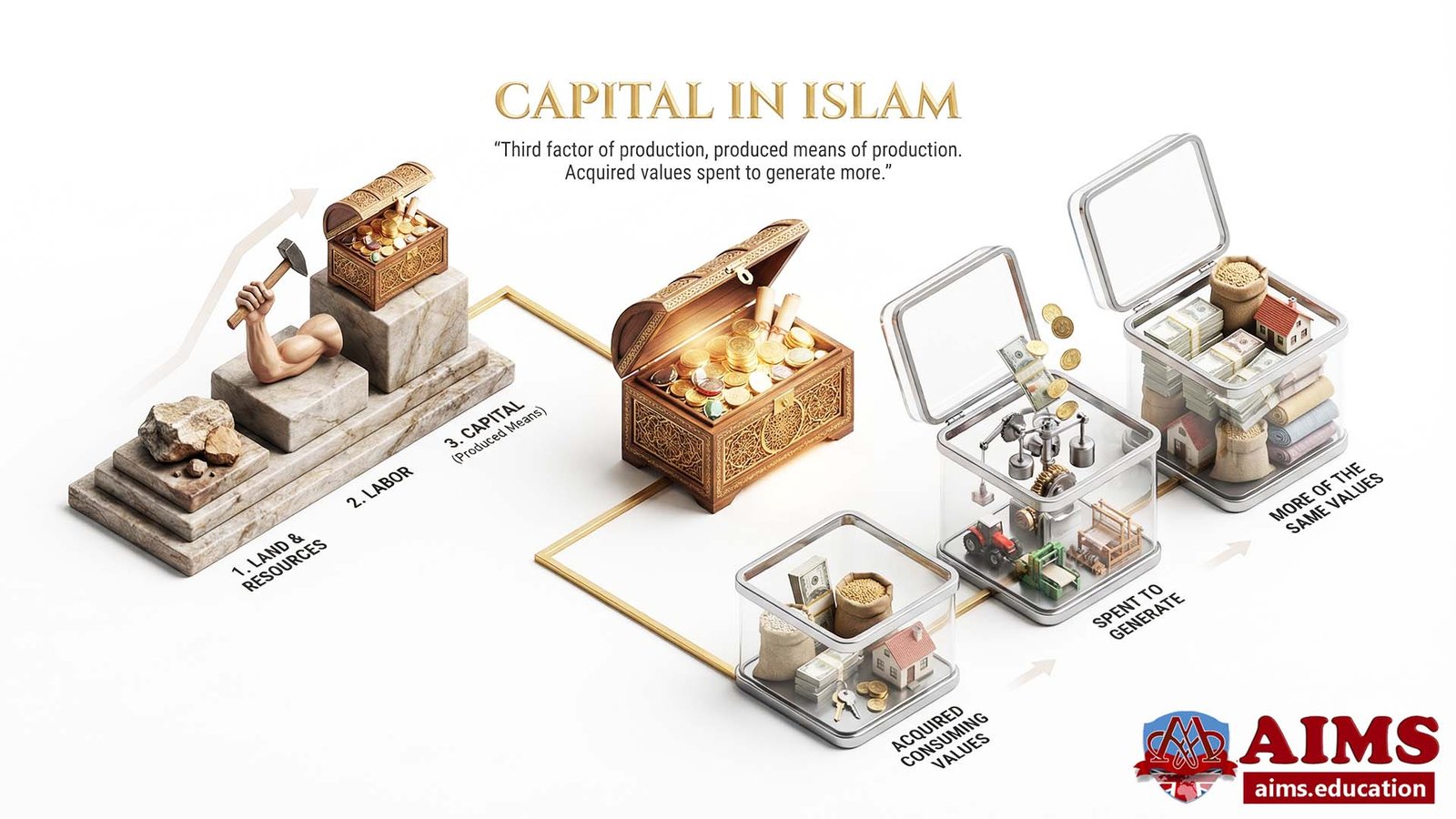
Capital in the Islamic economy refers to produced resources, productive assets, or invested funds used to create lawful goods, services, and additional wealth. It includes machinery, tools, business inventory, buildings, transport equipment, and money committed to a genuine commercial activity. Capital may earn profit or rent, but it cannot claim a guaranteed interest-based return merely because money has been lent.
The concept of capital in Islam therefore combines economic productivity with ethical responsibility. Capital supports production, employment, trade, innovation, and enterprise, while Shariah regulates how it is acquired, invested, and rewarded. This distinction is essential for understanding capital in Islamic economics, because Islam does not reject private ownership, investment, or profit. Instead, it requires lawful activity, valid ownership, contractual clarity, risk-bearing, and protection from riba, fraud, excessive uncertainty, and injustice.
What Is Capital in Islamic Economics?
Capital in Islamic economics is a produced factor of production that assists labour and natural resources in generating goods, services, or lawful income. It is called a produced factor because people create or accumulate it through saving, production, investment, and enterprise.
Examples of capital include:
- Machinery and tools used in agriculture, manufacturing, or construction.
- Vehicles and transport equipment used for commercial operations.
- Raw materials and trading inventory held for production or sale.
- Buildings, warehouses, and equipment used by a business.
- Technology, production systems, and productive infrastructure.
- Money invested in a lawful business, partnership, or asset-based transaction.
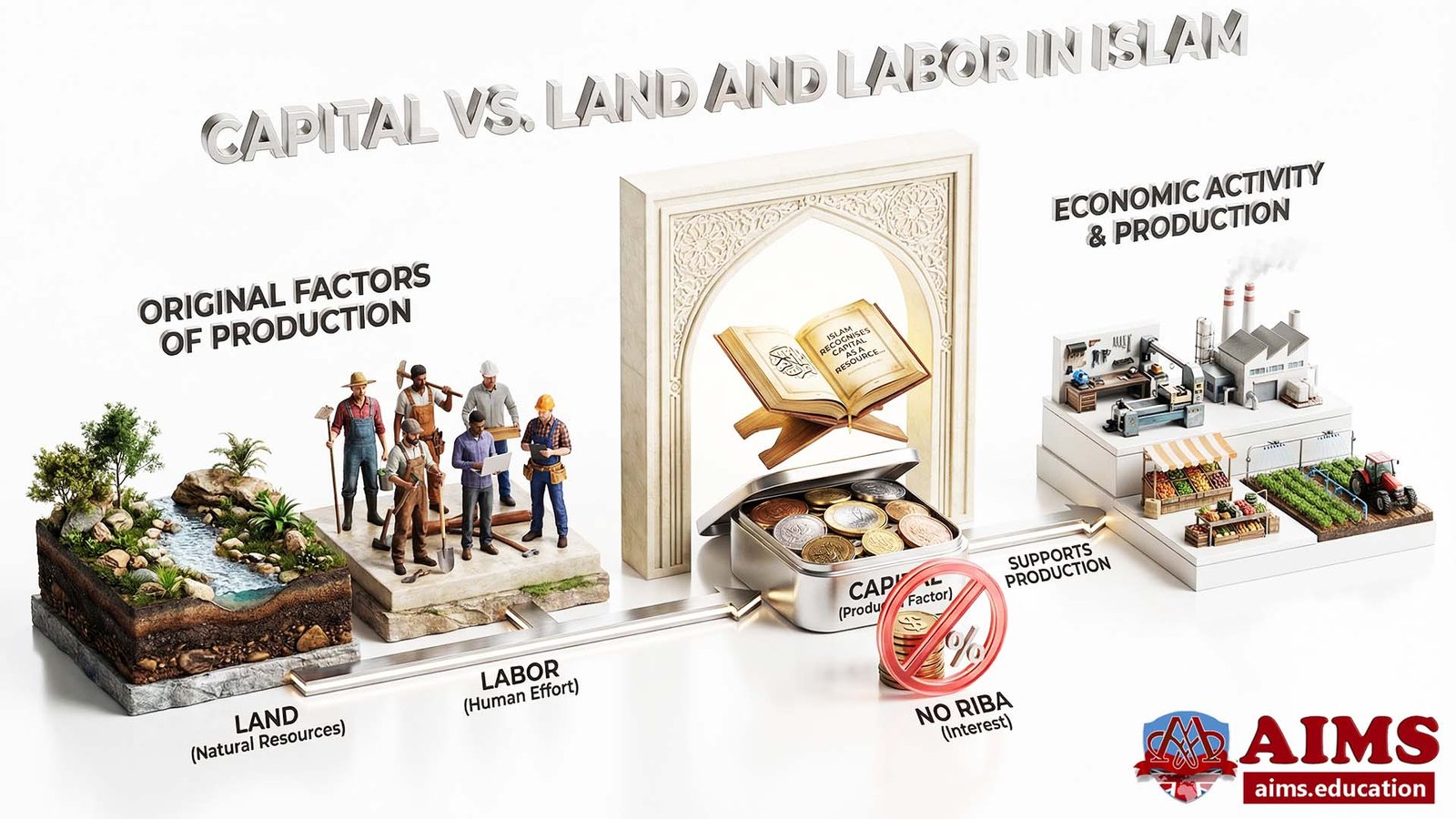
Capital is different from goods purchased for immediate personal consumption. A family car used only for private travel is normally a consumer asset, while a delivery vehicle used by a logistics business functions as productive capital.
Capital as a Factor of Production
Capital as a factor of production increases the productive capacity of labour and other economic resources. A worker may possess skill and effort, but tools, equipment, finance, and infrastructure often determine how efficiently that effort can be converted into output.
Islamic economists do not always classify the factors of production in exactly the same way. However, many discussions distinguish among natural resources, labour, capital, and entrepreneurship. Within this framework:
- Natural resources provide land, water, minerals, and other materials used in production.
- Labour contributes physical effort, knowledge, judgement, and professional skill.
- Capital supplies produced assets and investible resources that support production.
- Entrepreneurship organizes resources, makes decisions, accepts commercial exposure, and seeks lawful profit.
For a broader view of how production, ownership, circulation, and social responsibility interact, you may study the foundational principles of the Islamic economic system.
Main Characteristics of Capital in Islam
The main characteristics of capital in Islam are lawful ownership, productive use, contractual responsibility, exposure to commercial risk, and the prohibition of riba. Capital is economically valuable, but its return is not automatically justified by the passage of time.
- Capital should be lawfully acquired. Wealth obtained through theft, bribery, fraud, prohibited trade, or other unlawful means cannot become a legitimate basis for investment.
- Capital should support lawful activity. The business, asset, service, or transaction financed by capital must be permissible under Shariah.
- Capital may earn a return through recognized economic activity. Profit may arise from trade, partnership, investment, leasing, or another valid contract.
- Entitlement to return is connected with responsibility. A party claiming profit or rent must normally possess ownership, contractual responsibility, entrepreneurial exposure, or liability appropriate to the transaction.
- A guaranteed return on a pure loan is prohibited. An agreed increase over the principal of a loan is treated as riba, regardless of whether the borrower earns a profit.
- Capital should circulate rather than remain socially unproductive. Islam encourages lawful enterprise, spending, charity, investment, and productive deployment while discouraging hoarding, waste, and exploitation.
Money and Capital in Islamic Economics
Money is not always capital, although money can become capital when it is committed to productive or commercial activity. Money primarily functions as a medium of exchange, a measure of value, and a means of payment. Capital is a broader economic concept that includes assets and resources used to produce future output or lawful income.
| POINT OF COMPARISON | MONEY | PRODUCTIVE CAPITAL |
|---|---|---|
| Basic function | Money measures value and facilitates exchange and payment. | Capital supports production, trade, services, or investment. |
| Examples | Cash and balances available for payment. | Machinery, inventory, commercial vehicles, equipment, and invested funds. |
| When money becomes capital | Money held only for liquidity remains money. | Money becomes financial capital when committed to a lawful productive venture or transaction. |
| Basis of return | Money cannot earn a guaranteed increase merely by being lent. | Capital may earn profit or rent through ownership, trade, investment, or the transfer of usufruct. |
| Commercial exposure | A lender is entitled to repayment of the principal, not a predetermined interest return. | An investor or asset owner accepts relevant risk, responsibility, or liability. |
Example of Money Becoming Productive Capital
Amina has GBP 20,000 in cash. The money becomes productive capital when she uses it in a lawful business arrangement:
- She contributes GBP 12,000 to purchase bakery equipment.
- She uses GBP 5,000 to buy ingredients and packaging inventory.
- She retains GBP 3,000 for operating expenses and business liquidity.
- The bakery sells permissible products and earns revenue through genuine trade.
- Amina’s return depends on the business structure and actual performance, not on guaranteed interest charged against a loan.
The practical effect is that money earns a lawful return by entering real economic activity and accepting appropriate commercial responsibility.
Why Capital Is Important in the Islamic Economy
Capital is important because it enables labour, enterprise, and natural resources to operate at a higher level of productivity. Without tools, machinery, infrastructure, inventory, and investible funds, many forms of modern production would be slow, expensive, or impossible.
- Capital improves the efficiency and output of workers.
- It enables businesses to adopt technology and better production methods.
- It finances inventory, equipment, transport, and commercial expansion.
- It can create employment by supporting new and growing enterprises.
- It helps transform savings into productive investment.
- It supports trade, agriculture, manufacturing, services, and infrastructure.
Because of vital role of capital in production, Islam has given much importance to capital. Al-Qur’an, the revealed book of Islam, in the following verses talks of the use of cattle wealth as capital goods of production:
“And the cattle hath He created, whence ye have warm clothing and uses, and whereof ye eat…….. And they bear your loads for you unto a land ye could not reach save with great trouble to yourselves……… And horses and mules and asses that ye may ride them……….”
Al-Qur’an, Surah An-Nahl (16:5–8)
“And Lo! in the cattle there is a lesson for you. We give you to drink of that which is in their bellies…….. pure milk palatable to the drinkers.”
Al-Qur’an, Surah An-Nahl (16:66)
“And Allah hath given you in your houses an abode, and hath given (also), of the hides of cattle, tent-houses which ye find light (to carry) on the day of migration and on the day of pitching camp; and of their wool and their fur and their heir, caparison and comfort for a while.”
Al-Qur’an, Surah An-Nahl (16:80)
Thus in the above mentioned verses, the Holy Qur’an has referred to various uses of cattle and horses as factors of production such as in transportation, in production of milk, wool, fur, hides for tent-houses, and so on.
Types of Capital in Islamic Economics
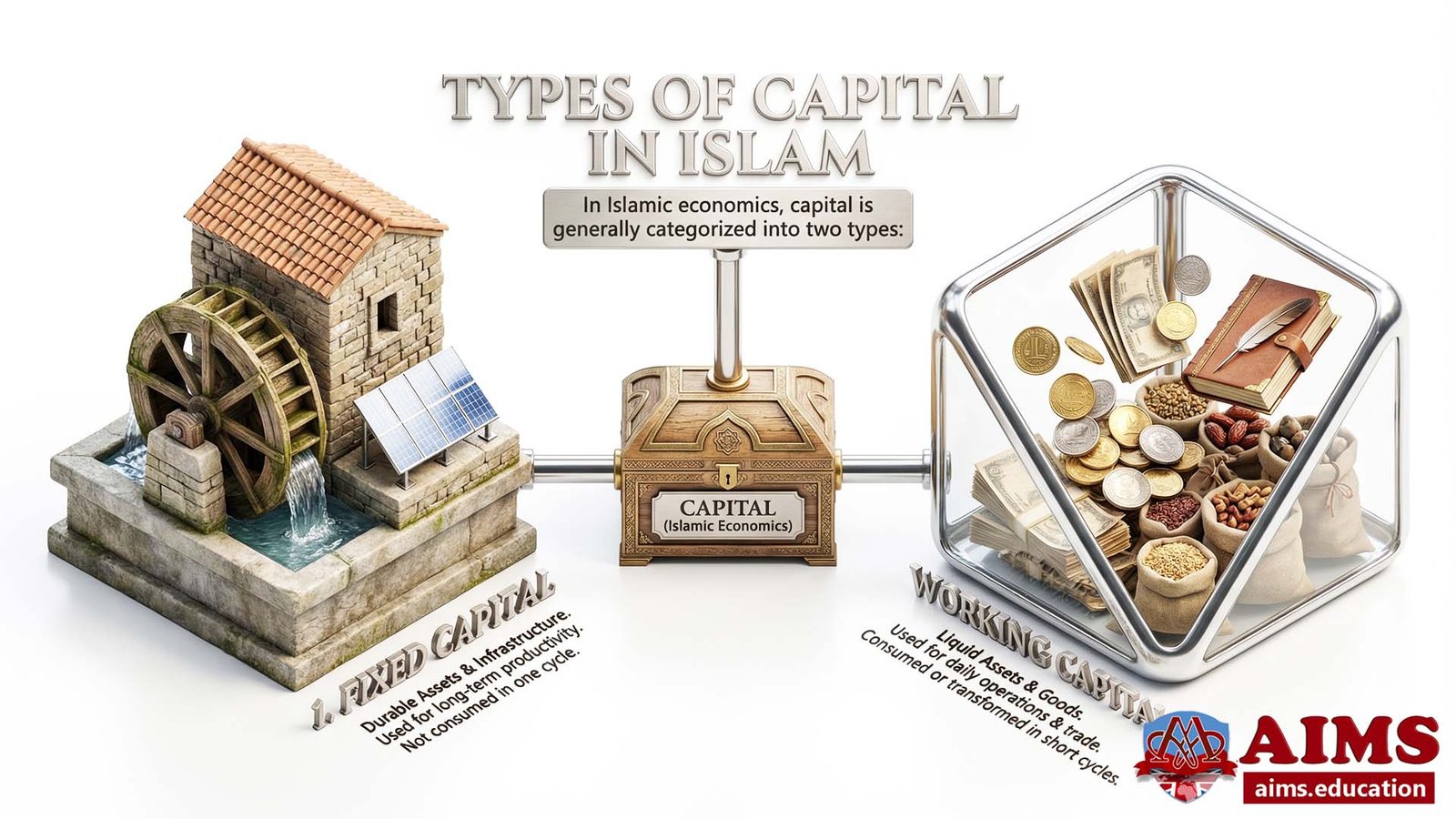
Capital may be classified according to how long it remains in production and how it is used by the enterprise. The two common categories are fixed capital and working capital.
- Fixed capital
- Working capital
Fixed Capital
Fixed capital consists of durable productive assets used repeatedly over more than one production cycle. The term “fixed” does not mean that the asset must remain physically stationary.
Examples include:
- Manufacturing machines and industrial plants.
- Tractors, harvesters, and irrigation equipment.
- Commercial vehicles, ships, and transport systems.
- Computers, servers, and production technology.
- Tools, office equipment, warehouses, and business premises.
Working Capital
Working capital consists of short-term resources used, transformed, or circulated during normal business operations. These resources help the enterprise purchase inputs, maintain inventory, meet operating obligations, and continue production.
Examples include:
- Raw materials consumed during manufacturing.
- Trading inventory held for resale.
- Packaging materials and production supplies.
- Cash allocated to wages, transport, and operating expenses.
- Short-term receivables generated through lawful sales.
Example of Fixed and Working Capital
Consider a furniture workshop operated by Bilal:
- The cutting machines, workshop building, and delivery van are fixed capital because they support repeated production.
- The wood, fabric, varnish, packaging, and operating cash are working capital because they are consumed or circulated during business activity.
- Bilal’s design knowledge and labour are not capital assets in the same sense, although they are essential productive contributions.
This classification helps a business understand which resources create long-term capacity and which resources sustain daily production.
How Can Capital Earn a Lawful Return in Islam?
Capital can earn a lawful return through trade, investment, partnership, or leasing when the return is connected with ownership, productive activity, and appropriate commercial exposure. Islam distinguishes profit earned from enterprise from interest charged on a loan.
| BASIS | LAWFUL PROFIT OR RENT | PROHIBITED INTEREST ON A LOAN |
|---|---|---|
| Underlying relationship | Sale, partnership, investment, or lease. | Loan of money with a stipulated increase. |
| Economic basis | Trade, asset ownership, enterprise, or transfer of usufruct. | Time passing on a debt. |
| Return | Depends on the valid contract and may reflect actual performance or an agreed rental payment. | Predetermined increase is owed regardless of the borrower’s business result. |
| Risk and responsibility | The earning party accepts relevant ownership risk, business risk, or contractual liability. | The lender seeks an increase while retaining a debt claim against the borrower. |
| Shariah position | Permissible when the contract, asset, activity, and conduct are lawful. | Prohibited as riba. |
If you need a fuller explanation of prohibited loan-based increases may review the meaning and forms of riba in Islamic finance. Standardized industry terminology is also available in the IFSB glossary of Islamic financial terminology.
Why Risk and Ownership Matter
Risk and ownership matter because a lawful financial return must arise from a recognized economic cause rather than from a guaranteed increase on debt. This does not mean that every investor must face unlimited risk or that every Islamic contract must use profit-and-loss sharing. It means that profit, rent, or markup should correspond to a valid sale, lease, partnership, service, or investment relationship.
- A seller may earn a trading profit because the seller owns and sells an asset.
- A lessor may earn rent because the lessor owns an asset and transfers its usufruct.
- A partner may earn profit because the partner contributes capital and accepts business exposure.
- An investment manager may receive an agreed share of profit for entrepreneurial effort under a valid partnership structure.
- A lender may recover the principal of a loan but cannot stipulate an additional return merely for waiting.
Capital in Mudarabah, Musharakah and Ijarah
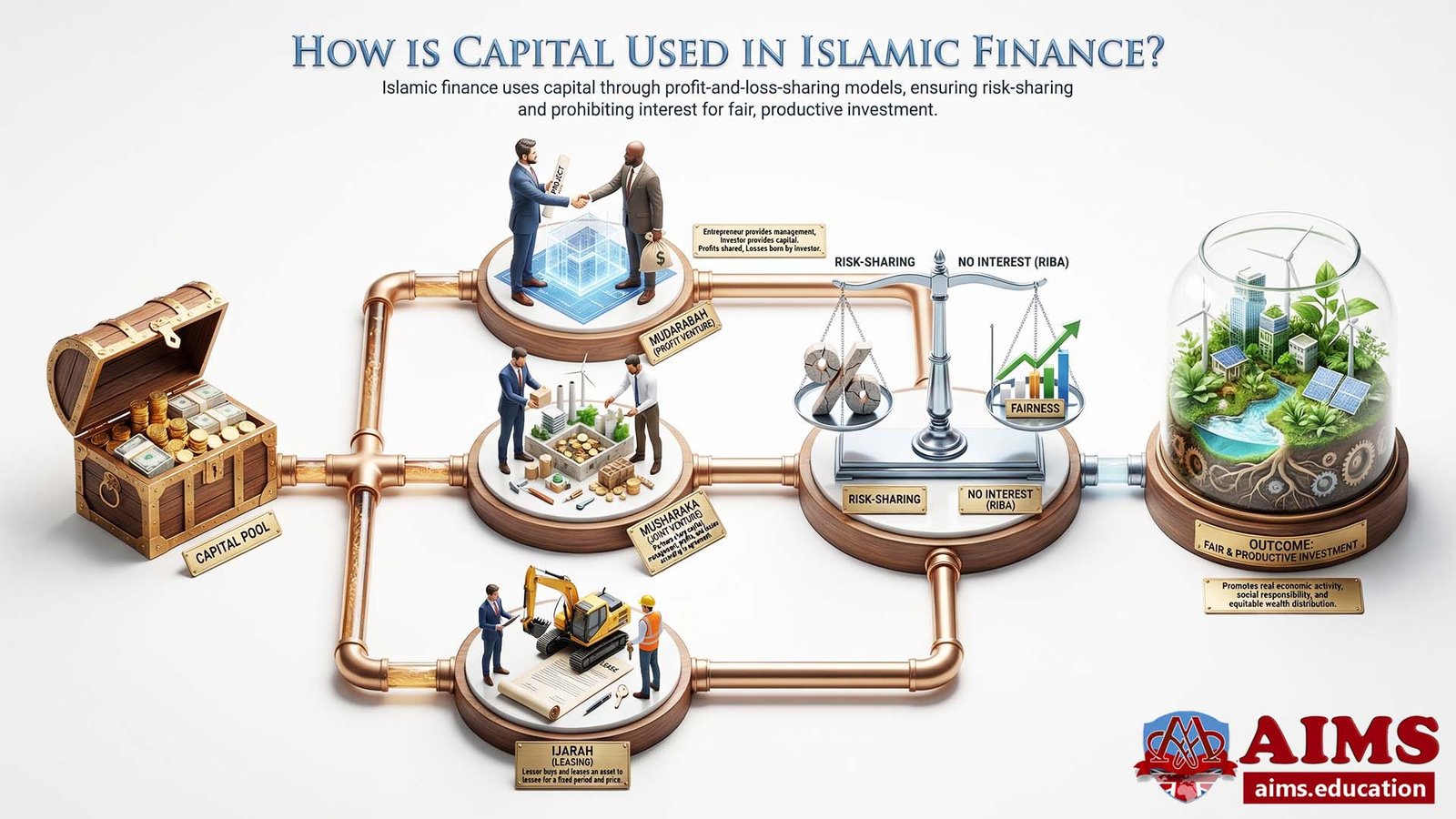
Islamic finance uses capital through contracts that connect financial return with investment, partnership, ownership, or asset use. Mudarabah, musharakah, and ijarah illustrate three different ways in which capital can support economic activity.
Mudarabah Capital Investment
Mudarabah is a partnership in which one party provides capital and another party manages the enterprise. The capital provider is known as the rabb al-mal, while the entrepreneur or manager is the mudarib.
- The profit-sharing ratio must be agreed in advance as a proportion of actual profit.
- A fixed monetary profit cannot be guaranteed to either partner as a return on capital.
- A genuine financial loss is normally borne by the capital provider in proportion to the invested capital.
- The mudarib loses time and effort unless the loss resulted from misconduct, negligence, or breach of agreed terms.
- The business activity and investment conditions must be lawful and clearly defined.
For a contract-focused explanation, see this guide to mudarabah capital investment and profit-sharing rules.
Example of Mudarabah Capital Investment
Fatimah provides GBP 30,000 to Hassan, an experienced furniture trader:
- Fatimah supplies the investment capital.
- Hassan manages purchasing, marketing, sales, and daily operations.
- They agree that Fatimah will receive 60 percent and Hassan 40 percent of actual profit.
- If the venture earns GBP 10,000, the profit is divided GBP 6,000 to Fatimah and GBP 4,000 to Hassan.
- If the business suffers a genuine GBP 5,000 commercial loss without Hassan’s negligence, the financial capital falls by GBP 5,000 and Hassan receives no compensation for his effort.
The arrangement links reward to actual business performance rather than guaranteeing a fixed return on the invested money.
Musharakah Capital Partnership
Musharakah is a partnership in which two or more parties contribute capital to a jointly owned enterprise or asset. Partners may also participate in management, depending on their agreement.
- Profit may be distributed according to an agreed ratio, subject to the applicable Shariah rules.
- Financial loss is borne in proportion to each partner’s capital contribution.
- Each partner’s capital remains exposed to the commercial outcome of the venture.
- The partnership must involve a lawful business, valid consent, and transparent terms.
The relationship between contribution, ownership, profit, and loss is explained further in this study of the musharakah contract and types of shirkah.
Example of Musharakah Financing
Two engineers establish a solar installation company:
- Yusuf invests GBP 40,000 and Maryam invests GBP 60,000.
- They agree on management duties and a permissible profit-sharing ratio.
- The business earns profit from actual installation services and equipment sales.
- If the venture incurs a GBP 20,000 genuine financial loss, Yusuf bears 40 percent and Maryam bears 60 percent because their capital contributions follow that proportion.
Musharakah combines shared ownership with shared exposure, making profit dependent on genuine enterprise rather than lending.
Ijarah and Productive Assets
Ijarah is a lease in which the owner transfers the right to use an asset for an agreed period and rental payment. The asset itself remains owned by the lessor unless a separate transfer arrangement is completed.
- The leased asset and permitted use must be clearly identified.
- The rent and lease period must be known or determinable.
- The lessor retains ownership-related responsibilities and risks.
- The lessee is responsible for misuse, negligence, and operating obligations allocated under the contract.
- Rent is earned for providing usufruct, not for lending money at interest.
You may explore the difference between asset ownership and rental income through this explanation of ijarah leasing and its applications in Islamic banking.
Capital Formation in the Islamic Economy
Capital formation is the process of creating or expanding productive assets through saving, investment, reinvestment, innovation, and enterprise. In an Islamic economy, this process should use lawful sources of wealth and avoid riba, fraud, prohibited industries, and wasteful or speculative conduct.
Example of Capital Formation Through Reinvestment
A farmer produces 500 kilograms of cotton and decides to improve future output:
- The farmer sells part of the cotton and converts another portion into thread.
- The higher-value thread produces additional lawful income.
- Instead of consuming all the income, the farmer saves and reinvests a portion.
- The farmer purchases a cotton spinner that increases processing capacity.
- In the following production cycle, the machine enables more cotton to be converted into thread efficiently.
Innovation and reinvestment convert current output into productive capacity that can generate greater value in the future.
How Islam Encourages Productive Capital Formation
Islam encourages productive capital formation through lawful enterprise, responsible saving, moderation, wealth circulation, and investment in useful assets. The following mechanisms support this objective.
1. Discouraging Hoarding and Economic Idleness
Islam discourages the accumulation of wealth when it becomes detached from social responsibility and productive use. Zakat, charitable obligations, lawful spending, and investment encourage wealth to circulate. However, the zakat treatment of an asset depends on its nature and the applicable jurisprudential rules. Business cash, receivables, and trading inventory may remain zakatable, while fixed assets used to produce income are generally treated differently from goods held for sale.
“That is why Prophet Muhammad asked the guardian of the wealth of orphans to put their wealth in business that Zakat should not consume it.”
Prophetic guidance
Thus Zakat forces a hoarder of wealth to bring it out of idle channels and to invest it in production. This helps in capital formation.
2. Protecting Productive Assets
Tools, machinery, buildings, and equipment used directly in production are not normally treated in the same way as trading stock for zakat purposes. This distinction can help productive capacity remain intact while zakat applies to relevant zakatable wealth or business assets. Detailed rulings should be assessed according to the asset, ownership structure, and applicable scholarly guidance.
3. Promoting Moderation in Consumption
Islam prohibits waste and extravagance while also rejecting harmful miserliness. The principle of moderation in Islamic economics encourages households and businesses to meet legitimate needs, avoid destructive consumption, and allocate part of their resources to saving, investment, charity, and productive development.
Squandering of wealth on extravagant spending has been strictly prohibited. Spending on luxuries is strongly forbidden and ostentatious living has been discouraged. The Qur’an says:
“Eat and drink, but be not prodigal. Lo! He (Allah) loveth not the prodigals.”
Al-Qur’an, Surah Al-A‘raf (7:31)
“…… and squander not (thy wealth) in wantonness. Lo! the squanderers were ever brothers of the devil……”
Al-Qur’an, Surah Al-Isra (17:26–27)
Since moderation in expenditure and simple living is the golden rule of Islam, so wastage of wealth stops and wealth starts flowing into productive channels. This also helps in capital formation.
4. Encouraging Enterprise and Reinvestment
Lawful trade and investment allow profits to be reinvested in equipment, inventory, technology, education, and business expansion. This process creates new productive capacity without depending on guaranteed interest-bearing finance. It may operate through personal investment, partnership, leasing, trade finance, or other Shariah-compliant structures.
Those who dispose of their capital assets like house or land have been enjoined upon by the Prophet (PBUH) to re-invest the cash in the purchase of some other land or house. The Prophet is reported to have said:
“God may not bless the price of that land and that house which is not again re-invested in land or a house”.
Hadith of Prophet Muhammad (PBUH)
Capital in Islamic Economics vs Conventional Economics
The central difference is not whether capital may be privately owned or earn a return, but how ownership, return, risk, and social responsibility are regulated. Both systems recognize the productive importance of capital, although their legal and ethical assumptions may differ.
| DIMENSION | ISLAMIC ECONOMIC APPROACH | COMMON CONVENTIONAL APPROACH |
|---|---|---|
| Status of capital | Capital is lawful and economically necessary when acquired and used permissibly. | Capital is treated as a productive resource and privately owned asset within the applicable legal system. |
| Return on a loan | A stipulated increase on a pure loan is prohibited as riba. | Interest is commonly accepted as the price of credit or the time value of money. |
| Basis of investment return | Return should arise from trade, ownership, investment, service, partnership, or the transfer of usufruct. | Return may arise from profit, interest, rent, capital appreciation, or other legally recognized sources. |
| Risk relationship | Entitlement to profit is connected with relevant ownership risk, liability, or commercial exposure. | Risk allocation depends mainly on contract, regulation, market practice, and financial engineering. |
| Permissible sectors | Capital must not finance activities prohibited under Shariah. | Permissibility generally depends on secular law, regulation, and investor policy. |
| Ethical objective | Production and wealth creation are balanced with justice, lawful circulation, moderation, and social responsibility. | Objectives vary by economic school, institution, law, and corporate governance framework. |
This comparison describes broad tendencies rather than every scholarly theory or financial institution. Conventional economics contains diverse schools of thought, while Islamic economists may also differ in terminology, classification, and policy interpretation.
Common Misconceptions About Capital in Islam
Islam does not prohibit capital, private ownership, investment, entrepreneurship, or profit. It regulates the source, use, contractual structure, and return associated with capital.
- Misconception: All returns on capital are prohibited. Profit, rent, and trading gains can be lawful when they arise from valid economic activity.
- Misconception: Money and capital are identical. Money becomes productive capital only when it is committed to an enterprise, asset, or commercial transaction.
- Misconception: Every Islamic financing method must share business losses. Profit-and-loss sharing applies directly to partnership contracts, while sales and leases allocate risks differently.
- Misconception: A fixed payment is always riba. A known rent or sale price may be lawful because it is attached to an asset, usufruct, or trade. A stipulated increase on a loan is different.
- Misconception: Islamic finance eliminates risk. It manages and allocates risk through lawful contracts rather than guaranteeing every party a commercial gain.
- Misconception: Productive business assets are always entirely outside zakat. The treatment differs among fixed assets, cash, receivables, inventory, agricultural output, and other forms of wealth.
Professional Relevance of Capital in Islamic Finance
Understanding capital is essential for structuring Islamic investment, entrepreneurship, asset finance, partnership finance, and risk-sharing arrangements. Professionals must distinguish between capital contributions, debt claims, asset ownership, profit entitlement, rental income, and the responsibilities attached to each contract.
This knowledge supports work in:
- Islamic banking product development and Shariah review.
- Mudarabah and musharakah investment structuring.
- Asset acquisition and ijarah financing.
- Entrepreneurial finance and small-business investment.
- Islamic investment funds and capital-market analysis.
- Financial reporting, risk management, and governance.
Learners seeking structured professional development may explore AIMS’ career-focused and AAOIFI compliant Islamic finance certification or progress to a broader professional executive diploma in Islamic banking and finance.
Final Words
Capital in the Islamic economy is a legitimate and necessary means of production, investment, and development. Its distinguishing feature is not the absence of profit, but the requirement that financial return should arise from lawful ownership, trade, enterprise, partnership, service, or asset use. By connecting capital with responsibility, risk, moderation, and social justice, Islamic economics seeks productive wealth creation without riba or exploitation.
Frequently Asked Questions
What is capital in Islamic economics?
Capital in Islamic economics consists of produced assets, productive resources, or invested funds used to create lawful goods, services, or additional wealth. Examples include machinery, business inventory, commercial vehicles, buildings, and money committed to a genuine enterprise.
How does Islam define capital as a factor of production?
Islamic economic discussions commonly treat capital as a produced factor that assists labour, natural resources, and entrepreneurship. Islam does not provide one single technical classification, so scholarly terminology may differ, but capital is generally recognized as an important productive resource.
What are the main characteristics of capital in Islam?
Capital should be lawfully acquired, invested in permissible activity, connected with a valid contract, and used without riba, fraud, or injustice. A lawful return normally depends on ownership, trade, service, asset use, or appropriate commercial exposure.
Is money considered capital in Islamic economics?
Money can become capital when it is invested in a lawful business, partnership, asset, or commercial transaction. Money held only as a medium of exchange or store of liquidity is not automatically productive capital.
What is the difference between money and capital in Islam?
Money facilitates exchange and measures value, while capital is used to produce output or lawful income. Money cannot earn a guaranteed increase merely through lending, but invested capital may earn profit through valid economic activity.
How can capital earn a lawful return in Islam?
Capital may earn profit through trade, partnership, investment, or asset ownership, and it may earn rent through a valid lease. The return must arise from a lawful contract and cannot be a predetermined interest charge on a loan.
Why is guaranteed interest on capital prohibited in Islam?
A guaranteed increase attached to a loan is prohibited as riba because it is owed independently of the borrower’s actual commercial result. Islamic finance instead connects return with trade, investment, ownership, service, or asset use.
What role do risk and ownership play in earning profit?
Risk and ownership provide the economic and contractual basis for return. A seller, investor, partner, or lessor may earn because that party owns an asset, accepts business exposure, provides a service, or carries relevant contractual responsibility.
What are examples of capital in an Islamic economy?
Examples include factory machinery, farming equipment, delivery vehicles, warehouses, production technology, raw materials, trading inventory, leased productive assets, and funds invested in a Shariah-compliant business.
How is capital used in mudarabah and musharakah?
In mudarabah, one party provides capital while another manages the enterprise. In musharakah, two or more partners contribute capital to a jointly owned venture and share profit according to agreed rules and loss according to capital contribution.
How are profits and losses distributed between capital providers and entrepreneurs?
In mudarabah, profit is divided according to an agreed ratio, while a genuine financial loss is normally borne by the capital provider unless the manager was negligent or in breach. In musharakah, losses follow each partner’s capital contribution.
How does the Islamic concept of capital differ from the conventional concept?
Both approaches recognize capital as productive and capable of earning a return. Islamic economics additionally prohibits interest on loans, restricts prohibited sectors, and connects lawful return with ownership, trade, investment, risk, responsibility, or asset use.
Advancing Professional Knowledge at AIMS Institute of Islamic Banking and Finance
Since 2005, AIMS’ Institute of Islamic Banking and Finance has delivered internationally accredited, career-focused education to learners worldwide. Its internationally standardized curriculum combines qualified faculty, industry-oriented teaching, practical skill development, 3D interactive learning content, and real-world case studies. This educational content, together with AIMS’ study materials and curriculum, is collaboratively developed and rigorously peer-reviewed by an academic board of qualified industry practitioners. Understanding capital strengthens professional competence in investment and financing decisions. Explore practical and accredited Islamic finance education.