
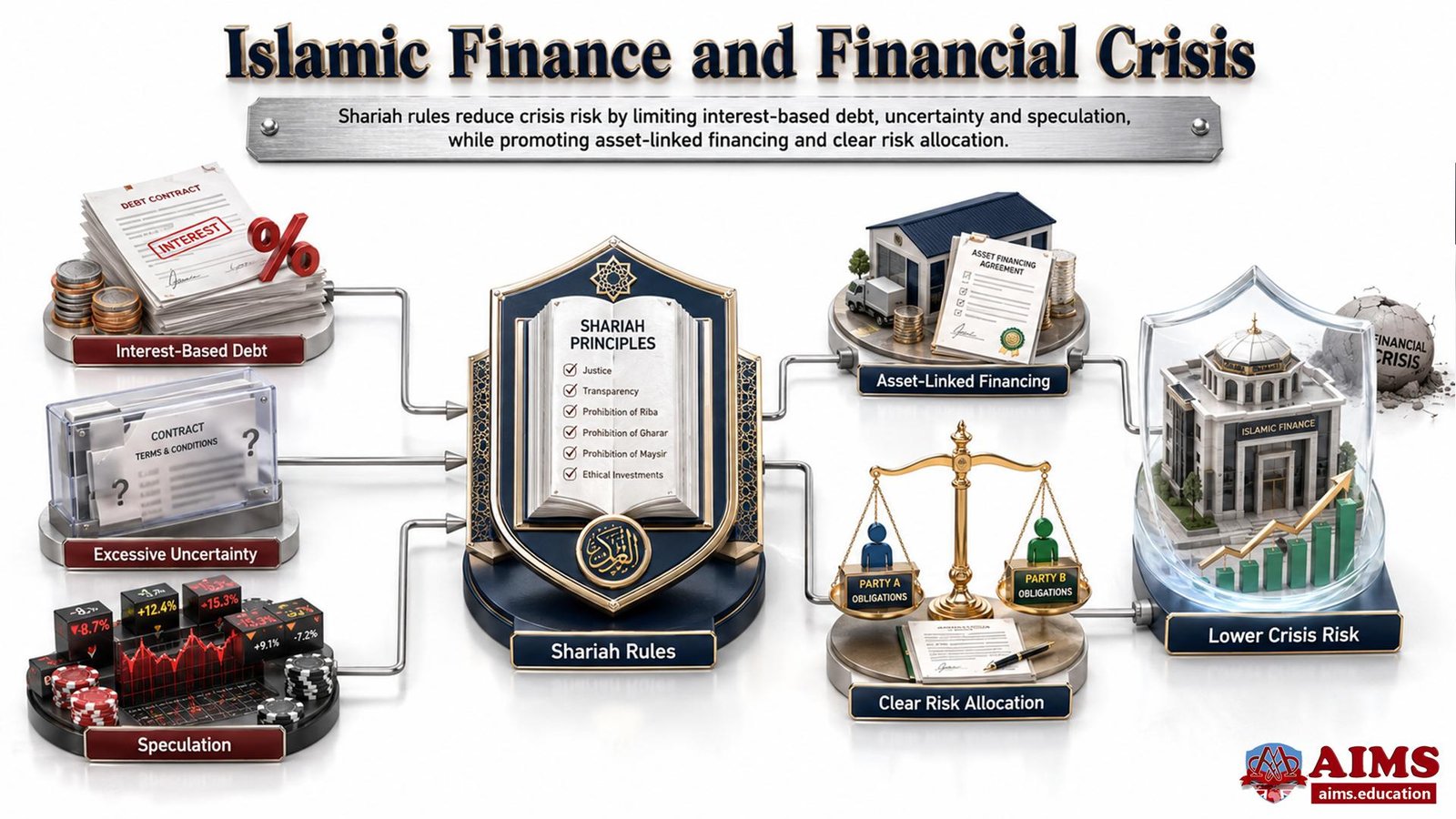
Islamic finance and financial crisis are connected through the way Shariah rules limit interest-based debt, excessive uncertainty and speculative transactions while encouraging asset-linked financing and clearer risk allocation. These features may reduce exposure to highly leveraged and opaque instruments, but they do not make Islamic banks immune to liquidity pressure, asset-price declines, weak governance or economic recession.
In this article, you will learn the relationship between Islamic banking and financial stability, examines the 2008 global financial crisis, compares Islamic and conventional banks, and clarifies why resilience depends on both Shariah-compliant structures and effective risk management. The central lesson is balanced: Islamic finance can reduce certain sources of instability, yet its institutions still operate within the real economy and remain exposed to commercial loss.
What Is the Relationship Between Islamic Finance and a Financial Crisis?
Islamic finance is a financial system in which transactions must comply with Shariah principles governing trade, ownership, risk, fairness and permissible economic activity. A financial crisis is a severe disruption in which asset values, credit flows, liquidity and confidence deteriorate across financial institutions or markets.
- The relationship between the two lies in financial structure. Islamic finance prohibits riba, restricts excessive gharar and maysir, and requires financing to arise from recognised contracts involving assets, services, trade or investment.
- These principles can limit some mechanisms that amplify crises, particularly excessive leverage, speculative risk transfer and opaque financial engineering.
However, Islamic banking resilience during financial crisis should not be treated as an automatic outcome. Islamic banks still face credit risk, market risk, operational risk, liquidity risk, concentration risk and losses caused by recession. Their performance depends on how faithfully contracts are structured, how effectively risks are governed and how supportive the regulatory system is.
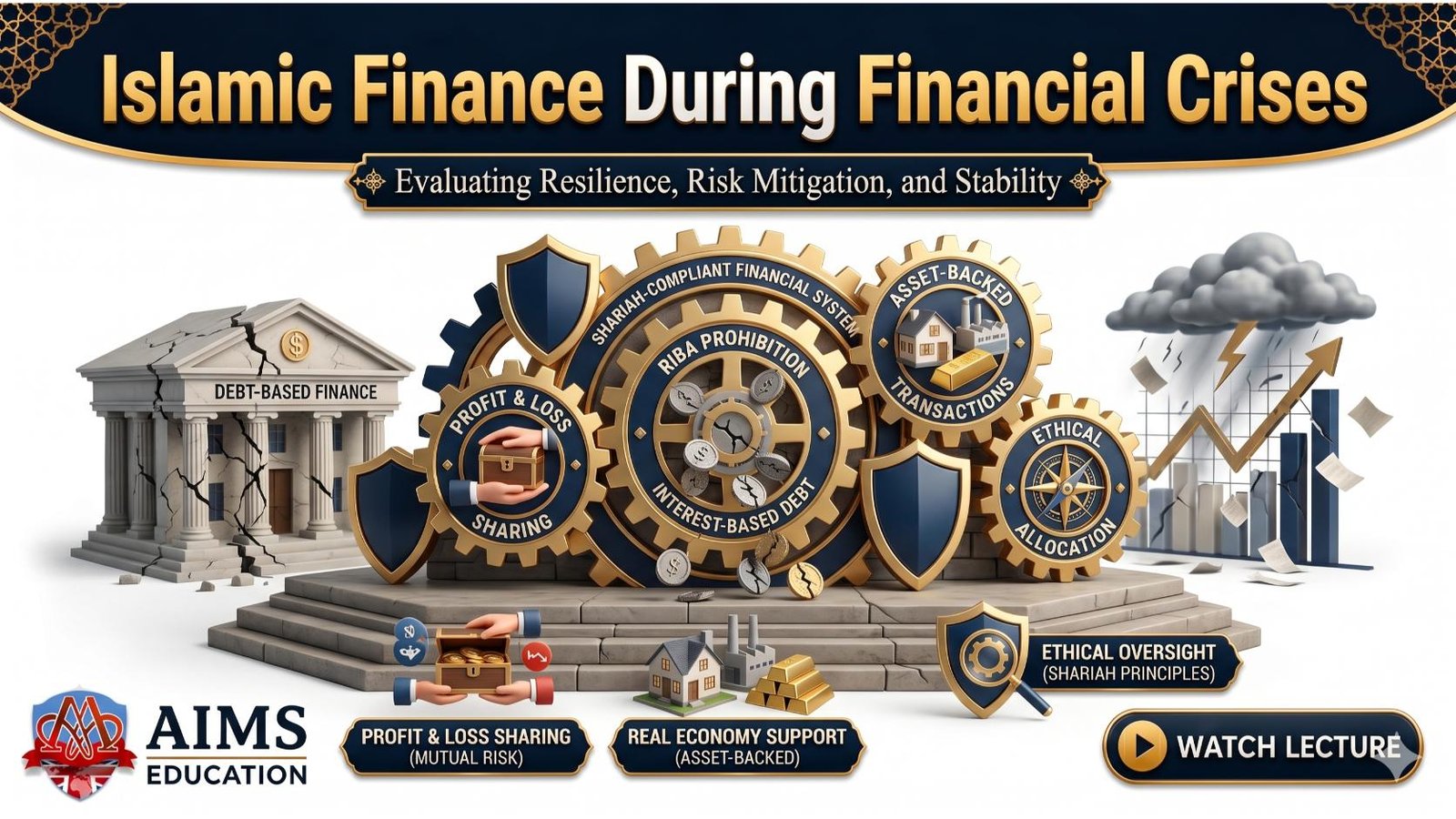
Understanding the Islamic Finance Principles That Affect Financial Stability
The financial-stability features of Islamic finance arise from a group of connected principles rather than from one isolated prohibition. If you need a broader foundation can first review the core Islamic banking and finance principles.
- Prohibition of riba: Returns cannot be generated merely by lending money at a predetermined interest rate.
- Restriction of excessive gharar: Contract terms, subject matter, price and obligations should be sufficiently clear.
- Prohibition of maysir: Gambling and transactions dominated by chance or zero-sum speculation are not permitted.
- Asset and activity linkage: Financing should relate to identifiable assets, services, trade or productive investment.
- Risk allocation: Each contract should assign ownership, liability, entitlement and commercial risk transparently.
- Ethical and Shariah governance: Institutions must assess both legal enforceability and Shariah compliance.
How Does the Prohibition of Riba Affect Financial Stability?
Riba is an unlawful increase associated with lending or exchange under the rules of Islamic commercial law. The prohibition does not mean that Islam rejects profit, deferred payment or commercial financing. It distinguishes lawful returns from trade, leasing and investment from a guaranteed return charged solely for the use of money. A detailed explanation is available in this guide to riba (interest) in Islamic banking and finance.
“Allah has permitted trade and has forbidden interest.” (Surah Al-Baqarah, Verse 275)
In crisis terms, the prohibition of riba can discourage uncontrolled interest-bearing leverage and repeated refinancing detached from productive activity. It does not eliminate debt-like obligations, because Murabaha and other sale-based contracts can create receivables. The stabilising effect therefore depends on genuine trade, responsible underwriting and limits on leverage, not on changing contract labels.
How Do Gharar and Maysir Reduce Speculative Risk?
Gharar refers to excessive uncertainty or ambiguity that makes contractual rights and outcomes unacceptably unclear. Its restriction encourages disclosure, identifiable subject matter and understandable obligations. This can reduce disputes and limit exposure to transactions whose risks cannot be properly assessed. See the explanation of gharar and uncertainty in Islamic financial contracts.
“The Messenger of Allah forbade Gharar transaction and Hasah transactions.” (Narrated by Abu Hurairah, Sahih Muslim, Book of Transactions, Hadith 1513)
Maysir is a gain based predominantly on chance, wagering or another party’s corresponding loss rather than productive exchange. Its prohibition places a boundary around gambling-like speculation and is relevant when assessing highly leveraged positions or transactions with no genuine commercial purpose. The concept is examined further in this discussion of maysir and games of chance in Islam.
“Intoxicants, gambling, idols, and drawing lots for decisions are all evil of Satan’s handiwork.” (Surah Al-Ma’idah, 5:90)
These rules do not prohibit every derivative, hedge or uncertain business outcome. Commercial risk is unavoidable. The relevant distinction is between legitimate risk connected to trade or investment and excessive uncertainty or speculation that undermines fairness and informed consent.
How Does Asset-Linked Financing Support the Real Economy?
Asset-linked financing connects a financial claim to an identifiable asset, service, usufruct or commercial transaction. Murabaha finances a disclosed sale, Ijarah transfers the use of an asset, Salam supports advance purchase, and Musharakah represents partnership participation. This structure can reduce the separation between financial claims and real economic activity.
It is important to distinguish asset-based from strictly asset-backed structures. Many Islamic banking transactions are asset-based, meaning an asset supports the contractual structure, while the financier may still rely substantially on the customer’s payment obligation. For a fuller explanation, review asset-backed financing in Islamic banking.
Asset linkage can restrain purely synthetic balance-sheet expansion, but it also creates direct exposure to property, commodities, businesses and consumer activity. When the real economy contracts, the value and income of those assets may decline.
Five Reasons Islamic Finance May Be More Resilient During a Financial Crisis
Islamic finance may show greater resilience when its principles reduce leverage, improve contractual transparency and keep financing connected to productive economic activity. The following five reasons preserve the useful logic of the original article while replacing absolute claims with a more accurate analysis.
1. Shariah Constraints Place Boundaries Around Financial Risk
Shariah prohibits riba, maysir, excessive gharar and financing for impermissible activities. These restrictions can prevent Islamic institutions from holding some highly speculative, opaque or interest-based instruments that transmit shocks quickly across markets.
The protection is not automatic. A product may comply formally with contract requirements while still creating excessive leverage, concentration or maturity mismatch. Shariah governance must therefore work with prudential regulation and independent risk oversight.
2. Financing Is Linked to Assets and Economic Activity
Islamic financing generally arises through a sale, lease, partnership, agency or investment contract. This creates a stronger connection between finance and the underlying transaction than a purely unsecured exchange of money for more money.
In practice, this linkage can discourage financial claims that multiply without corresponding productive activity. On the other hand, it can expose banks to downturns in property, construction, trade and other financed sectors.
3. Risk Allocation Is Defined Through Recognised Contracts
Islamic contracts identify who owns the asset, who bears loss, who performs the work and how profit is earned. Musharakah and Mudarabah provide direct forms of profit-and-loss sharing, while Murabaha and Ijarah allocate different combinations of ownership, payment and asset risk.
Not every Islamic banking product shares losses equally. The practical benefit comes from transparent allocation of risk, not from assuming that every transaction is a partnership.
4. Money Is Treated as a Medium of Exchange, Not a Self-Generating Commodity
Islamic finance recognises money as a measure of value and a means of exchange. A lawful return should arise from trade, leasing, investment, service or the assumption of recognised commercial risk rather than from money producing a guaranteed return by itself.
Money is merely a tool to promote economic activity and freedom to exchange goods more efficiently, as money does.
This useful insight from the original article should be understood carefully. Islamic law does not deny the time-related value of commercial exchange, but it regulates how that value may be earned and documented.
5. Ethical Governance and Trust Can Strengthen Institutional Stability
Islamic banking combines legal documentation with Shariah supervision, fiduciary responsibility and ethical expectations. Clear governance can improve confidence among depositors, investment-account holders, customers, regulators and shareholders.
Trust alone cannot prevent a bank run or insolvency. It must be supported by capital adequacy, transparent reporting, suitable deposit-protection arrangements, credible resolution procedures and effective risk management in Islamic banking institutions.
How Did Islamic Banks Perform During the 2008 Global Financial Crisis?
Islamic banks were not affected in exactly the same way or at exactly the same time as conventional banks during the 2008 global financial crisis. Their initial exposure to certain toxic securities and highly leveraged instruments was often lower, but later losses emerged when the crisis spread to property markets, businesses and the wider economy.
An IMF comparative study of Islamic and conventional banks during the global crisis examined around 120 banks in eight countries. It found that Islamic banks generally contained the adverse effect on profitability better in 2008 because of lower leverage, smaller investment portfolios and restrictions on problematic instruments.
The position changed in 2009. Some Islamic banks experienced a larger profitability decline as weaknesses in risk management, sector concentration and exposure to particular borrowers became more visible. Across 2008-09, average profitability was broadly similar for Islamic and conventional banks in the study, although Islamic banks maintained stronger credit and asset growth.
Example: Why Initial Resilience Did Not Mean Complete Protection
This simplified example shows how two banking models may experience different stages of the same crisis.
- Amanah Bank has a £100 million portfolio concentrated in property-related Murabaha and Ijarah financing.
- Harbour Bank has a £100 million portfolio that includes £30 million in leveraged structured-credit securities.
- When structured-credit markets collapse, Harbour Bank records losses earlier because its securities rapidly lose liquidity and value.
- Amanah Bank initially avoids those instruments, so the first financial-market shock is smaller.
- When recession reduces property prices, rental income and customer cash flow, Amanah Bank then faces defaults, asset impairment and concentration losses.
The practical lesson is that contract design can delay or redirect risk, but sound management remains essential.
Islamic Banking vs Conventional Banking During a Financial Crisis
Islamic and conventional banks differ mainly in how financing is created, how returns are justified and how contractual risk is allocated. Both models can remain stable or become distressed, depending on leverage, asset quality, liquidity, governance, regulation and economic conditions.
| DIMENSION | ISLAMIC BANKING | CONVENTIONAL BANKING |
|---|---|---|
| Debt Creation | Financing generally arises from a sale, lease, partnership or service contract rather than an interest-bearing loan. | Financing commonly arises through interest-bearing loans and other debt instruments. |
| Asset Linkage | Transactions usually require an identifiable asset, service, usufruct or commercial activity. | Credit may be secured or unsecured and does not always require a direct trade or asset transaction. |
| Risk Allocation | Ownership, liability and entitlement depend on the selected Shariah contract; genuine risk-sharing varies by product. | The borrower normally carries the repayment obligation while the lender earns contractual interest. |
| Speculation | Restrictions on excessive gharar and maysir limit gambling-like and purely speculative transactions. | Speculative trading and derivatives may be permitted within applicable market and regulatory rules. |
| Liquidity | Liquidity tools may be narrower where Shariah-compliant money-market instruments and central-bank facilities are limited. | Banks usually operate in deeper interest-based money markets with a wider range of liquidity instruments. |
| Bad Debt and Losses | Defaults and impairments remain possible in sale, lease and partnership portfolios; Shariah compliance does not remove credit risk. | Defaults, collateral losses and deterioration in loan quality can weaken capital and profitability. |
| Real-Economy Exposure | Direct asset and trade links may reduce synthetic exposure but transmit downturns in property, commerce and production. | Banks face real-economy risk through borrowers and collateral, alongside exposure to financial-market instruments. |
Why Are Islamic Banks Not Completely Immune to Financial Crises?
Islamic banks are not crisis-proof because Shariah compliance changes the form and allocation of risk rather than removing economic risk. A bank can avoid interest-based securities and still suffer losses from weak customers, falling asset prices, concentrated portfolios, inadequate liquidity or poor governance.
- Liquidity risk: A bank may struggle to obtain short-term Shariah-compliant funding or liquidate assets without loss.
- Concentration risk: Heavy exposure to property, construction, commodities or a small number of customers can magnify a downturn.
- Credit and counterparty risk: Customers may default on Murabaha payments, lease rentals or other contractual obligations.
- Market risk: The value of financed assets, sukuk or investment portfolios can decline.
- Operational and Shariah risk: Documentation failures, weak controls or non-compliant execution can create legal, financial and reputational loss.
- Profit-rate and displaced commercial risk: Banks may face pressure to provide competitive returns to investment-account holders even when underlying profits decline.
- Regulatory and resolution risk: Incomplete insolvency, deposit-insurance or lender-of-last-resort arrangements can complicate crisis management.
Deposit protection also varies by jurisdiction. Some Islamic bank deposits are covered by national protection schemes, while investment accounts may carry different contractual characteristics. The original article’s suggestion that Islamic banks generally lack deposit protection is therefore too broad.
Can Islamic Finance Provide Solutions to Systemic Financial Crises?
Islamic finance can contribute to crisis prevention and recovery, but it cannot independently eliminate systemic financial crises. Its strongest contribution is a framework for responsible leverage, transparent contracting, asset-linked financing, ethical screening and risk allocation.
- Before a crisis: Regulators and banks can limit concentration, ensure genuine asset linkage, strengthen Shariah governance and monitor leverage.
- During a crisis: Institutions can restructure obligations, preserve viable businesses and use partnership, leasing or trade-based facilities where suitable.
- After a crisis: Financing can support productive assets, infrastructure, small businesses and employment rather than relying only on speculative asset inflation.
For systemic resilience, these principles must operate alongside effective central-bank facilities, capital and liquidity standards, credible resolution frameworks, macroprudential supervision and disciplined institutional governance.
What Can Conventional Finance Learn From Islamic Banking?
Conventional finance can learn from Islamic banking without adopting every Islamic contract or religious rule. The most transferable lessons concern the relationship between finance and productive activity, limits on excessive leverage, transparency of risk, ethical screening and accountability for contractual outcomes.
- Financial returns should be supported by a clear economic purpose and understandable source of value.
- Institutions should not rely excessively on transferring risks that the system ultimately cannot absorb.
- Complexity should not replace transparency, due diligence or responsible underwriting.
- Risk management should assess concentration, liquidity and real-economy exposure, not only immediate market volatility.
- Governance should consider customers, communities and systemic consequences alongside short-term profitability.
Professional Relevance for Islamic Banking and Finance Practitioners
Professionals must understand both the theoretical resilience of Islamic finance and the practical vulnerabilities of Islamic financial institutions. This knowledge is relevant to Shariah governance, product development, treasury, regulation, liquidity management, bank resolution, credit analysis and systemic-risk policy.
AIMS offers an Islamic finance certification course for applied professional knowledge, a broader diploma in Islamic banking and finance for advanced practice, and research based online phd Islamic finance. These programs help learners connect Shariah principles with modern banking operations, risk governance and financial-stability challenges.
Final Words on Islamic Finance and Financial Crisis
Islamic finance can reduce exposure to some causes of financial instability, particularly excessive interest-based leverage, opaque speculation and finance detached from identifiable economic activity. Its performance during the 2008 crisis showed both strengths and limits. Some Islamic banks absorbed the initial financial shock more effectively, but later suffered when recession, property exposure, concentration and weak risk management affected the real economy.
The correct conclusion is not that Islamic banks always survive crises. It is that Shariah principles can create a more disciplined financial structure when they are supported by genuine compliance, capable management, sound regulation, adequate liquidity and strong institutional governance.
Frequently Asked Questions
What is the relationship between Islamic finance and financial crisis?
Islamic finance affects crisis exposure through restrictions on riba, excessive gharar and maysir, together with asset-linked transactions and defined contractual risk. These features may reduce some forms of leverage and speculation, but Islamic institutions remain exposed to defaults, liquidity shortages, falling asset values and recession.
What makes Islamic finance resilient during a financial crisis?
Potential resilience comes from lower exposure to interest-based and highly speculative instruments, clearer links to assets or services, limits on excessive uncertainty and more disciplined risk allocation. Actual resilience still depends on capital, liquidity, diversification, governance, regulation and the quality of risk management.
How did Islamic banks perform during the 2008 global financial crisis?
Many Islamic banks experienced a smaller initial profitability impact in 2008 because they had lower leverage and less exposure to certain toxic instruments. In 2009, however, some suffered larger declines as the crisis reached property markets and the real economy, revealing concentration and risk-management weaknesses.
How do Islamic and conventional banks differ during financial crises?
Islamic banks use Shariah-compliant sale, lease, partnership and investment contracts, while conventional banks rely mainly on interest-bearing lending. Islamic structures may reduce some speculative exposures, but they can face greater constraints in liquidity management and remain vulnerable to credit, market and real-economy risks.
How do risk-sharing and asset-backed financing promote financial stability?
Risk-sharing can distribute commercial outcomes between capital providers and entrepreneurs, while asset-linked financing connects financial claims to identifiable activity. These features may discourage purely synthetic leverage. They promote stability only when risks are genuinely shared, assets are properly valued and contracts are responsibly managed.
What role does the prohibition of riba play in preventing financial instability?
The prohibition of riba prevents a guaranteed return from being charged merely for lending money. It encourages profit to arise from trade, leasing, services or investment. This can restrain some debt-driven instability, although sale-based Islamic financing can still create payment obligations and credit risk.
How do the prohibitions of gharar and maysir reduce speculative risk?
Gharar rules require sufficient clarity about contractual rights, obligations and subject matter, while maysir rules prohibit gambling-like gains based predominantly on chance. Together, they can limit opaque and zero-sum speculation, but they do not prohibit normal commercial uncertainty or every legitimate risk-management instrument.
Can Islamic finance prevent speculative bubbles and market crashes?
Islamic finance may restrain some bubble-forming behaviour by limiting excessive leverage, gambling-like speculation and transactions detached from real assets. It cannot prevent every bubble or crash because asset prices, investor behaviour, policy errors, concentration and economic shocks can still affect Shariah-compliant markets.
Why did some Islamic banks suffer when the crisis reached the real economy?
Some Islamic banks were concentrated in property, construction or a limited number of borrowers. When asset values and customer cash flows declined, defaults and impairments increased. Weak diversification, liquidity constraints and inadequate risk management reduced profitability even though the original contracts were Shariah-compliant.
Are Islamic banks completely immune to financial crises?
No. Islamic banks are exposed to credit, market, liquidity, operational, concentration and regulatory risks. Shariah principles can change how risks arise and are allocated, but immunity depends on neither religious identity nor contract labels. Strong governance, supervision and risk controls remain essential.
Can Islamic finance provide solutions to systemic financial crises?
Islamic finance can support a more stable system through responsible leverage, asset-linked financing, ethical screening and transparent risk allocation. Systemic crises also require central-bank liquidity, effective supervision, deposit protection, resolution mechanisms, capital buffers and coordinated macroeconomic policy.
What lessons can conventional finance learn from Islamic banking?
Conventional finance can learn the value of connecting returns to identifiable economic activity, controlling leverage, improving transparency and considering the ethical and systemic effects of financial decisions. These lessons can strengthen stability even where institutions do not use Islamic contractual forms.
Professional Islamic Banking and Finance Education at AIMS
Since 2005, AIMS’ Institute of Islamic Banking and Finance has delivered career-focused education supported by international accreditations to learners across more than 178 countries. Its internationally standardised curriculum combines qualified faculty, industry-oriented teaching, practical skill development, 3D interactive learning content and real-world case studies. Educational articles, study content and curricula are collaboratively developed and rigorously peer-reviewed by an academic board of qualified industry practitioners. Understanding crisis resilience strengthens competence in banking governance and risk management. Explore institute for practical and accredited Islamic banking and finance programs.