
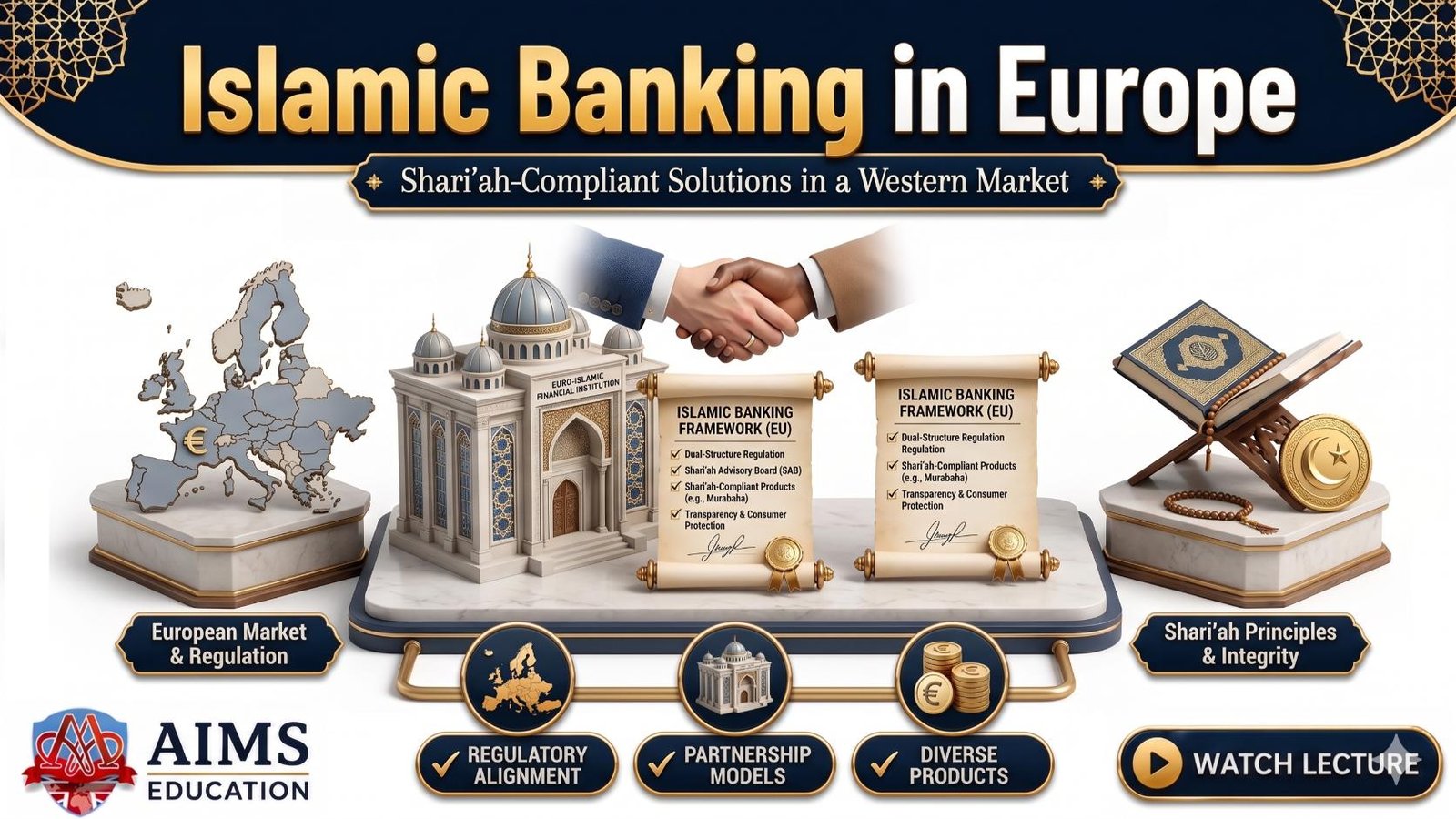
Islamic banking in Europe is Sharia-compliant financial activity delivered through institutions that must also satisfy the banking, consumer-protection, tax and financial-crime laws of their European jurisdiction.
- Its religious foundation is the prohibition of riba, together with restrictions on excessive gharar, gambling-like speculation and financing prohibited industries.
- It is based on Shariah-compliant models using trade, leasing, partnership and asset-linked structures instead.
- Availability varies considerably by country, with the United Kingdom maintaining Europe’s most developed Islamic finance ecosystem.
- Across Europe, customers may access full-fledged Islamic banks, specialist banking units, fintech platforms, home-finance providers, investment funds and sukuk services.
- The sector serves Muslims seeking faith-aligned finance and non-Muslims attracted by ethical, transparent and asset-focused products. This article explains where these services exist, how they work, how regulators treat them and what may shape future growth.
If you need a foundation before comparing European markets can first review what is Islamic banking and how it works in practice. The central commercial idea is not that finance must be free of cost. Rather, earnings should arise through a valid sale, lease, investment, agency or partnership arrangement instead of a predetermined return on a pure loan.
“Allah has permitted trade and forbidden interest.” Quran, Surah Al-Baqarah, Verse 275.
“The Messenger of Allah cursed the accepter of interest and its payer, and one who records it, and the two witnesses.” Narrated by Jabir ibn Abdullah, Sahih Muslim, Book of Musaqah, Hadith 1598.
The main operating principles include:
- The institution must avoid interest-based lending and investment income.
- Transactions should have a lawful commercial purpose and a sufficiently clear contractual structure.
- Financing should be connected to an asset, service, trade or investment activity where the contract requires it.
- The institution must avoid sectors such as gambling, alcohol and other activities prohibited by Sharia.
- Products require credible Sharia governance, documentation and ongoing compliance review.
A deeper explanation of these requirements is available in AIMS’ guide to the fundamental principles of Islamic banking and financial transactions.
Types of Islamic Banks in Europe
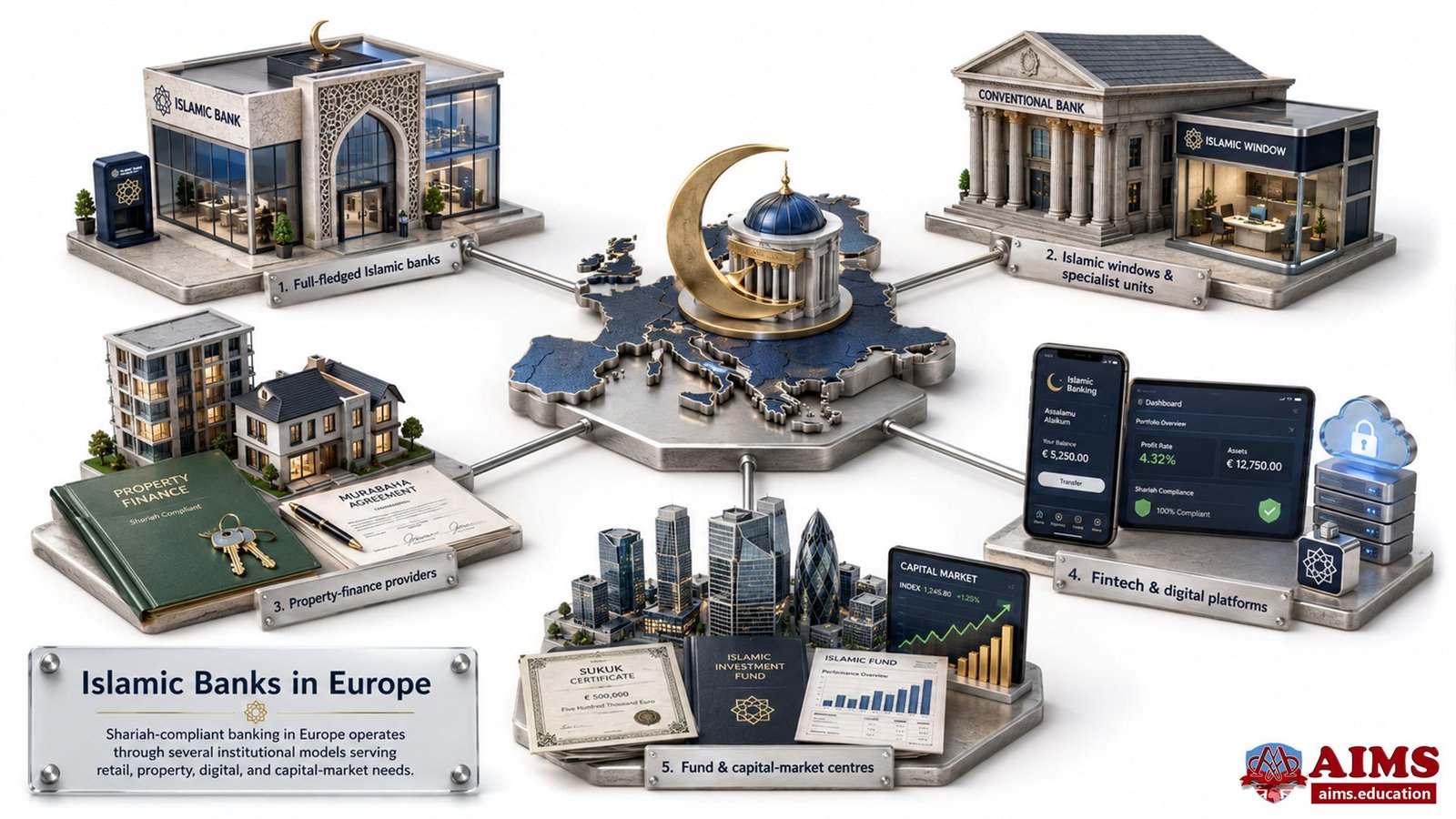
Islamic banking does not appear in the same institutional form across every European country. A country may have a dedicated Islamic bank, a conventional bank offering selected products, an investment-fund centre, a fintech platform or only cross-border services.
- Full-fledged Islamic banks: These institutions conduct their banking activities under an entirely Sharia-compliant business model.
- Islamic banking windows or specialist units: A conventional banking group may offer selected Sharia-compliant services through a separate desk, division or product line.
- Specialist property-finance providers: These firms focus on home purchase, commercial property or real-estate investment structures.
- Fintech and digital platforms: These businesses provide payment, savings, investment or financing access through technology-led models, sometimes in partnership with licensed banks.
- Fund and capital-market centres: Some jurisdictions are more important for Sharia-compliant funds, sukuk listings and cross-border investment than for retail banking.
This classification is important because the phrase Islamic banks in Europe can misleadingly suggest that every market offers the same retail services. In reality, the depth of European Islamic banking depends on local licensing, tax treatment, market size, institutional capability and customer demand.
History and Development of Islamic Banking in Europe
The development of Islamic banking in Europe combines older Islamic commercial principles with modern banking institutions created mainly during the late twentieth and early twenty-first centuries. Islamic commercial law has a long intellectual history, but contemporary European Islamic banks emerged through modern regulation, international investment and demand for faith-compatible financial services.
The earlier article correctly connected the subject to the wider history of Islamic finance, but the modern European sector should not be presented as a direct continuation of medieval banking institutions. A more accurate account distinguishes the historical influence of Islamic trade from the recent establishment of licensed banks, investment funds, sukuk markets and specialist home-finance products. AIMS provides a fuller account of the historical development of Islamic banking institutions.
Several forces encouraged the sector’s European development:
- European Muslim communities created demand for savings, payments, home finance and business funding that avoided riba.
- London and other financial centres attracted investment from the Gulf and wider Muslim-majority markets.
- Governments introduced tax-neutral treatment so that asset transfers in Islamic structures were not unfairly taxed more than conventional finance.
- Fund domiciles and stock exchanges developed expertise in Sharia-compliant investment funds and sukuk.
- Digital distribution reduced the need for large branch networks and allowed specialist providers to reach customers across wider areas.
Which European Countries Have Islamic Banking?
Islamic banking is present in several European countries, but the type and maturity of that presence differ sharply. The United Kingdom has the broadest combination of banks, home finance, savings, private banking, professional services and capital-market activity. Germany and Bosnia and Herzegovina have dedicated Islamic banks, while France, Luxembourg and Ireland have more specialised product or investment-market roles.
| COUNTRY OR MARKET | MAIN FORM OF PRESENCE | TYPICAL PRODUCTS OR ACTIVITIES | MARKET DEVELOPMENT |
|---|---|---|---|
| United Kingdom | Full-fledged banks, specialist property finance, private banking and capital markets | Savings, home purchase plans, property finance, commercial finance, sukuk and investment services | Europe’s most developed and diversified Islamic finance centre |
| Germany | Dedicated Islamic bank and selected ethical-finance services | Current accounts, participation accounts, trade-based financing and property-related services | Established but considerably smaller than the UK market |
| France | Selected bank products, property finance, investment services and advisory platforms | Murabaha property finance, ethical accounts and Sharia-screened investments | Meaningful demand, but limited dedicated retail-bank capacity |
| Luxembourg | Investment funds, sukuk listings, structuring and cross-border finance | Sharia-compliant funds, securities listings and international investment vehicles | A major European centre for Islamic asset management and capital markets |
| Ireland | Fund domicile and international financial-services platform | Islamic ETFs, UCITS funds and selected structured-finance activities | Stronger in funds than in dedicated retail Islamic banking |
| Bosnia and Herzegovina | Full-fledged Islamic commercial banking | Retail banking, business finance and investment support | An established Southeast European Islamic banking market |
| Türkiye | Large participation-banking sector | Retail, corporate, trade and investment products based on participation-finance principles | A mature market often analysed separately from EU-focused comparisons |
The table is a market overview rather than a complete list of Islamic banks in Europe. Bank licences, product ranges and cross-border availability can change. Customers should therefore verify a provider’s current authorisation, deposit protection, territorial eligibility and Sharia-governance disclosures before applying.
Leading Examples of Islamic Banks in Europe
Leading European examples include institutions serving different customer groups rather than a single continent-wide banking network. In the UK, Al Rayan Bank and Gatehouse Bank are prominent Sharia-compliant institutions, while QIB UK focuses largely on private banking and property-related services. Germany’s KT Bank provides comprehensive Islamic banking services, and Bosna Bank International operates according to Islamic financial principles in Bosnia and Herzegovina.
These examples should not be interpreted as a permanent ranking. Some institutions specialise in retail customers, while others focus on real estate, corporate clients, private banking or investment markets. The better question is whether a provider offers the product, consumer protection, pricing transparency and Sharia oversight that a particular customer requires.
Why Is the UK a Major Centre for Islamic Banking in Europe?
The UK became Europe’s leading Islamic finance centre because it combined market demand with regulatory neutrality, legal expertise, international capital flows and a broad financial-services ecosystem. London’s role in global banking and capital markets helped institutions structure Islamic finance transactions for both domestic customers and international investors.
Several practical advantages support the UK market:
- Specialist Islamic banks operate under the same prudential expectations as conventional banks.
- Tax rules have been adjusted to reduce disadvantages that could arise when Islamic property-finance structures involve more than one legal transfer.
- English law is widely used in cross-border commercial and financial documentation.
- The market includes Sharia scholars, lawyers, accountants, auditors, asset managers and product specialists.
- The Bank of England provides an Alternative Liquidity Facility for eligible banks that face formal restrictions on interest-bearing activity.
This combination helps explain why Islamic banks in the UK offer a wider range of retail and property-related services than most continental European markets.
What Islamic Banking Products Are Available in Europe?
Islamic banking products in Europe include payment accounts, profit-based savings, home finance, commercial property finance, trade finance, Sharia-compliant investment funds and sukuk-related services. Product availability depends on the country, provider, customer type and regulatory permissions.
| PRODUCT AREA | COMMON SHARIA STRUCTURE | PRACTICAL PURPOSE | EUROPEAN AVAILABILITY |
|---|---|---|---|
| Current accounts | Qard or safekeeping-based arrangements | Payments, transfers and everyday money management | Available in selected markets, especially the UK and Germany |
| Savings and deposits | Wakala, murabaha or participation-based structures | Generate an expected profit through Sharia-compliant investment activity | Relatively accessible in the UK and through selected European providers |
| Home finance | Diminishing musharakah, ijara or murabaha | Purchase or refinance residential property without an interest-bearing mortgage contract | Most developed in the UK, with selected options elsewhere |
| Business and asset finance | Murabaha, ijara, musharakah or wakala | Finance equipment, property, inventory, trade or investment | Available mainly through specialist or corporate providers |
| Investment funds | Sharia-screened equity, real-estate or multi-asset funds | Provide diversified investment exposure while excluding prohibited activities | Available through major European fund domiciles and investment platforms |
| Sukuk | Asset-based or asset-backed certificates using recognised Islamic contracts | Raise capital for governments, financial institutions and companies | Primarily a wholesale and capital-market activity |
Students and practitioners can examine the broader range of Islamic financial instruments used by banks and capital markets to understand how product structures differ.
Example of Sharia-Compliant Home Finance in Europe
A Sharia-compliant home-finance plan replaces a conventional interest-bearing loan with a recognised sale, lease or partnership structure. Consider a simplified diminishing musharakah arrangement:
- Amina identifies a home in Manchester priced at GBP 300,000.
- She contributes GBP 60,000, while the bank contributes GBP 240,000.
- Amina and the bank acquire beneficial ownership shares in the property.
- Amina pays rent for using the bank’s remaining share and gradually purchases additional units of that share.
- As her ownership increases, the bank’s ownership and the corresponding rent decline according to the contract.
- After the agreed payments are completed, Amina becomes the full owner.
The practical result is gradual home ownership through co-ownership and rent rather than a cash loan carrying interest.
Actual contracts include legal fees, valuation requirements, purchase conditions, early-settlement rules and regulatory disclosures. A prospective customer should therefore study how a halal mortgage or Islamic home purchase plan is structured before comparing providers.
How Do Islamic Banks Operate Under European Banking Regulations?
Islamic banks in Europe generally operate under the same banking laws, authorisation standards and supervisory expectations that apply to conventional institutions. Sharia compliance does not replace statutory regulation. It adds a second layer of contractual and ethical governance within the legal framework of the relevant country.
Within the European Union, banks must follow the harmonised prudential framework explained through the European Banking Authority’s Single Rulebook. Depending on their activities, institutions may also be subject to rules concerning deposit protection, mortgage credit, payments, investment services, consumer treatment, operational resilience, recovery and resolution, and anti-money-laundering controls.
In practice, a European Islamic bank must manage two connected compliance systems:
- Regulatory compliance: The institution must satisfy capital, liquidity, governance, conduct, disclosure, financial-crime and consumer-protection requirements.
- Sharia compliance: The institution must ensure that its contracts, asset use, investment screens, income treatment and operational processes follow its approved Sharia framework.
There is no single EU-wide licence called an “Islamic banking licence.” National and European authorities assess the legal and economic risks of the institution and its products. Sharia boards or advisers normally review religious compliance, but they do not replace the legal powers of regulators, directors or courts.
Why Tax Neutrality Matters
Tax neutrality prevents an Islamic structure from being penalised merely because it uses additional asset transfers or contractual stages. For example, a murabaha or diminishing musharakah property transaction may involve the bank acquiring an interest in the property before transferring it to the customer. Without suitable tax treatment, this sequence could create duplicate transaction taxes that a conventional mortgage would not face.
The objective of neutrality is equal treatment, not a special financial advantage. A sound framework allows Islamic and conventional products to compete on their real costs, risks and customer value.
Islamic Banking Versus Conventional Banking in Europe
The main difference is contractual: conventional banking commonly earns interest from lending money, while Islamic banking must generate permissible returns through trade, leasing, partnership, agency or investment structures. Both systems still require credit assessment, risk management, legal documentation, consumer protection and regulatory capital.
| COMPARISON AREA | ISLAMIC BANKING | CONVENTIONAL BANKING |
|---|---|---|
| Return mechanism | Profit, rent, fee or investment return from a Sharia-compliant contract | Interest, fees and investment returns |
| Relationship to assets | Many financing structures require an identified asset, service or trade | A loan may be secured or unsecured and does not always require a trade transaction |
| Investment restrictions | Excludes prohibited sectors and excessive speculative activity | Uses legal, regulatory and institution-specific ethical restrictions |
| Governance | Corporate governance plus Sharia supervision or advisory review | Corporate governance and regulatory compliance |
| Customer eligibility | Generally open to Muslims and non-Muslims who meet product conditions | Open to eligible customers without a religious criterion |
| Regulatory treatment | Subject to ordinary banking regulation, with additional Sharia requirements | Subject to ordinary banking regulation |
AIMS examines these distinctions in greater depth in its comparison of Islamic banking and conventional banking systems.
Common Misunderstanding: Is Islamic Finance Interest with Different Terminology?
Sharia compliance depends on the legal substance, asset relationship, ownership duties, risk allocation and contractual sequence, not merely on Islamic terminology. A product does not become permissible simply because it is labelled murabaha, ijara or musharakah. The institution must actually perform the sale, lease, agency or partnership required by the contract.
At the same time, a benchmark linked to conventional market rates does not automatically convert a valid trade or lease into an interest-bearing loan. The decisive issue is the underlying contract and whether its rights, obligations and risks are genuine, transparent and properly executed.
Four Key Challenges for Islamic Banking in Europe and Their Solutions
The central challenges are limited scale, pricing pressure, regulatory complexity and uneven Sharia-governance capability. These problems are more precise and supportable than broad claims that European Islamic institutions are inherently unethical or that a continent-wide ECB Islamic banking framework already exists.
1. Limited Scale and Uneven Product Access
Islamic banking remains a specialist segment in most European countries. Small customer bases, limited distribution and high setup costs can restrict the availability of current accounts, home finance and small-business funding.
- Banks can expand through digital onboarding and partnerships with regulated platforms.
- Providers can focus on high-demand products before building a wider portfolio.
- Cross-border services can be developed where passporting, consumer law and local licensing permit them.
- Public financial education can improve awareness without treating Islamic finance as a product only for Muslims.
2. Pricing and Competition with Conventional Banks
Islamic products may cost more when providers lack scale or must complete additional legal, asset-transfer and Sharia-review processes. Customers may compare only the headline monthly payment and overlook differences in ownership, deposit requirements, fees, early settlement and risk allocation.
- Providers should disclose total cost and contractual responsibilities clearly.
- Standardised documents can reduce legal and operational expense.
- Fintech automation can improve processing efficiency.
- Competition should focus on fairness, service quality and product suitability rather than religious branding alone.
3. Regulatory, Tax and Accounting Complexity
Islamic contracts must fit legal systems originally designed around conventional deposits, loans and securities. Questions can arise about asset ownership, capital treatment, deposit classification, insolvency, consumer disclosure, tax and accounting recognition.
- Regulators can provide product-neutral guidance that clarifies how existing rules apply to alternative structures.
- Governments can maintain tax neutrality where multiple transfers would otherwise create unequal treatment.
- Institutions should involve legal, tax, accounting and Sharia specialists before product launch.
- Industry bodies can develop consistent terminology and documentation without weakening supervisory standards.
4. Sharia Governance and Professional Skills
European institutions need professionals who understand both modern regulation and Islamic commercial jurisprudence. A product may fail operationally even when its legal documents appear sound if staff do not understand asset ownership, contract sequencing, income purification, customer disclosure or Sharia audit requirements.
- Banks should establish clear authority between directors, compliance teams and Sharia advisers.
- Product approval should be followed by operational testing and periodic Sharia audit.
- Staff training should cover both the commercial purpose and the detailed execution of each contract.
- Governance reports should explain how non-compliant income or process failures are identified and corrected.
These controls also form part of effective risk management for Islamic banking institutions.
Qualifications for Islamic Finance Jobs in Europe
A career in European Islamic finance requires knowledge of finance, regulation and Sharia-compliant product structures. Employers may need professionals in retail banking, product development, compliance, risk, audit, law, accounting, fintech, asset management, treasury and Sharia governance.
Useful competencies include:
- Understanding murabaha, ijara, musharakah, mudarabah, wakala and sukuk.
- Interpreting European banking, consumer-protection and anti-money-laundering requirements.
- Evaluating the legal substance and operational sequence of Sharia-compliant transactions.
- Comparing Islamic products with conventional alternatives without confusing economic pricing with contractual form.
- Communicating clearly with customers, regulators, lawyers, scholars and technology teams.
Professionals seeking advanced academic and managerial preparation may consider an MBA degree in Islamic banking and finance. If you are seeking focused professional development, you should explore CIFE – a job-oriented Islamic finance certification or globally recognized and career-oriented diploma in Islamic banking and finance.
Future of Islamic Banking and Finance in Europe
The future of Islamic banking in Europe is promising but will depend on practical execution rather than optimistic market forecasts. Growth is most likely where providers solve real customer problems, operate efficiently, maintain credible Sharia governance and fit their products cleanly within national and European regulation.
Several developments may shape the next phase:
- Digital banking: Mobile onboarding and platform partnerships can serve customers beyond a small branch network.
- Home-finance innovation: More transparent and flexible ownership structures may address unmet housing demand.
- Sustainable and ethical investment: Areas of overlap between Sharia screening, responsible investment and real-economy finance may attract a wider customer base.
- Green and infrastructure sukuk: European issuers may use sukuk where projects, legal structures and investor demand support them.
- Cross-border investment: Europe can continue connecting Gulf and Asian Islamic capital with property, infrastructure, trade and investment opportunities.
- Professional standardisation: Better documentation, governance, audit and regulatory understanding can reduce cost and inconsistency.
The sector is unlikely to develop uniformly. The UK may remain the broadest hub, Luxembourg and Ireland may continue to specialise in funds, Germany and Bosnia may deepen dedicated banking, and other countries may rely on selected products or fintech-led access.
Key Takeaways
- Islamic banking is available in Europe, but service depth differs greatly by country.
- The UK has the continent’s most developed combination of banks, home finance, professional services and capital markets.
- Germany and Bosnia and Herzegovina have dedicated Islamic banks, while France offers selected products and Luxembourg and Ireland are stronger in investment markets.
- European Islamic banks follow ordinary banking regulation alongside an additional layer of Sharia governance.
- Islamic products use sales, leases, partnerships, agency and investment structures instead of interest-based loan contracts.
- Future growth depends on affordability, digital access, regulatory clarity, governance quality and professional competence.
Final Words
Islamic banking in Europe has moved beyond a narrow religious-finance niche, but it remains unevenly developed. Its strongest markets demonstrate that Sharia-compliant products can operate within demanding European regulatory systems when contracts are genuine, tax treatment is neutral and governance is credible. Sustainable growth will require fewer slogans and more practical work in product design, customer protection, professional training and transparent execution.
Frequently Asked Questions
What is Islamic banking in Europe?
Islamic banking in Europe is the provision of savings, financing, investment and payment services that follow Sharia principles while complying with European banking law. It avoids interest-based lending and uses approved trade, lease, partnership, agency or investment contracts.
Are there Islamic banks operating in Europe?
Yes. Europe has full-fledged Islamic banks, specialist finance providers, private banks, fintech platforms and conventional institutions offering selected Sharia-compliant services. Availability is concentrated in a limited number of markets rather than spread evenly across the continent.
Which European countries have Islamic banks?
The strongest examples include the United Kingdom, Germany, Bosnia and Herzegovina and Türkiye. France has selected Islamic banking and property-finance products, while Luxembourg and Ireland play larger roles in Sharia-compliant funds, securities and cross-border investment.
What are the leading Islamic banks in Europe?
Examples include Al Rayan Bank, Gatehouse Bank and QIB UK in the United Kingdom, KT Bank in Germany and Bosna Bank International in Bosnia and Herzegovina. Their customer focus differs, so consumers should compare services rather than treat the list as a ranking.
Why is the UK a major centre for Islamic banking in Europe?
The UK combines specialist banks, legal and professional expertise, tax-neutral treatment, international investment links and capital-market infrastructure. The Bank of England’s alternative liquidity arrangements also help eligible Islamic banks meet prudential liquidity needs without relying on interest-bearing deposits.
How do Islamic banks operate under European banking regulations?
They must meet the same licensing, capital, liquidity, governance, consumer-protection and financial-crime requirements as other regulated banks. Sharia governance adds religious and contractual oversight, but it does not replace the authority of European regulators or national law.
What Sharia-compliant banking products are available in Europe?
Products may include current accounts, expected-profit savings, home purchase plans, commercial property finance, asset finance, trade finance, Sharia-screened investment funds and sukuk services. The exact range depends on the country and provider.
Can Muslims obtain Islamic mortgages in European countries?
Yes, particularly in the United Kingdom, where home purchase plans are well established. Selected property-finance products also exist in countries such as France and Germany. Customers should compare ownership structure, total cost, fees, protection and early-settlement terms.
How is Islamic banking different from conventional banking in Europe?
Conventional banks commonly earn interest from lending, while Islamic banks use permissible profit, rent, fees or investment returns generated through approved contracts. Both systems remain subject to regulation, risk management, credit assessment and consumer-protection requirements.
Are European Islamic banks available to non-Muslim customers?
Yes. Islamic banking products are generally available to any eligible customer. Non-Muslims may choose them because of their ethical screens, asset-linked structures, transparent product design or competitive savings and property-finance features.
What challenges limit the growth of Islamic banking in Europe?
The main constraints are limited scale, uneven product availability, higher documentation costs, regulatory and tax complexity, pricing pressure, shortages of specialised professionals and inconsistent Sharia-governance practices.
What is the future of Islamic banking and finance in Europe?
Growth is likely to come from digital banking, home finance, ethical investment, green sukuk, cross-border capital and stronger professional standards. Progress will vary by country and will depend on customer demand, regulatory clarity and credible product execution.
Professional Islamic Banking Education at AIMS
Since 2005, AIMS’ Institute of Islamic Banking and Finance has delivered internationally accredited, career-focused education to learners worldwide. Its internationally standardised curriculum is taught by qualified faculty through industry-oriented instruction, practical skill development, 3D interactive learning content and real-world case-study-based qualifications. This educational article, AIMS study content and its curriculum are collaboratively developed and rigorously peer-reviewed by an academic board of qualified industry practitioners. Understanding European Islamic banking strengthens competence in regulation, product development and cross-border finance. Explore Institute for practical and accredited Islamic banking studies.